Historical compilation: This article preserves the scientific biography in the original manuscript. The English material is credited to Famous Scientists. No named author or translator could be verified from the export, and the original publication date remains unverified.
On April 1, 2022, Science published six papers presenting a complete version of a human reference genome sequence, which at the time did not yet include the Y chromosome. They filled gaps left by sequencing efforts twenty years earlier, offering new hope for finding disease-causing mutations and genetic variants.
As the code of heredity, genes store important information for the beginning, growth, and death of living organisms. Exploring genes is a tireless pursuit for countless scientists.
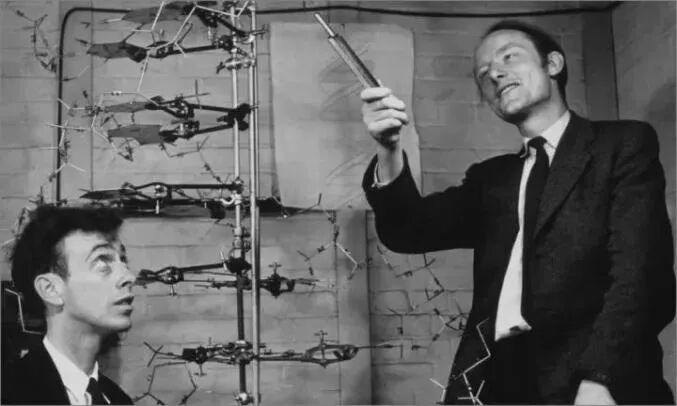
In 1951, at the Cavendish Laboratory in Cambridge, British biologist Francis Crick met American scientist James Watson. Both were interested in what genes really were, and believed that deciphering DNA's structure would greatly help reveal the truth about heredity.
It was a life-changing encounter. Despite many difficulties, they never abandoned their determination to explore DNA's structure.
In 1962, Francis Crick was awarded that year's Nobel Prize in Physiology or Medicine for discovering the molecular structure of nucleic acids and their importance in transmitting biological information!
The Great Mysteries of Living Organisms
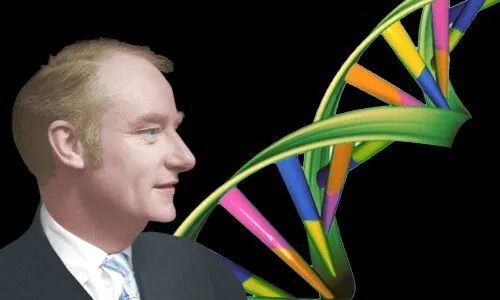
Francis Harry Compton Crick was born on June 8, 1916 into a middle-class family in Northampton, England, UK. He was the older of the family’s two children. His father was Harry Crick, who helped run the family shoe factory. His mother was Annie Elizabeth Wilkins, who had worked as a nurse and was the daughter of a self-made businessman.
At the end of the war, Crick served in Naval Intelligence for a short time before he felt an urge to return to scientific work, but he wasn’t sure what to do.
He then had an epiphany, realizing the subjects he gossiped about must be his true passions. And these happened to be questions in biology:
·The great mystery of life: how is the division between the living and the non-living decided?
·The great mystery of consciousness: how does the human brain work?
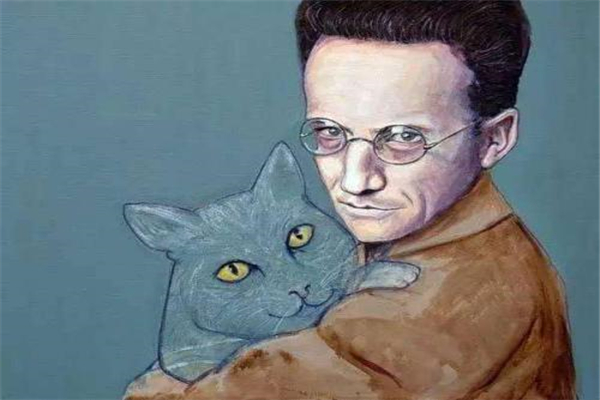
Crick had been inspired partly by the great quantum physicist Erwin Schrödinger’s 1944 book What is Life? Schrödinger told his fellow physicists that the molecules of life were the great unexplored frontier.
Crick believed life could be explained using a simple combination of:
·self-replicating molecules produced and governed by the laws of chemistry and physics
·natural selection acting upon these molecules
An Encounter That Changed Their Lives
In 1949, age 33, Crick began a third attempt to get a doctorate, and this time he hit the scientific jackpot.
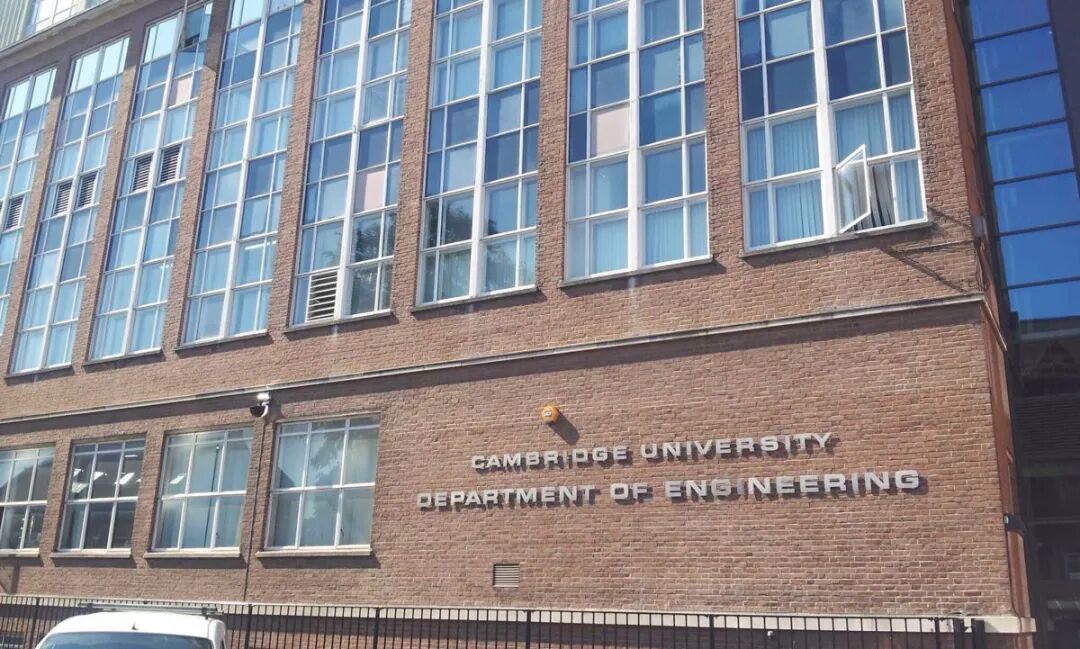
Crick’s lively scientific interests had impressed Max Perutz, who accepted him into his research group at the elite Cavendish laboratory. Perutz was using X-ray diffraction to study the 3D structures of proteins. Proteins are fundamental to life, and Crick was happy to study them.
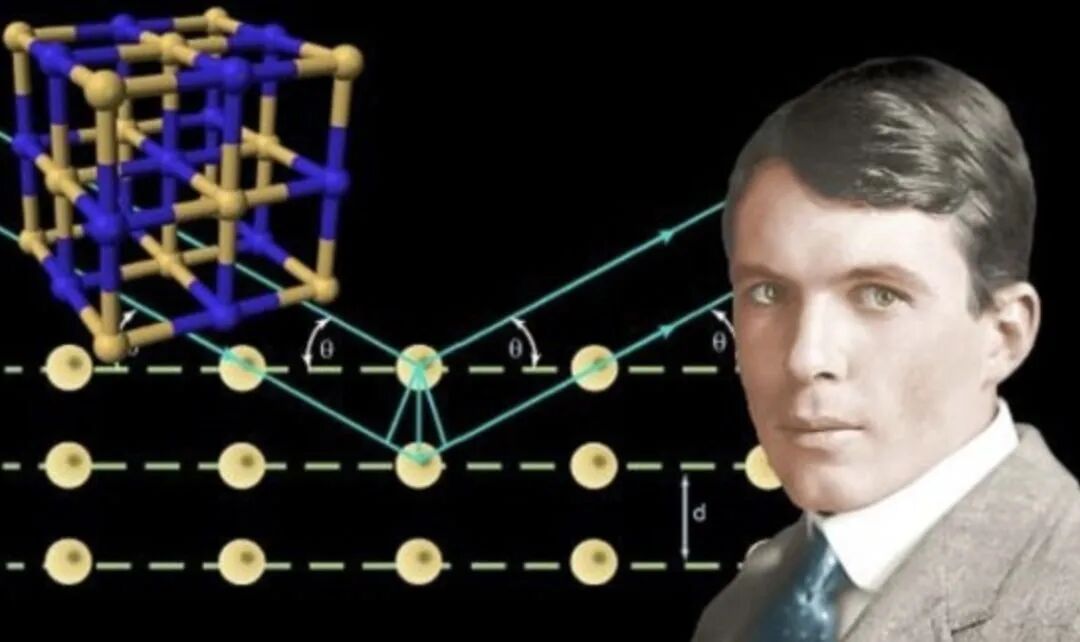
The director of the Cavendish was Lawrence Bragg who, four years before Crick’s birth, had discovered how X-ray diffraction can reveal the structures of molecules, showing the locations of individual atoms.
Perutz, with Bragg’s help, was now extending Bragg’s techniques to huge biological molecules like proteins.
Crick’s task was to use X-ray diffraction to discover the structure of hemoglobin, the molecule that carries oxygen in the blood.
Crick taught himself X-ray diffraction theory before beginning work at the Cavendish. Crick found he possessed a remarkable gift: he could look at a diffraction pattern, process it mentally, and visualize the shape of the molecule (in technical jargon the space group symmetry) that caused it.
Crick’s destiny changed in October 1951. The 35-year-old physicist met 23-year-old biologist James Watson.
Watson had a single overwhelming desire: he wanted to discover how DNA transferred heredity instructions from parent to offspring.
In the summer of 1951, Watson attended a lecture given by Maurice Wilkins of King’s College, London. Wilkins showed an X-ray image of DNA taken by Raymond Gosling, his graduate student. The image set Watson on fire. It showed that DNA undoubtedly had a regular, symmetrical structure.
Watson was now desperately seeking a scientific partner who understood X-ray diffraction and could help him discover that structure. He struck gold when he met Francis Crick.

The pair began to misbehave, ignoring the work they had been funded to do, devoting their time to DNA.
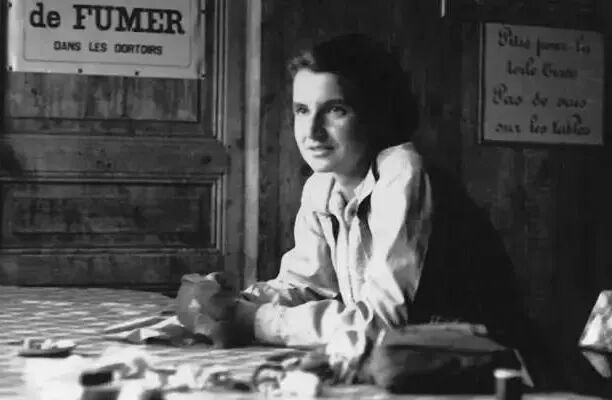
In October 1951, Watson traveled to King’s College to attend a DNA colloquium where he heard Rosalind Franklin, discuss her X-ray analysis of a new DNA structure she had discovered – type B DNA.
Watson was a newcomer to X-ray analysis. He didn’t really understand what Franklin said and didn’t write anything down.
This was a key moment that could have changed the history of science. Franklin told her audience that B DNA had a “face-centered monoclinic” 3D structure. But Crick wasn’t there.
A Winding Path of Research
Inspired by the example of Cal Tech’s Linus Pauling, who had discovered the protein alpha-helix structure by building a paper model, Crick said to Watson they should build a wire model of DNA. This was a much quicker method of seeing how a large molecule might look in 3D.
Crick and Watson built their model, then Crick phoned Maurice Wilkins, inviting him to Cambridge to see it. And so, in November 1951, scientists including Franklin, Gosling, and Wilkins from King’s and Crick & Watson from Cambridge got together.
Crick and Watson had built a triple helix model. Franklin argued that her X-ray diffraction photos provided no certainty of a helix.
Then, with distinct relish, she used her knowledge of chemistry to launch a polite but nonetheless devastating attack on Crick and Watson’s prototype model of DNA; their lack of chemistry knowledge had resulted in a number of blunders.
Crick and Watson hoped to improve their model and asked the King’s people to collaborate with them on DNA, but Franklin and Gosling did not wish to. Wilkins later wrote Crick a letter turning down formal cooperation.
The Cavendish’s director Lawrence Bragg instructed Crick and Watson to stick to their officially funded work – Crick shouldn’t be messing around with DNA when he hadn’t even finished his doctorate!
A key DNA discovery had come from Erwin Chargaff of Columbia University in New York.
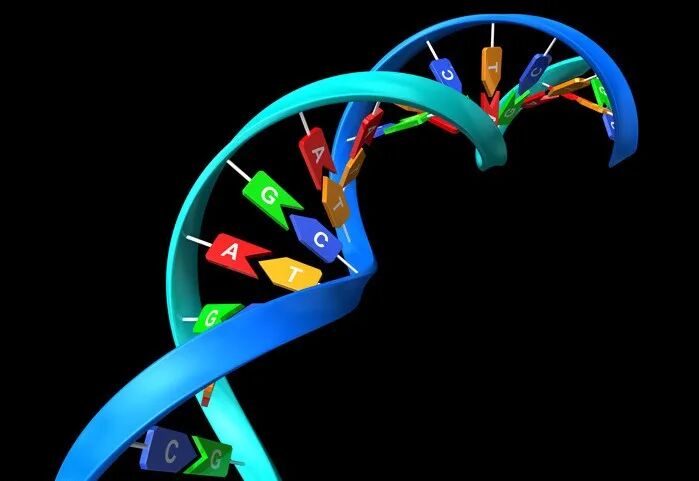
For decades, scientists had known that a DNA molecule contains bases (in the acid/base sense). There are four bases in DNA: guanine, cytosine, adenine and thymine – abbreviated G, C, A and T.
Chargaff discovered that:
·the relative amounts of G, C, A and T change from species to species.
·whatever species DNA is taken from, there is always a 1:1 ratio of G: C and a 1:1 ratio of A: T.
On hearing about the 1:1 ratios Crick instantly had an idea that seems to have escaped Chargaff. Crick envisioned DNA as a molecule in which guanine and cytosine are paired with one another, as are adenine and thymine. This pairing suggested to him that DNA replication might involve a complimentary – i.e. lock and key – mechanism.
In January 1953, Bragg learned that Cal Tech’s Linus Pauling had proposed a triple helix structure for DNA.
Nevertheless, the fact that Pauling was working on DNA set alarm bells ringing for Bragg. Frustrated that Franklin and Wilkins at King’s College seemed to be piling up data, but making no progress interpreting it, Bragg let loose his maverick DNA fanatics Crick and Watson.
It was now a race. But not everyone in the field knew it. Rosalind Franklin, a methodical perfectionist, who was scheduled to leave her job at King’s in March, had long refused to build a scale model of DNA. She now tentatively started one. She was barely communicating with her colleague Maurice Wilkins.
Crick and Watson, meanwhile, were fizzing with ideas – arguing and communicating freely – making meaningful progress with their DNA model.
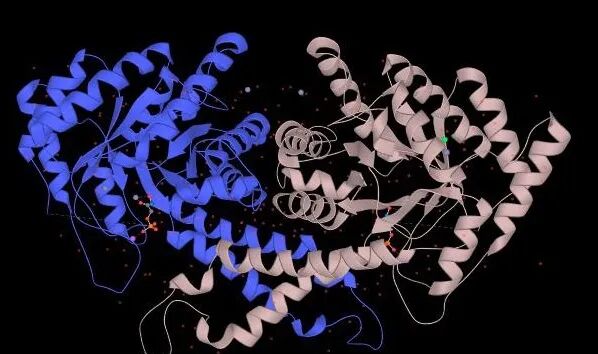
Unveiling DNA's Structure
Franklin had been unhappy working at King’s for some time and was moving to London’s Birkbeck College. In December 1952, she wrote a report for the MRC summarizing her DNA findings. Crick’s supervisor, Max Perutz, and Crick were also doing work supported by the MRC and, quite correctly, received a copy of the non-confidential report in February 1953.
When Crick read it, he saw for the first time the key words “face-centered monoclinic.” He would have been aware of these words a year earlier, if only he had attended the seminar at King’s.
Crick recognized DNA’s space group must be monoclinic C2, one of 230 possible arrangements a crystal could have. He had discovered exactly the same arrangement in horse hemoglobin. Having already figured out what it meant for horse hemoglobin, he now saw exactly what this space group meant for DNA – something Wilkins, Franklin, Perutz, Bragg, Watson, and a host of other scientists had not seen.
In his mind’s eye he could now see the symmetry of a DNA molecule: two helices that formed a dyad. The dyad symmetry meant that if the double helix structure were rotated through 180 degrees, it would look the same as it did before the rotation.
Diffraction work by William Astbury and his colleagues at the University of Leeds spanning the 1930s and 1940s had shown that the bases were stacked ‘like a pile of pennies’ attached at 90 degrees to the supporting structure.
Work done by Sven Furberg at Birkbeck College suggested the G, C, A, and T base units lay within the double helix, while another chemical unit, the phosphate group, would lie on the outside of the structure.
Franklin’s work verified the work of the earlier researchers and, moreover, supplied DNA’s space group and excellent data about spacing between chemical groups in DNA.
Crick could now picture DNA:
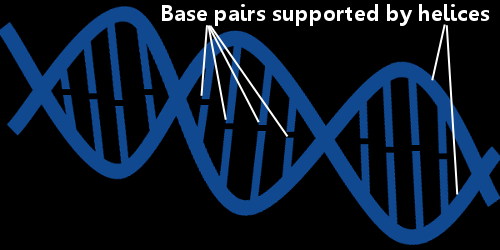
Working on the scale model, Watson had been struggling to fit the awkwardly sized base pairs within the supporting structure of the double helix.
He chatted about the bases with Jerry Donohue, a researcher from Cal Tech who was spending time working at the Cavendish. Donohue said the textbooks Watson was using were wrong. Although Donohue knew nothing about DNA, he knew about bases.
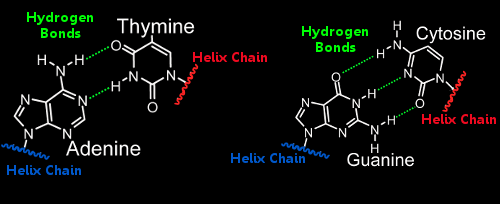
Watson went back to his model and then had his own moment of revelation. He saw that, with appropriate hydrogen bonding, T paired with A was identical in shape to C paired with G. This meant that each base pair would fit anywhere within the double helix: a DNA molecule could be strikingly regular even though the sequence of base pairs was irregular. The hydrogen bonds between the base pairs would hold the two helical chains together.
The revelation went further: the shape of the double helix meant that T could only pair with A; and C could only pair with G. Other pairings were not possible. This explained Chargaff’s 1:1 base ratios: the ratios meant exactly what Crick had envisioned when Chargaff told him about them – DNA replication involves a complimentary – i.e. lock and key – mechanism.
Crick now painstakingly put together an accurate scale model. All the potentially awkward units fitted perfectly. He completed it on March 7, 1953.
Wilkins was invited to see the model on March 13. He saw that it was perfect and his reaction was anger. Although at an earlier meeting he had grudgingly accepted Crick and Watson were re-entering the race, he thought it was a race he could win. He rejected their offer to co-author a paper with them.
In the end, the heads of the King’s and Cavendish laboratories agreed that three separate papers would be submitted to Nature – Watson and Crick’s paper discussing their model plus papers from the King’s College scientists Franklin & Gosling; and Wilkins, Stokes & Wilson; describing their X-ray work.
All three papers appeared in Nature on April 25, 1953.
In May 1953, Watson and Crick published a further paper in Nature explaining how DNA replicates.
Acceptance of Watson and Crick’s work came slowly, but soon enough they were famous.
Crick, Watson, and Wilkins shared the 1962 Nobel Prize in Medicine. Rosalind Franklin died in 1958, and Nobel Prizes are not awarded posthumously.
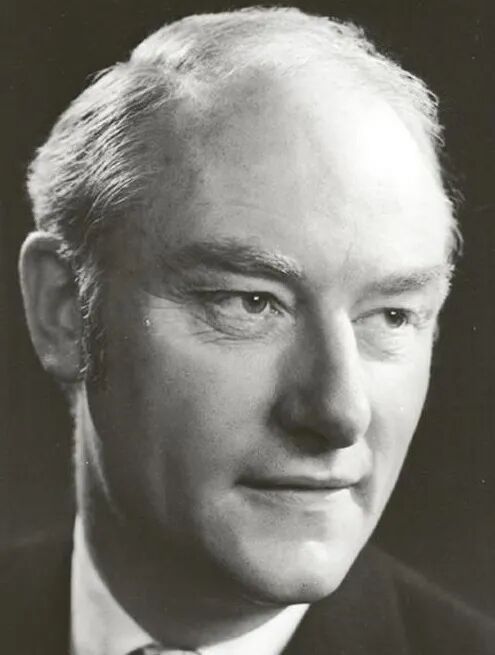
He had studied physics at the University of London, but the outbreak of the Second World War forced him to interrupt his doctorate. After the war, curiosity about the difference between living and nonliving things led him to devote a great deal of time to teaching himself biology and organic chemistry, completing his transition from physicist to biologist.
He was a celebrated Nobel laureate in Physiology or Medicine. His outstanding contributions to research on DNA molecules helped outline the foundations of biomedicine.
Despite his fame, at sixty he resolutely entered a new field, beginning to examine the nature of consciousness theoretically. He proposed the 'astonishing hypothesis': that thought and consciousness could be explained through interactions among neurons!
Francis Crick, an outstanding scientist who retained his love of science and desire to explore, brought us a richly varied scientific feast!
Original source:
https://www.famousscientists.org/francis-crick/
Source: Famous Scientists
Some material in this article comes from the internet. Please contact us for removal if it infringes your rights.
Editorial note
Editorial note: The complete sequence reported in 2022 refers to the T2T human reference genome then available. It did not yet include the Y chromosome, which was completed later, and cannot represent the genetic diversity of every individual. Genes are described as storing important information rather than 'all information', avoiding an overbroad generalization. The historical DNA-structure narrative and original captions are preserved.
Supporting references
NHGRI: The Complete Reference Genome in 2022
Human Pangenome Review Preserved by NHGRI
Sources and editorial history
Restored from a complete historical article exported from the PhDSciNet Official Account.
Editorial revision: Editorial note: The complete sequence reported in 2022 refers to the T2T human reference genome then available. It did not yet include the Y chromosome, which was completed later, and cannot represent the genetic diversity of every individual. Genes are described as storing important information rather than 'all information', avoiding an overbroad generalization. The historical DNA-structure narrative and original captions are preserved.