

Historical compilation: This article preserves the scientific biography in the original manuscript. The English material is credited to Famous Scientists. No named author or translator could be verified from the export, and the original publication date remains unverified.
How could a woman scientist possibly overturn traditional genetic theory?
In 1944, at Cold Spring Harbor Laboratory in New York, American geneticist Barbara McClintock began a famous investigation: were changes in the colors of maize kernels related to genes on chromosome 9?
After a series of crosses and cytogenetic experiments, in 1950 Barbara McClintock concluded that, near a pigment-production gene on chromosome 9, there was a Dissociation element, Ds, capable of 'jumping freely'. It could affect expression of the pigment-production gene and thus regulate maize-kernel color.
Could genes move freely along chromosomes—transpose? This was a new view at odds with traditional genetic theory, and almost every geneticist questioned it.
Working alone, Barbara McClintock remained true to her purpose and continued research that others did not favor. Persistence finally brought recognition: in 1983, the Nobel Assembly at Karolinska Institutet awarded that year's Nobel Prize in Physiology or Medicine to the eighty-one-year-old scientist.
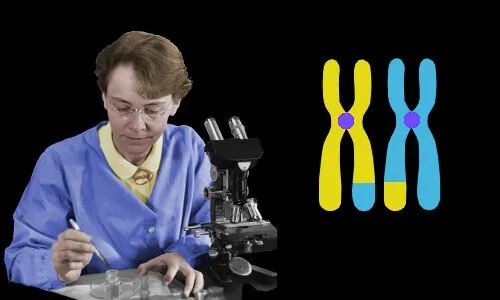
Decoding the Mysteries of Plant Genetics
Barbara McClintock was born on June 16, 1902 in Hartford, Connecticut, USA. Her father, Thomas Henry McClintock. Her mother, Sara Handy, came from an upper-class Boston family; she was a housewife, poet and artist.
In 1908 the whole family moved to Brooklyn, New York. At Brooklyn’s Erasmus Hall High School her teachers could see that Barbara was exceptionally clever, and perhaps destined for life as a college professor. Her mother was very uncomfortable about this. She refused to allow Barbara to go to college, believing it would turn Barbara into an oddball nobody would ever want to marry.
Eventually, in September 1919, Barbara’s father overcame her mother’s objections and, age 17, Barbara rushed off to enroll at Cornell University in Ithaca, New York. Leaving home was a liberating experience for Barbara. She grew happier, more relaxed. Her intense desire to be alone also faded: she socialized with other students, joined a jazz band, and was elected president of the women’s freshman class.

Barbara McClintock took her first genetics course in 1921. Her ability in this field soon caught the attention of her teacher, Claude Hutchison, who recommended that she should jump straight on to the graduate-level course the following year. She was delighted to do this, all the time growing ever more fascinated by the genetics of plants. After receiving a B.S. in agriculture in 1923, she decided to pursue her fascination at graduate school.
In 1925 McClintock was awarded an M.S. in botany and in 1927 a Ph.D. in botany, both earned at Cornell. After she completed her Ph.D., Cornell appointed McClintock to the role of instructor in the Botany Department.
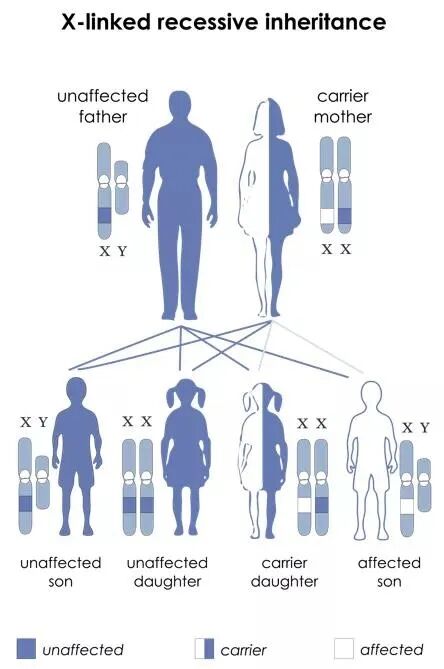
McClintock worked in plant cytogenetics, meaning she used microscopes to investigate plant genetics at the cellular level – particularly studying chromosomes.
Decoding the Mysteries of Chromosome Crossing Over
In addition to her own individual research work and her teaching load, McClintock began guiding Harriet B. Creighton, a graduate student. McClintock and Creighton had been researching the behavior of chromosomes. McClintock and Creighton proved the existence of chromosomal crossover.
Chromosomal crossover happens while the cells that take part in sexual reproduction are being made in a process called meiosis. In animals these are the egg and sperm cells.
Egg and sperm cells are different from normal cells because they only contain half the normal number of chromosomes. In the case of a human, a normal cell contains 46 chromosomes, while sex cells contain 23.
When egg and sperm cells merge during reproduction, they each provide 23 chromosomes to produce a new cell with 46 chromosomes. This new cell will grow into a new person. Half of its chromosomes come from mom and half from dad.
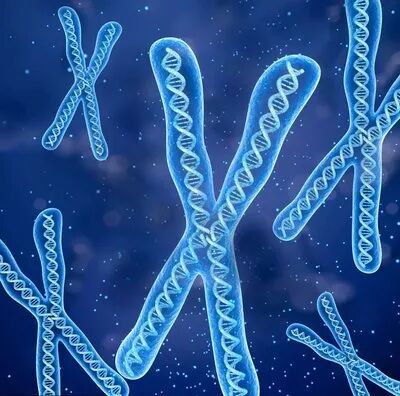
What McClintock & Creighton discovered is that when sex cells are being manufactured, nature can shuffle the genetic pack of cards to produce chromosome variations.
Imagine a cell in dad’s body. This is a special cell that is going to produce sperm cells. This cell contains 46 chromosomes, 23 of which dad inherited from his dad (paternal chromosomes) and 23 from his mom (maternal chromosomes).

Each paternal chromosome is paired with a maternal chromosome.

To make new cells, every chromosome makes a copy of itself so now there are two identical packages of DNA attached in a single chromosome.

This paternal chromosome continues to be paired off with its maternal partner.
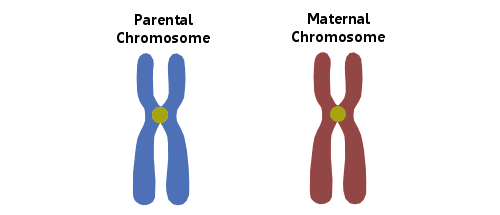
McClintock & Creighton showed that these chromosomes line up and then crossover:

The chromosomes swap sections of genetic material (we now know that these are sections of DNA) to produce new chromosomes. In the image below you can see that the new chromosomes now have different genetic coding from the originals.
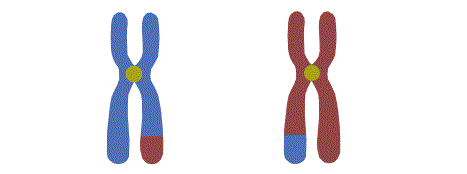
So genetic variations are introduced even before the sperm cell meets an egg cell.
The two chromosomes shown above split in half to produce the genetic material for four sperm cells. Each of the four sperm cells is genetically different.

Each human sperm cell contains 23 different chromosomes ready to pair with 23 chromosomes in an egg cell to make a genetically unique new living being.
Chromosomal crossover had been proposed as a theory 20 years earlier by Thomas Morgan to account for the way offspring inherit genes from their parents. McClintock & Creighton proved the theory was correct.
New Paths in Cytogenetics
In 1936, age 34, McClintock became an assistant professor at the University of Missouri, where she worked until 1941.
A few years earlier, in the summers of 1931 and 1932, McClintock had visited Missouri and learned how to use X-rays to cause mutations in cells.
When she returned in 1936, she began using X-rays again. She discovered that large-scale mutations can arise from breaking, fusion, and bridging of chromosomes. This BFB cycle, discovered by McClintock, leads to chromosomal instability.
In early 1941, age 38, McClintock became a visiting professor at Columbia University in New York.
In 1942 she had been offered and accepted a permanent faculty position at the Cold Spring Harbor Laboratory on Long Island. She was very pleased with her new role. She no longer had teaching duties, and she had freedom to do whatever research she liked. She worked at Cold Spring Harbor for the rest of her career.
In 1944 she became the third woman ever to be elected to America’s National Academy of Sciences.

Beginning in 1944 McClintock studied the relationship between color patterns on corn plants and the look of their chromosomes.
Comparing offspring with parent chromosomes, she found it looked like the offspring chromosomes were reorganized versions of parent chromosomes. Parts of the chromosomes looked like they had been snipped out and shifted to entirely new locations. She discovered parts of the chromosome – she called them Dissociators (Ds) and Activators (Ac) – that could cause insertions, deletions, and relocations of genes in the chromosome.
The theory of the time said genes were in fixed positions on the chromosome: McClintock’s work showed this was wrong.
In 1948 she discovered that Dissociators and Activators could transpose – in other words, jump to different places on the chromosome. They are often, therefore, called transposable elements.

Working Alone on Transposable Elements
McClintock produced a theory that the Dissociators (Ds) and Activators (Ac) were in fact gene controllers. They controlled the genes on a chromosome – they could inhibit or modify their behavior. This explained why an individual living thing, such as a person, can produce all sorts of different cells even though every cell has the same genetic code. The gene controllers make the difference by giving specific instructions in specific circumstances.
In McClintock’s view, genes could no longer be thought of as unchangeable instructions handed from parents to offspring. They could react to specific circumstances in the environment. Mobile genes could jump around within chromosomes and switch physical traits on or off.
She studied this phenomenon until 1950 before she began publishing her work.
In a scientific world that believed genes were very stable and could only change a little at a time, her findings were so radical that she was worried about how people would react to them.
McClintock presented her work in 1951 to an audience of key players from America’s universities at Cold Spring Harbor’s annual summer symposium. She focused on her theory of controlling elements as gene regulators. She was dismayed by the reaction. Other scientists could not follow her line of thought.
Although she had won plenty of recognition for her previous work, McClintock regarded her work on mobile genetic elements as her most important work by far, yet nobody seemed to be taking any notice of it. Feeling ignored, she became depressed. She stopped publishing her work in this field.
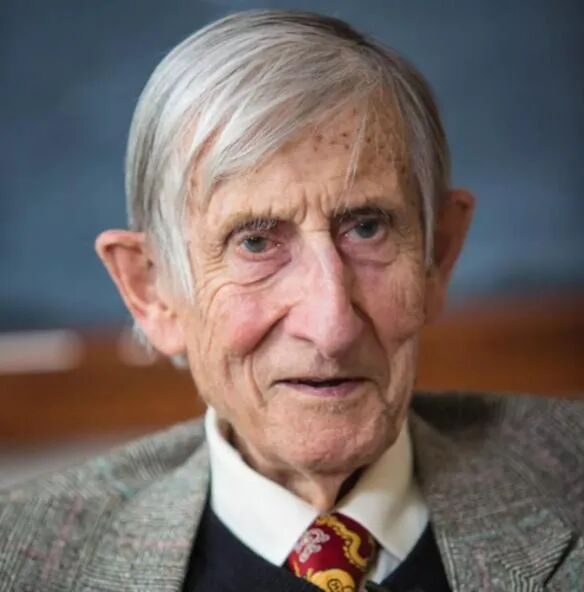
McClintock’s dismay has close parallels with Richard Feynman’s dismay three years earlier when he presented his revolutionary ideas in quantum field theory at the 1948 Pocono Conference.
In Feynman’s case, a young mathematical physicist by the name of Freeman Dyson came to his rescue. He translated Feynman’s work into terms other physicists could understand. Unfortunately, in cytogenetics, there was no Freeman Dyson to act as Barbara McClintock’s white knight.
In 1960 Francois Jacob and Jacques Monod started to publish their work describing genetic regulation in bacteria. Realizing the similarities between their work and hers, McClintock responded in 1961 with a paper: Some Parallels Between Gene Control Systems in Maize and in Bacteria.
Slowly, her theory of transposable elements and gene control began to gain credibility.
At the beginning of the 1970s molecular biologists discovered transposition taking place in bacteria and viruses. They began to see that transposition was important in immunology and cancer. Scientists also saw the potential importance of transposition in manipulating genes to function in the way scientists wanted them to – genetic engineering.
Today we know that 50 percent of the human genome is made up of transposable elements!
In May 1971 McClintock received the National Medal of Science from President Richard Nixon. A large number of other awards and honorary degrees followed, culminating in the 1983 Nobel Prize in Physiology or Medicine “for her discovery of mobile genetic elements.”
She was, by this time, 81 years old.
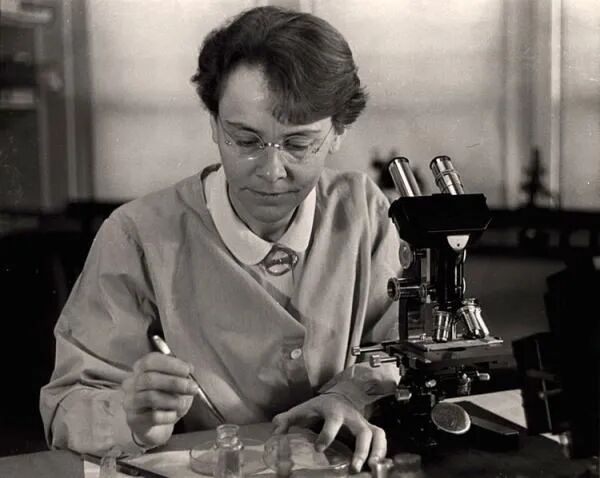
In 1944, Barbara McClintock was elected to the U.S. National Academy of Sciences. No one then could have imagined that this outstanding geneticist would embark on such a difficult and lonely scientific path.
Persisting in her research on transposable elements, Barbara McClintock was viewed as an outsider and a heretic in genetics. Her conclusions contradicted traditional genetic theory, and countless people regarded them with doubt and astonishment.
Working alone, staying true to her purpose, never marrying, and devoting herself entirely to research, Barbara McClintock finally received that long-delayed honor at eighty-one!
A tribute to Barbara McClintock, a brilliant figure in the history of genetics!
Original source:
https://www.famousscientists.org/barbara-mcclintock/
Source: Famous Scientists
Some material in this article comes from the internet. Please contact us for removal if it infringes your rights.
Editorial note
Editorial note: The body that decided the 1983 Nobel Prize in Physiology or Medicine was the Nobel Assembly at Karolinska Institutet. The manuscript's 'Royal Swedish Academy of Sciences' has been corrected. The opening rhetorical question about a woman scientist and the account of working alone belong to the historical narrative, rather than an assessment of women's scientific abilities.
Supporting references
Nobel: Archive of the 1983 Medicine Prize Announcement
Nobel: Barbara McClintock Prize Facts
Sources and editorial history
Restored from a complete historical article exported from the PhDSciNet Official Account.
Editorial revision: Editorial note: The body that decided the 1983 Nobel Prize in Physiology or Medicine was the Nobel Assembly at Karolinska Institutet. The manuscript's 'Royal Swedish Academy of Sciences' has been corrected. The opening rhetorical question about a woman scientist and the account of working alone belong to the historical narrative, rather than an assessment of women's scientific abilities.