English translation of the original Chinese article. Publication dates and the extent of recovered text are preserved. Figures retain their original labels. Read the Chinese original.
Physics and nonlinear optics
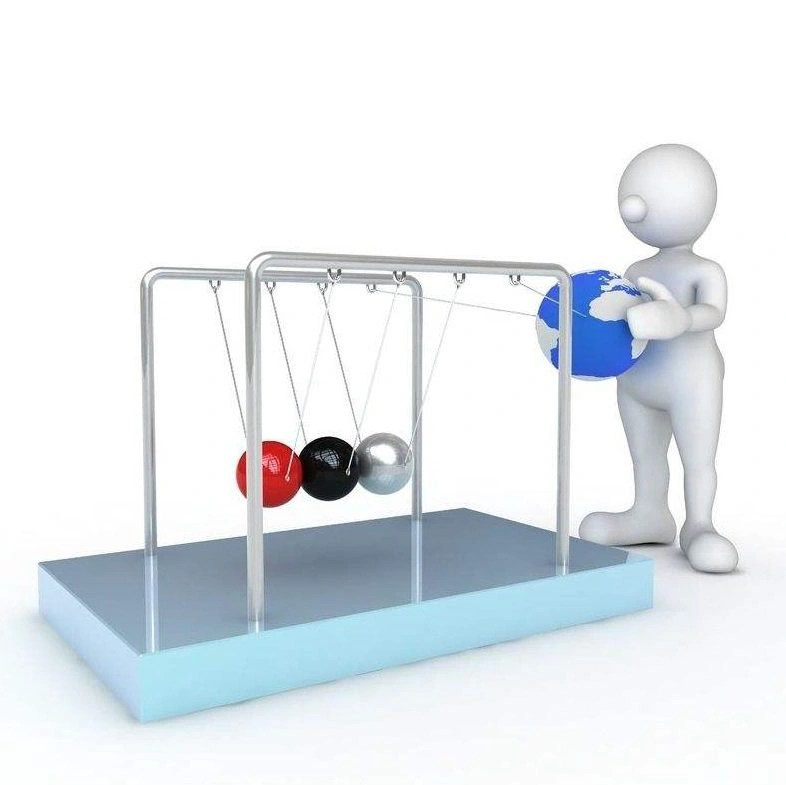
My first inspiring teacher once told me a story. A young physics teacher, delighted to be invited to mark university entrance examination papers, subsequently spent night after night tormented by nightmares of little balls colliding, unable to sleep. I later realized that this was also the rigid image most outsiders had of my subject, physics: studying little balls colliding with other little balls.
Figure 1: A physics experiment.
It was like a spell. During my first year or so at university, we encountered one model of little balls after another: rolling balls in mechanics, charged balls in electromagnetism, and countless colliding, rigid balls in thermodynamics. At the time, optics was the one course that explained a range of phenomena using waves, letting me temporarily forget these petty frustrations. Then one day, the lecturer mentioned, almost in passing, that in nonlinear optics,two intersecting light beams can change their directions of propagation. My puzzlement at this unfamiliar phenomenon unsettled me again. I understood waves to be linear, passing through one another without interfering with their propagation, just as in the scene described in a song by Li Jian: “No two waves meet without parting.” I pictured little photon balls colliding and being deflected.
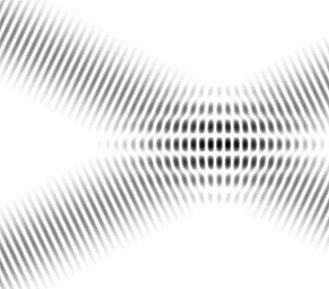
Figure 2: Under ordinary conditions, two waves of the same frequency interfere when they meet and then separate, as though they had never met.
(Wave interference, Wikipedia).
Femtosecond Experiments
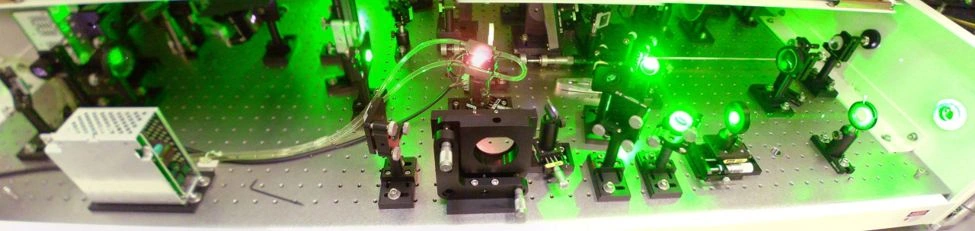
Some time later, I joined a femtosecond laser laboratory and began working with nonlinear optical phenomena every day. The first technique I mastered was autocorrelation, used to measure the duration of femtosecond pulses. The laser to be measured is split into two beams, which enter a nonlinear crystal at a small angle to one another. In the region where the two pulses overlap, they generate a third beam at twice the frequency, as though the colliding beams had merged. The duration of the light pulse is thus converted into the transverse width of the frequency-doubled light, which is easier to measure. I gradually came to understand the principle behind frequency doubling as well.
Figure 3: A laser pulse amplifier.
Figure 4: Measuring pulse duration by autocorrelation.
The pale shapes show the paths of laser propagation; the dark stripes represent ultrashort laser pulses..
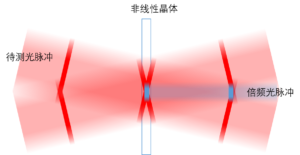
Frequency Doubling
Finally
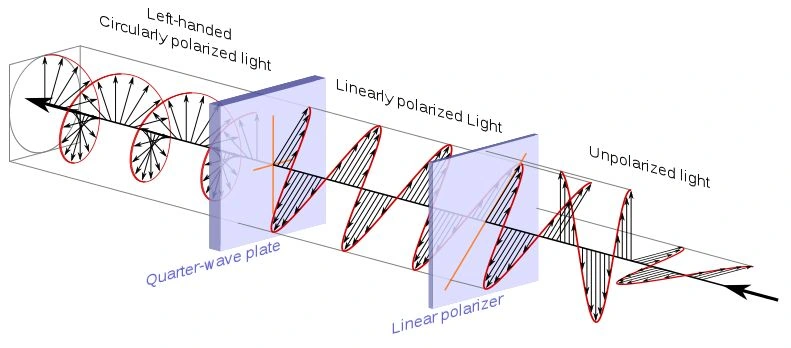
You may already have noticed that in ordinary media, spectral components can be absorbed but cannot appear from nowhere. Mixing bright red and green pigments, for example, gives you some unattractive dark colour because most spectral components of white light have been absorbed. A fluorescent yellow is a little different: it converts ultraviolet light, to which the human eye is insensitive, into lower-frequency visible light. People have also made dye lasers using this principle. But these processes are unlike the frequency doubling described above, which generates a light beam at exactly twice the frequency in a colourless, transparent crystal.So where does the frequency-doubled light come from? We all know that light is an electromagnetic wave. Under an electric field, the centres of positive and negative charge in molecules within the medium shift in a particular direction.
Figure 5: Light waves are transverse waves. This figure shows how light changes after passing through a polarizing element (Wave, Wikipedia).
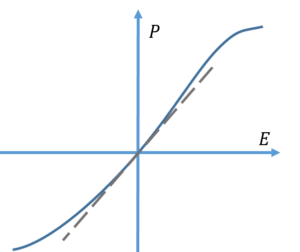
This directed displacement of charge is represented by the electric polarization P, and the susceptibility by χ. For simplicity, we write only the scalar component along a chosen polarization direction here. In SI units, for a weak electric field, P≈ε₀χ⁽¹⁾E. When the instantaneous electric field of the light is sufficiently strong, we must consider a nonlinear response such as P=ε₀[χ⁽¹⁾E+χ⁽²⁾E²+…]. The local electric field of a laser with angular frequency ω can be written as A·cos(ωt+Φ). A simple trigonometric transformation of the second-order term separates out an oscillating term at frequency 2ω. If oscillations at two different frequencies are present simultaneously, sum-frequency and difference-frequency terms can also appear. This is the source of the new frequency components. The formula also tells us that concentrating the light’s energy should make the nonlinear effects more pronounced. Under ordinary illumination, these effects are extremely small, and the crystal appears colourless and transparent.
Figure 6: The relationship between electric polarization and electric field strength in the medium departs from linearity.
If you overlap light pulses of sufficient energy density in a nonlinear crystal, there is still one more step before you can generate frequency-doubled light efficiently. When unlucky, I have spent a considerable amount of time adjusting the angle of a frequency-doubling crystal. For the frequency-doubled fields generated at different locations to build up coherently during propagation, the phase-matching condition must be satisfied: the wave vectors must obey k⃗₃=k⃗₁+k⃗₂. The magnitude of the wave vector is k=2π/λ=nω/c, where ω is the angular frequency, λ is the wavelength in the medium, n is the effective refractive index for the relevant direction of propagation and polarization, and c is the speed of light in vacuum. In the common case of normal dispersion, for example, n(2ω)>n(ω), so |k₂ω|>2|kω|. With the same polarization and collinear propagation, phase matching for frequency doubling generally does not occur naturally. Common nonlinear crystals are anisotropic. In a uniaxial crystal, for example, the effective refractive index can vary with frequency, temperature, and the angle between the polarization direction and the crystal axis. By choosing suitable beam and crystal orientations and polarizations, the fundamental and frequency-doubled light can satisfy the required phase-matching condition, allowing the frequency-doubled field to build up efficiently.
Figure 7: A schematic of phase matching.
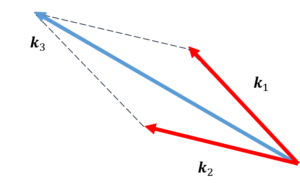
One of the wonders of science is that a simple principle may lie behind a complicated situation. From a quantum perspective, a single photon has energy ωℏ and momentum kℏ. If we regard sum-frequency generation as the merging of two little photon balls, it satisfies precisely the conservation of energy and momentum! We are back to the most basic model. The corridors of the physics building often rang with the clattering of colliding steel balls. I once thought this reflected other people’s superficial understanding of physics; perhaps it really is one of the subject’s essential ideas. Nonlinear phenomena in oscillations and waves make the world interesting. Just as the phenomena mentioned above add colour to optics, the nonlinearity of transistors adds warmth to music. And those two waves that once met have, through a little nonlinearity, each had their shape changed by the other.
About the Author严浩
Hi, everyone! I am 严浩 from the PhDSciNet team:
Institution: Institute of Mechanics, Chinese Academy of Sciences Pursuing a PhD in fluid mechanics, in an interdisciplinary field combining fluid mechanics and optics.;
Research interests: Using optical methods to investigate the phenomena and underlying nature of hypersonic flows and reacting combustion flows. My most frequently used technique is laser-induced fluorescence of NO molecules or CH and OH radicals.;
Thoughts on science communication: Since joining PhDSciNet, I have read many interesting, thought-provoking articles and met friends from different fields around the world. I hope everyone gains something from PhDSciNet.
Interests: Drinking tea, listening to music, swimming, and following the latest developments in science and technology.
*This article expresses the author’s personal views, not those of this website. Other media outlets, websites or individuals who reproduce it must credit the source and bear their own responsibility for copyright and other legal matters. Authors who do not wish their work to be reproduced, or who wish to discuss reproduction fees, should contact us.
References
[1] Robert W. Boyd, Nonlinear Optics 3rd Ed. , Academic Press, 2008
[2] Second Harmonics Generation, Wikipedia, https://en.m.wikipedia.org/wiki/Second-harmonic_generation
Editorial Note — October 10, 2026
Edited on 2026-10-10: Corrected the wave-number formula to k=2π/λ=nω/c (where λ is the wavelength in the medium), the refractive-index inequality for normal dispersion, and the phase-matching condition for frequency doubling. Clarified that P and χ denote electric polarization and susceptibility, respectively, and used the SI-unit expansion. The original narrative, main-text illustrations and original references have been retained.
Additional References
- MIT: Optical Properties of Solids, Chapter 11 (PDF pp. 141–143)(k=nω/c, sum-frequency phase matching, and the effective-refractive-index condition for frequency doubling)
- MIT: Optics, Section 10.3.2 (PDF pp. 12–13)(The SI-unit expansion of linear and nonlinear polarization and the second-order response)
The body text has been restored from a preserved WeChat manuscript with the same title, retaining the original website’s publication record. The old WeChat promotional layout has been removed. Available original illustrations have been restored.
Editorial note: Edited on 2026-10-10: Corrected the wave-number formula to k=2π/λ=nω/c (where λ is the wavelength in the medium), the refractive-index inequality for normal dispersion, and the phase-matching condition for frequency doubling. Clarified that P and χ denote electric polarization and susceptibility, respectively, and used the SI-unit expansion. The original narrative, main-text illustrations and original references have been retained.


