
English translation of the original Chinese article. Publication dates and the extent of recovered text are preserved. Figures retain their original labels. Read the Chinese original.

Department of Materials Science and Engineering, Massachusetts Institute of Technology
Keywords: lithium-ion batteries, ion intercalation and deintercalation, electrodes, electrolytes
Among the major events in chemistry in 2019, the Nobel Prize in Chemistry announced two days ago surely stands out. The committee awarded the prize to John B. Goodenough of the University of Texas at Austin, M. Stanley Whittingham of Binghamton University, State University of New York, and Akira Yoshino of Japan's Asahi Kasei Corporation for their outstanding contributions to the development of lithium-ion batteries. The batteries in the laptops, mobile phones and even electric cars we commonly use today are lithium batteries. Their invention has a long history, and today's applications and advances are the result of successive generations of researchers building on one another's work.
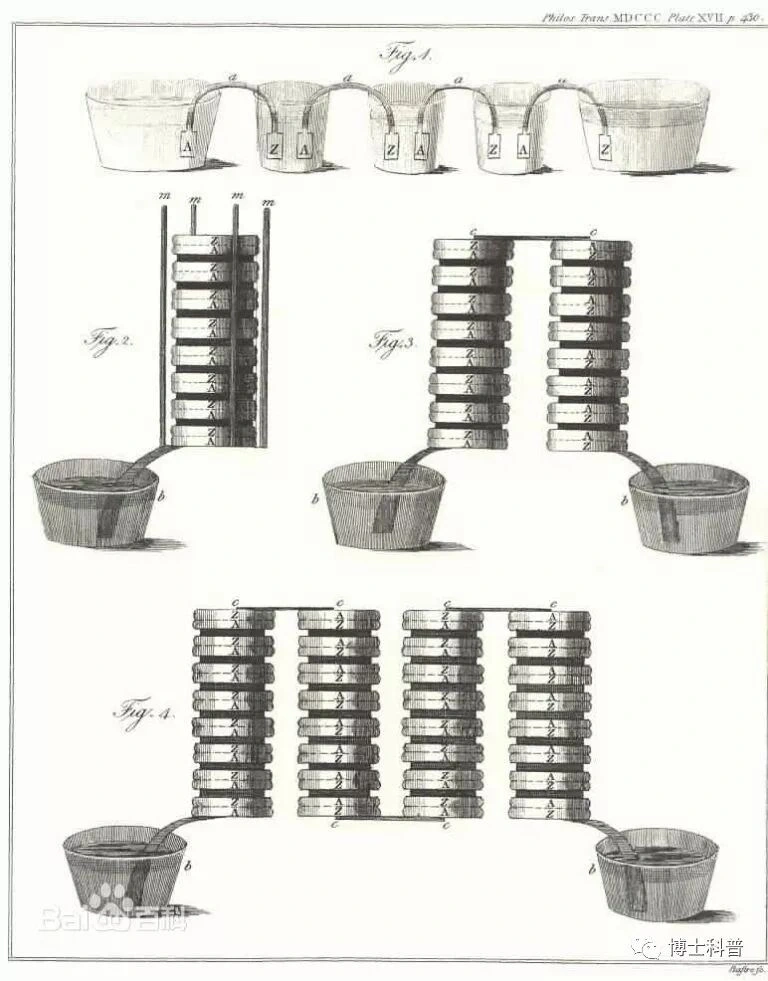
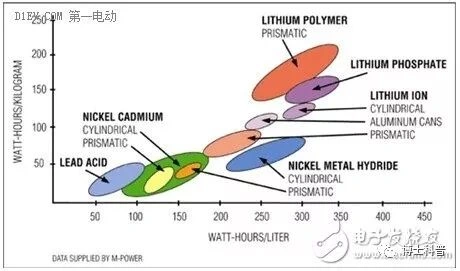
The concept of the battery is generally attributed to the Italian physicist Alessandro Volta around 1800. Inspired by the contraction of frog muscles when they touched metal, he repeatedly stacked zinc plates, copper plates and cloth soaked in an acidic solution, producing a continuous current. This was the original “voltaic pile” (Figure 1), a prototype of the galvanic cells taught in high-school chemistry. Building on this simple electrochemical reaction between two metals, familiar batteries such as lead-acid, nickel-metal hydride and alkaline batteries followed. They made small electronic devices and car-engine starting possible. However, their energy density was still too low for portable applications such as computers and mobile phones (Figure 2 compares the energy densities of different batteries). In other words, the energy per unit mass or volume—watt-hours per kilogram or watt-hours per liter—was too low, requiring a huge battery to deliver a specified operating range. Energy density fundamentally depends on the electrochemical reactions and materials inside a battery. To increase it while reducing battery weight, researchers focused on the lightest metallic element in the periodic table: lithium!
Figure 1: Volta's “voltaic pile.”
Figure 2: Comparison of energy densities in different battery systems.
Interestingly, electric cars were invented before cars with internal combustion engines, but slow progress in battery technology later caused them to be “eliminated” by history. Their return a century later was made possible by successive heroes in lithium-ion battery research, whose efforts gave electric cars a new lease of life. The three Nobel laureates are the most representative examples. Without the exceptional contributions of M. Stanley Whittingham and John B. Goodenough, we might still be living in a world without lightweight smartphones and laptops.
As early as the 1960s, the French scientist Jean Rouxel and the German scientist Robert Schroeder explored reversible intercalation and deintercalation of lithium ions in layered sulfides. This was among the earliest explorations of intercalation electrodes: lithium ions could enter a crystal structure and remain stable there, enabling the storage of ions and electrons. The oil crisis of the 1970s later prompted the oil giant Exxon to pursue battery-based energy storage vigorously in an effort to reduce dependence on petroleum. Whittingham joined Exxon at this time. Drawing on his condensed-matter physics research into superconducting materials, he discovered that potassium ions could reversibly intercalate into tantalum disulfide. In pursuit of lighter materials, layered titanium disulfide (TiS2) with a higher energy density was subsequently identified, and the concept of the intercalation battery was comprehensively described for the first time.
However, the voltage of TiS2 electrodes was too low, limiting overall energy density. At this point, Goodenough—a master of the field—quietly entered the scene (Figure 3). With undergraduate training in mathematics and a PhD in physics, he had decided to pursue solid-state chemistry. As head of the Inorganic Chemistry Laboratory at the University of Oxford, he discovered the remarkable material LiCoO2 (lithium cobalt oxide). Its two-dimensional layered structure also allowed reversible lithium-ion intercalation and deintercalation, and it could raise battery voltage to 4 V, a level scientists at the time had hardly dared imagine. Lithium batteries using LiCoO2 then emerged and still occupy much of today's lithium-battery market. If you do not believe it, look inside your computer or mobile phone—you are sure to find it there!
Figure 3: Goodenough, “Mr. Good Enough,” in his later years.
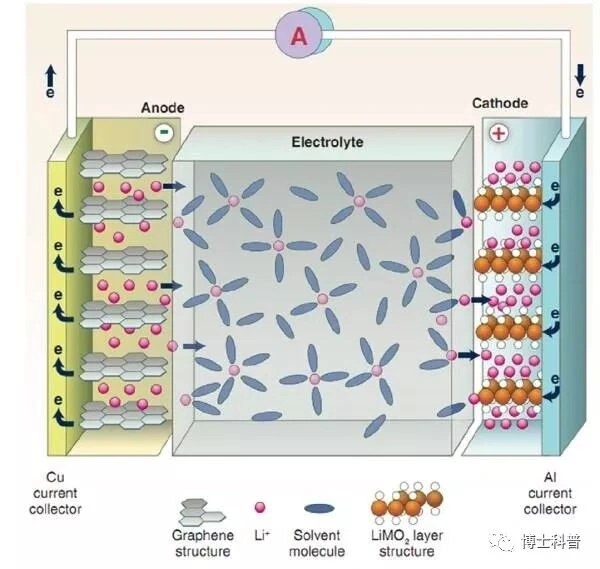
Whittingham and Goodenough laid the theoretical and technological foundations for the rapid development of lithium batteries. Batteries at the time mainly used lithium metal as the negative electrode and required flammable organic solvents as electrolytes. Safety problems made commercialization extremely difficult. Akira Yoshino replaced lithium metal with petroleum coke as the negative electrode and used LiCoO2 as the positive electrode, assembling the first lithium-ion battery suitable for commercial use (Figure 4). In 1991, Japan's Sony successfully launched the first commercial lithium-ion battery.
Figure 4: The structure of a typical lithium-ion battery, showing the positive electrode, negative electrode and electrolyte.
Lithium-ion batteries supported the consumer-electronics industry and changed the world. In turn, the enormous consumer-electronics market drove rapid expansion of the lithium-ion battery industry and inspired their use in electric cars. Today's electric-vehicle industry demands still better energy density, cost and safety, which most electrochemists and materials scientists are working tirelessly to achieve. Lithium-ion batteries now include positive-electrode materials such as LiFePO4 (lithium iron phosphate) and ternary systems. High-energy-density lithium–sulfur and lithium–air batteries have also appeared. Wherever oxidation and reduction can occur, with a sufficient difference in chemical potential and adequate material stability, a battery application may be possible. Meanwhile, wider use of lithium batteries will inevitably create future shortages of lithium resources, attracting attention to batteries based on other metals such as sodium, magnesium, aluminum and zinc. It is hoped that in the near future, lithium batteries better suited to electric cars and other vehicles will make travel more convenient.
*This article represents the author's personal views, not those of this website. Other media, websites or individuals reproducing material from this website must acknowledge its source and assume responsibility for copyright and other legal matters. Authors who do not wish their work to be reproduced, or who wish to discuss reproduction fees or related matters, should contact us.
Images from the matching WeChat article
The following images were recovered from the matching article retained by the WeChat account and restored in their original order.

Additional images were recovered from the matching article retained by the WeChat account and grouped after the main text. The historical archive text and existing editorial corrections are preserved.


