English translation of the original Chinese article. Publication dates and the extent of recovered text are preserved. Figures retain their original labels. Read the Chinese original.

Molecular “Left and Right Hands” in the Nobel Prize
On October 7, 2026, the Nobel Prize in Chemistry was announced. The French chemist Henri B. Kagan and the Japanese chemist Kensō Soai shared the prize equally for discovering nonlinear effects and autocatalysis in asymmetric organic synthesis.[1]
Both achievements concern the “left and right hands” of molecules.
Hold out your hands. They have the same kinds of fingers in the same order, but however you turn them, your left hand cannot become your right. Some molecules are similar: they have the same atomic composition, but their spatial arrangements resemble left and right hands. This is chirality.
“Asymmetric synthesis” sounds rather complicated. Put simply, when a reaction can produce a pair of mirror-image molecules, chemists want it to favor the one they need. The two laureates' discoveries show more clearly how a preference for one molecular “hand” can change and be amplified.[1]
Henri Kagan: Beyond Ratios Lie Molecular Interactions
Kagan is a professor emeritus at Université Paris-Saclay and conducted research for many years at its predecessor, Université Paris-Sud.[9]
In 1986, he and his collaborators discovered that the degree of chiral preference in a catalyst and that in the final product are not always proportional. In some reactions, a catalyst that only slightly favors one “hand” can produce a product with a much stronger preference for that side. Such departures from a simple proportional relationship are called “nonlinear effects.” They provide important clues to how reactions occur and how selectivity can be improved.[7]
Kensō Soai: A Product Can Help Make More of Itself
Soai is a professor emeritus at Tokyo University of Science. In 1990, he and his team discovered asymmetric autocatalysis; in 1995, they demonstrated amplification of a chiral preference.[8,10,11]
In these particular reactions, the product itself can act as a catalyst, helping form more molecules of the same kind. An initially very weak preference for one “hand” can grow as the reaction proceeds.[8]
One discovery shows that reaction outcomes can go beyond simple proportional predictions; the other shows how a tiny preference can be gradually amplified through autocatalysis. Together, they show that molecular chirality is not just about shape—it can also influence how a reaction proceeds.[7,8]
Let us follow chirality one step further. Once molecules have been made, how can they be assembled into a material? What surprises might arise if a pair of mirror-image molecules assemble together?
The following independent peptide study hides its answer inside a soft gel.
A Gel's Unexpected Behavior
If you wanted to make a soft gel sturdier, what would you do?
Adding more raw material is a natural idea. Building a small bridge with a few extra supports seems likely to make it steadier.
One peptide experiment took a different approach: keep the total amount of material unchanged and replace half of it with the original molecule's mirror image. The resulting gel became much better at resisting small deformations.[2]
Stranger still, if the same two molecules were first allowed to assemble separately into short structures and were only then mixed, the strengthening was much less apparent.[3]
The gel's secret lies in how the molecules build their structure together.
From Amino Acids to Proteins
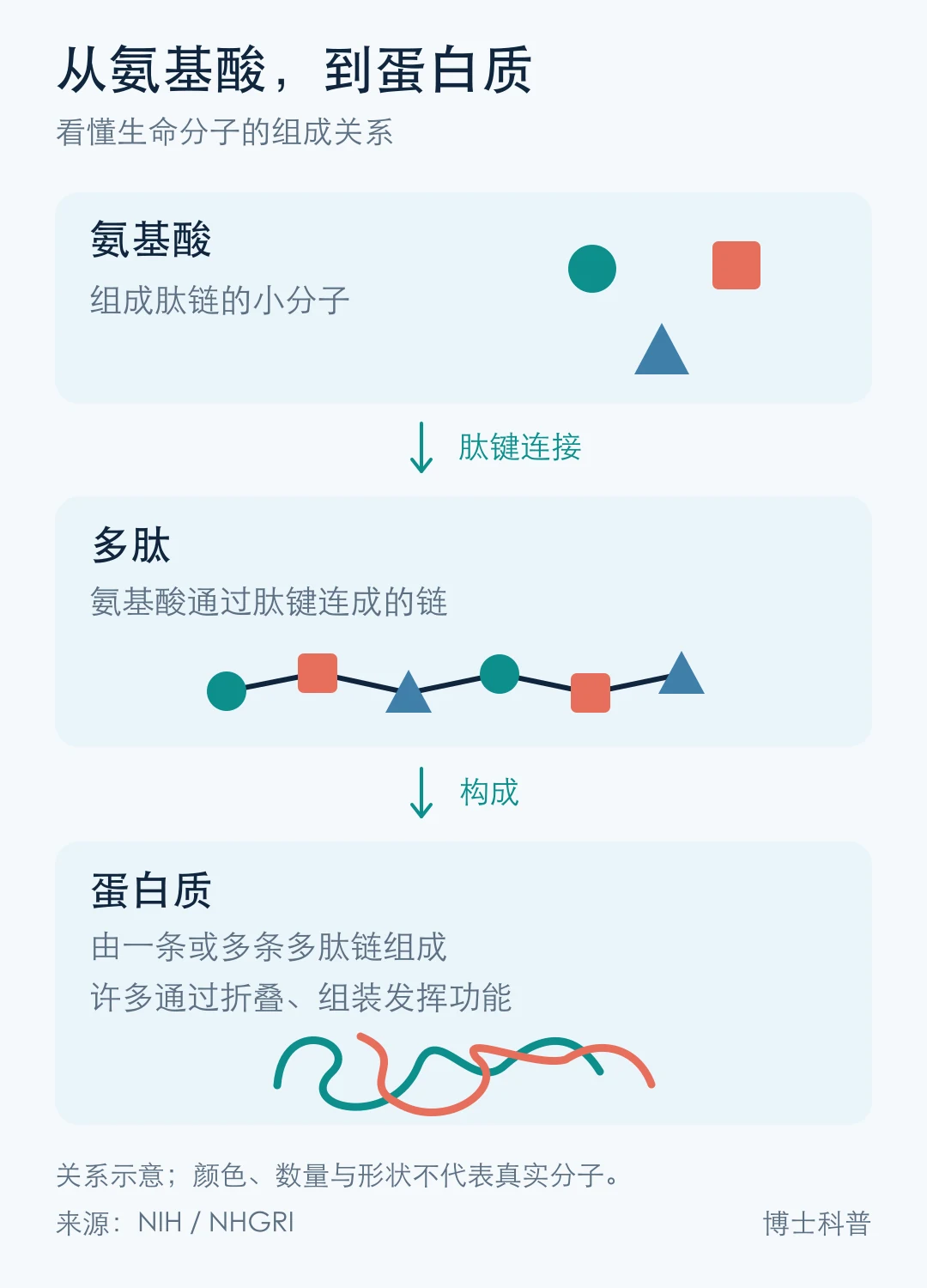
First, what is a peptide? Amino acids are small molecules that we can imagine as parts with different shapes and properties. A chemical connection called a “peptide bond” links them into chains. A chain made by joining many amino acids in this way is a polypeptide.[4]
The proteins familiar to us consist of one or more polypeptide chains. Many proteins must fold their chains into suitable three-dimensional shapes, and some must assemble with other chains, before they can function properly. Chain length alone cannot determine whether something is a protein.[5]
These molecules work inside our bodies. Digestive enzymes help break down food, cytoskeletal proteins provide support, and some proteins carry messages between cells. Proteins are an important material foundation of life, and polypeptide chains form their basic backbone.[5,6]
The Secret Lies in the Order of Assembly
Back to the gel. The researchers used an artificially designed peptide, MAX1, and its complete mirror image, DMAX1. You need not remember the names; think of them as a pair of mirror-image partners. Each consists of 20 amino acids linked together, and the complete molecules are mirror images of each other.[2]
In this experiment, an entire peptide becomes a component for building a larger structure. Under suitable conditions, these peptide molecules self-assemble into long, slender fibers. The fibers connect into a network that supports a water-containing gel.[2] Think of it as an extremely small scaffold: the molecules are the parts, the fibers are the supports, and the connected supports hold water within the network.
A gel made from either peptide alone has similar stiffness. Using equal amounts of the two and allowing them to assemble together, however, produces a result beyond a simple average: at the same total concentration, the gel's storage modulus is about 4 times the original value. [2]
For a first understanding, “storage modulus” describes how difficult it is to change a material's shape through a small elastic deformation. This is the property meant by “stiffer” in the title.
No extra material was added. What changed was how the molecules fitted together.
The strengthening was reported in 2011. A follow-up study in 2017 asked whether these mirror-image partners cooperate within the same fiber, or each build their own fibers, with the two fiber systems only mixed at the end.[2,3]
The two possibilities initially look similar. In building a house, two kinds of parts might be joined into a single beam from the start, or made into separate beam sections and then brought together. Either way, a support structure might result. A glance at the list of materials cannot reveal the difference.
The researchers therefore controlled temperature and the assembly process to create a comparison: first let the two peptides form local fibers separately, then mix them and let gel formation continue. This time, the gel's stiffness did not significantly exceed that of a gel made from just one peptide. The strengthening became pronounced only when the unassembled molecules were mixed first and assembly was then initiated.[3]
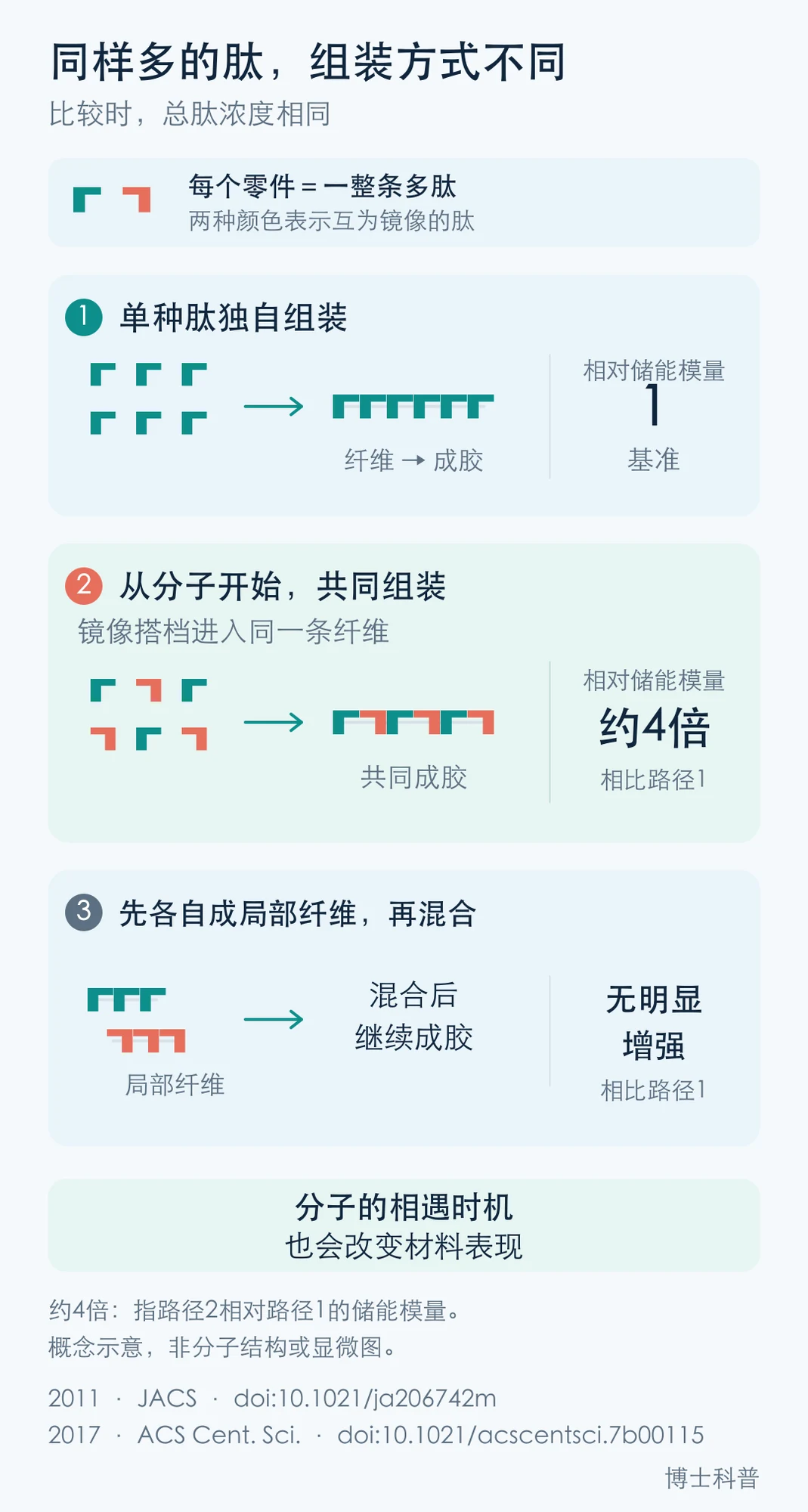
This comparison offers a clue: bringing together the same ingredients at the end does not necessarily produce the same structure. The structures that molecules have already built before meeting influence what happens next.
Further experiments and structural models advanced the answer: the two mirror-image peptides can alternate within the same fiber. This arrangement lets molecules pack more closely inside the fiber. The fiber itself becomes harder to bend, and the entire gel becomes more resistant to deformation.[3]
Returning to the scaffold metaphor, the key is that the supports themselves become more rigid. You can change the performance of the whole structure without adding more material.
Of course, this result applies to this particular pair of peptides under the corresponding experimental conditions. Whether replacing other molecules with mirror-image partners will produce similar strengthening requires new experiments.
From Materials to Life
When we shift our attention from this artificial gel back to the body, the question goes deeper. Life also builds proteins by joining amino acids into peptide chains. Studying how they fit together helps us understand the relationship between structure and function in living systems.
For example, what shape must a signaling protein have to be recognized by another molecule? If an otherwise normal chain folds or aggregates incorrectly, how does that affect a cell? Protein structures, interactions and functions are important research subjects for understanding certain diseases and finding ways to intervene.[6]
This gel provides a small, easily understood example: the kinds and quantities of ingredients are not enough to describe a material. The three-dimensional configurations of molecules, and how they meet and assemble, can also change the outcome. In cells, there are more participants, together with energy consumption, regulation and continuous renewal. These processes must be studied together.
Returning to the Nobel Prize
Having followed this story, we can look back at this year's Nobel Prize in Chemistry and more easily understand the two scientists' contributions.
Kagan revealed that the relationship between the chiral preferences of a catalyst and its product can be nonlinear, giving chemists new clues for interpreting and improving reactions. Soai made it possible to observe experimentally how a weak chiral preference can be gradually amplified through asymmetric autocatalysis.[7,8]
These discoveries help chemists better understand and control molecular chirality, offering approaches to selectively synthesizing desired molecules. Asymmetric autocatalysis also provides experimental clues for exploring chiral preferences in the molecules of life.[1,8]
The prize-winning research concerns chemical reactions, while the gel story concerns molecular assembly; their mechanisms differ. Yet they share a path of investigation: by understanding how molecules interact, we can explain why a larger system displays a particular property.
The fundamental discoveries recognized by the Nobel Prize give us new ways to explain and control the molecular world. Applying those approaches to life allows more specific questions: how does a string of amino acids acquire a function, how do tiny structural differences affect cells, and how do many molecules cooperate to sustain a living system?
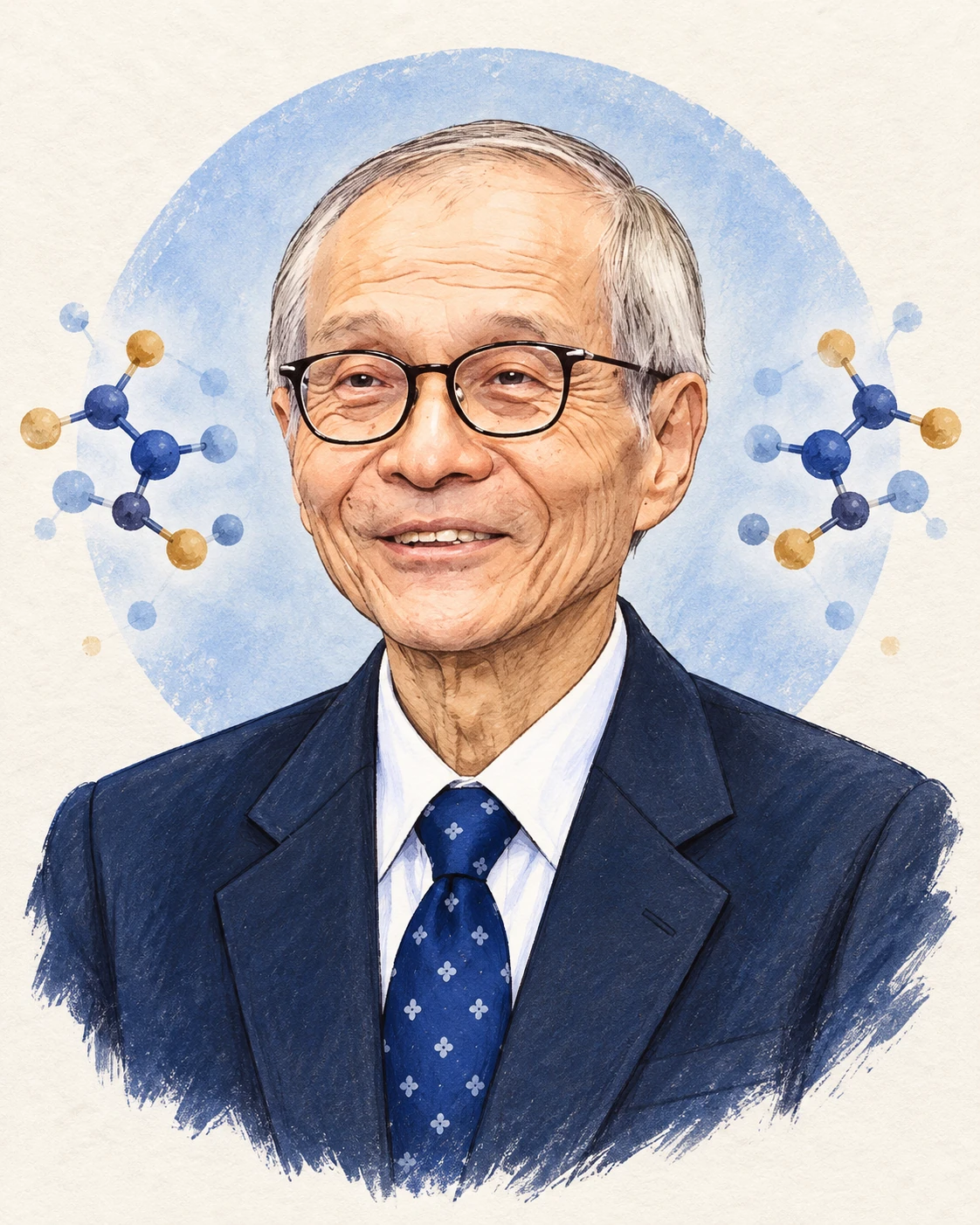
Meet the Two Chemists
References
- American Chemical Society. ACS president comments on award of 2026 Nobel Prize in Chemistry. 2026-10-07. Original source
- Nagy K. J. et al. Enhanced Mechanical Rigidity of Hydrogels Formed from Enantiomeric Peptide Assemblies. Journal of the American Chemical Society 133, 14975–14977 (2011). DOI: 10.1021/ja206742m. Original source
- Nagy-Smith K. et al. Molecular, Local, and Network-Level Basis for the Enhanced Stiffness of Hydrogel Networks Formed from Coassembled Racemic Peptides: Predictions from Pauling and Corey. ACS Central Science 3, 586–597 (2017). DOI: 10.1021/acscentsci.7b00115. Original source
- IUPAC Gold Book. Peptides. The chemical composition and linking of peptides. Original source
- National Human Genome Research Institute (NHGRI). Protein. The relationship between proteins and polypeptide chains. Original source
- National Institute of General Medical Sciences (NIGMS). Science Snippet: The Power of Proteins. 2023-05-03. Original source
- Puchot C. et al. Nonlinear effects in asymmetric synthesis. Examples in asymmetric oxidations and aldolization reactions. Journal of the American Chemical Society 108, 2353–2357 (1986). DOI: 10.1021/ja00269a036. Original source
- Soai K., Shibata T., Morioka H., Choji K. Asymmetric autocatalysis and amplification of enantiomeric excess of a chiral molecule. Nature 378, 767–768 (1995). DOI: 10.1038/378767a0. Original source
- Université Paris-Saclay. The 2026 Nobel Prize in Chemistry awarded to Henri Kagan, Professor Emeritus of Université Paris-Saclay. 2026. Original source
- Tokyo University of Science. 2026年ノーベル化学賞:硤合憲三. Official award feature and biographical introduction. Original source
- Soai K., Niwa S., Hori H. Asymmetric self-catalytic reaction. Self-production of chiral 1-(3-pyridyl)alkanols as chiral self-catalysts in the enantioselective addition of dialkylzinc reagents to pyridine-3-carbaldehyde. Journal of the Chemical Society, Chemical Communications, 982–983 (1990). DOI: 10.1039/C39900000982. Original source


