
English translation of the original Chinese article. Publication dates and the extent of recovered text are preserved. Figures retain their original labels. Read the Chinese original.

If a reaction can detect an extremely slight molecular difference, does that mean it can measure that difference accurately?
Intuition says that, if even an almost invisible difference cannot escape it, a larger difference should be easier to measure.
Behind this year’s Nobel Prize in Chemistry lies a story that challenges precisely that intuition.
On October 7, 2026, Henri B. Kagan and Kenso Soai received the Nobel Prize in Chemistry for work involving nonlinear effects and autocatalysis in asymmetric organic synthesis.[1]
Understanding this work usually begins with the “left and right hands” of molecules: some molecules are mirror images of each other but cannot be superimposed as the same object. We call this property chirality.
Today, however, let us ask a different question. Rather than asking how to make one “hand” increasingly abundant, we ask: if we use this reaction to test an unknown sample, can we determine exactly how strongly it originally favored one side?
Imagine three samples whose two mirror-image molecules have number ratios of 51:49, 75:25, and 99:1. All three favor the first molecule, but the extent of that preference differs greatly.
Chemists describe this imbalance using “enantiomeric excess,” abbreviated ee. Taking the total amount of the two enantiomers as 100%, ee is the absolute difference between their percentages. The three hypothetical samples above therefore have ee values of 2%, 50%, and 98%, respectively. Here, 98% ee corresponds to 99:1, not 98:2.[2]
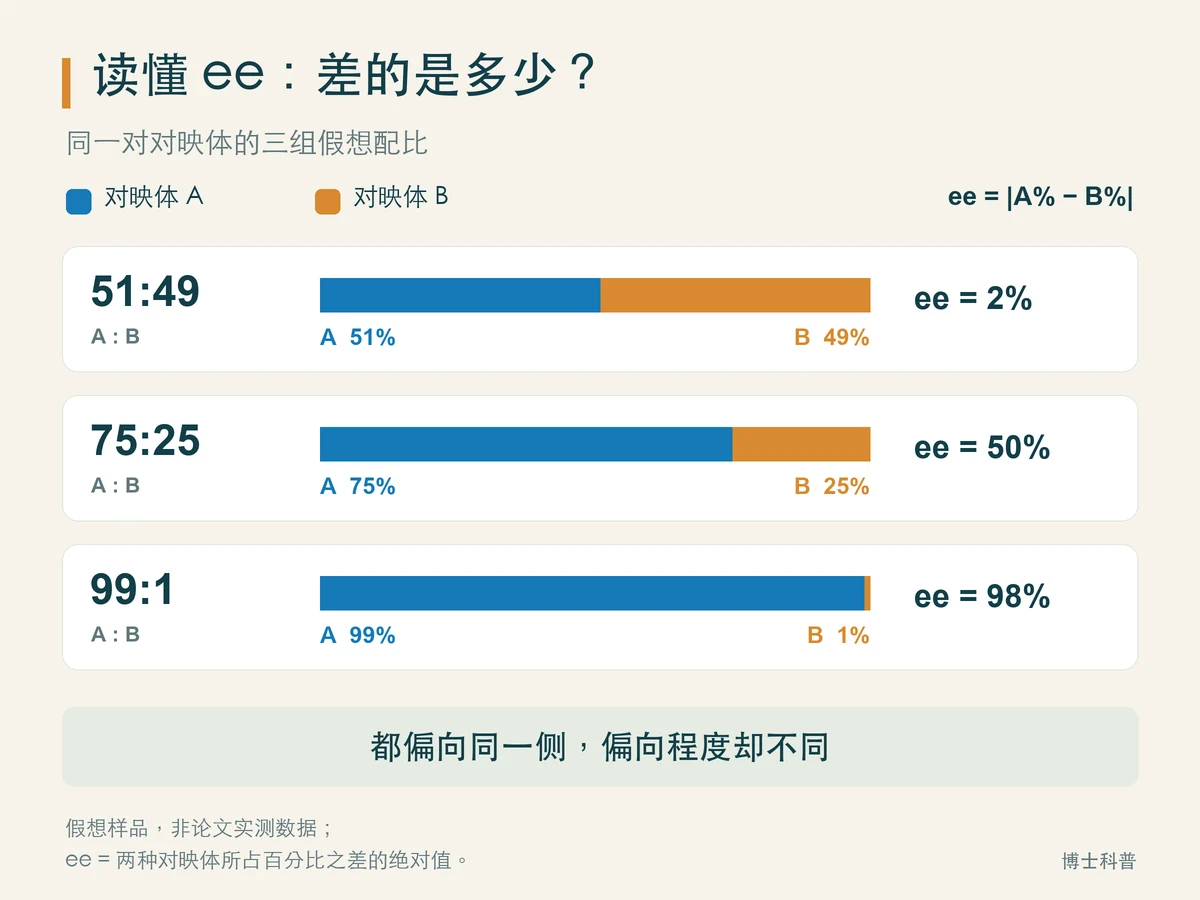
If an analytical tool tells us only that “there is more of the first molecule,” all three samples give the same answer. If the task is to determine their ratios, that answer is clearly insufficient.
Identifying “which side is favored” and accurately measuring “by how much” are two different tasks.
What makes the Soai reaction special is that its product participates in catalyzing its own formation. In 1995, Soai and colleagues reported that a chiral alcohol initially having only a small enantiomeric excess could, in a particular reaction, form a catalytic system that promoted the production of more of the same product and increased the product’s ee.[3]
Think of it as a chemical amplifier: the side initially ahead by only a little may pull increasingly far ahead. The additional molecules still come from the starting materials supplied, of course; they are not copied out of nothing.
This naturally suggests an appealing idea: could an unknown sample first trigger this amplifier, allowing its chiral information to be read by analyzing the reaction products? We call the original sample being tested the “input,” and the reaction product used for analysis the “reporter molecule.” What is measured here is the sample’s influence on another reaction system. The reporter molecule need not be the same molecule as the analyte.
Welch, Soai, and colleagues actually tested this idea. One of their papers appeared in the 2017 volume of Organic & Biomolecular Chemistry, having been published online in 2016. It asked precisely whether the Soai reaction could become a general analytical tool for measuring enantiomeric purity and determining absolute configuration.[4]
In the small set of substances tested, different types of chiral substances could indeed trigger the reaction. But measurement difficulties emerged as well.
The first problem was that the output too readily “picked a side.” In the simple, single-addition experiments tested, the study observed a pronounced “all-or-none” tendency. The reaction was sensitive to ee near zero, but performed less well in distinguishing moderate from very high enantiomeric purity.[4]
Imagine a doorbell that rings especially easily: a light touch makes it ring, and so does a firm press. It is excellent at telling you that “someone has arrived,” but the final ring alone cannot tell you how hard the person pressed. This analogy describes only the input–output relationship, not the reaction mechanism.
The same problem applies to molecular detection. If different degrees of initial bias are ultimately driven toward outputs that strongly favor one side, it is difficult to reconstruct the original ratio accurately from the endpoint alone. A high ee in the reporter product does not mean that the analyte in the unknown sample originally had a high ee.
The second problem is that molecules “speak” at different volumes. The paper found large differences in the triggering ability of different substances. Thus, when an abundant main component triggers weakly while a small amount of impurity triggers strongly, the impurity may substantially interfere with the reading.[4]
It is like a room full of people: the loudest voice captured by a recording device does not necessarily represent the largest group. Being able to hear a very quiet sound does not automatically tell the device whose voice it should be listening to.
Even the correspondence between “which way the output goes” and “what configuration the input has” requires checking the reaction conditions. Another study in a 2017 volume reported that, with the same chiral alcohol as the trigger, the preferred configuration of the Soai reaction product could be opposite at 0 °C and −44 °C.[5]
This does not mean that low temperature transformed the original sample into its own mirror image. Rather, the way the sample guides this reaction system depends on the conditions. After reading the reporter molecule’s configuration, we still need to know exactly what information about the input sample it corresponds to under those conditions.
At this point, the real task for designers of a detection method becomes clear: establish a correspondence using standards with known ratios, identify the range over which ratios can be reliably distinguished, check interference from impurities, and control experimental conditions that affect the reading. Amplification is only one part of the process.
One crucial qualification must be retained: the quantitative limitations identified in the analytical study above apply to the simple, single-addition experiments tested. The authors also suggested that more elaborate experimental designs might improve performance. It must therefore not be rewritten as “the Soai reaction can never be quantitative.”[4]
Nor can it be generalized to “all highly sensitive detection is inaccurate.” Here, “sensitive” refers to the response to a slight chiral bias; the ability to distinguish differences may vary greatly across different input ranges.
For chemists seeking a high-ee product, making a tiny initial bias pronounced is an exciting capability. For those trying to reconstruct an unknown sample’s original ratio, preserving and reading the differences between inputs matters just as much.
So, the next time a science story says that “even extremely tiny differences can be amplified,” consider asking: after amplification, can we still tell how large the original difference was?
For an excellent amplifier to become a good ruler, its scale must still be demonstrated.
Meet the Two Chemists


References
- American Chemical Society. ACS president comments on award of 2026 Nobel Prize in Chemistry. 2026-10-07. Original source
- IUPAC Gold Book. Enantiomer excess (enantiomeric excess). DOI: 10.1351/goldbook.E02070. Original source
- Soai K., Shibata T., Morioka H., Choji K. Asymmetric autocatalysis and amplification of enantiomeric excess of a chiral molecule. Nature 378, 767–768 (1995). DOI: 10.1038/378767a0. Original source
- Welch C. J. et al. Can the analyte-triggered asymmetric autocatalytic Soai reaction serve as a universal analytical tool for measuring enantiopurity and assigning absolute configuration? Organic & Biomolecular Chemistry 15, 96–101 (2017; online 2016-09-28). DOI: 10.1039/C6OB01939K. Original source
- Matsumoto A. et al. Unusual reversal of enantioselectivity in the asymmetric autocatalysis of pyrimidyl alkanol triggered by chiral aromatic alkanols and amines. Organic & Biomolecular Chemistry 15, 555–558 (2017; online 2016-12-02). DOI: 10.1039/C6OB02415G. Original source


