
English translation of the original Chinese article. Publication dates and the extent of recovered text are preserved. Figures retain their original labels. Read the Chinese original.

PhDSciNet Elements Team
Did you know? Neptunium was the first artificially synthesized transuranium element—an element with an atomic number greater than 92—to be discovered, laying a foundation for the modern periodic table and the actinide series.
What Kind of Element Is Neptunium?
PhDSciNet's short answer: Neptunium has the chemical symbol Np and atomic number 93 and is an actinide. Neptunium-237 is an extremely stable isotope, with a half-life as long as 2144000 years. Common oxidation states of neptunium include +3, +4, +5 and +6.
In the spring of 1939, the American physicist McMillan discovered a highly radioactive substance while analyzing the products of uranium fission1. Analysis by the chemist Abelson established its atomic number. They named it neptunium after the planet Neptune.
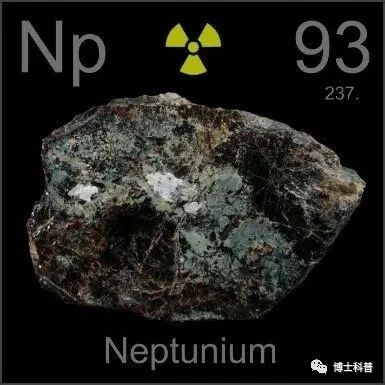
Figure 1: Neptunium
What Are Neptunium's Chemical Properties?
PhDSciNet's short answer: The abundance of neptunium in nature is extremely low. Its study requires complex equipment, and the strong toxicity of this transuranium element makes many aspects of its chemistry difficult to investigate in depth. Neptunium has 18 isotopes, all of which are radioactive. Trace quantities of metallic neptunium can be prepared by reducing neptunium trifluoride with barium vapor at 1200°C. The resulting metal is a silvery-white heavy metal2. Its density is 20.45 g/cm3; its melting point is 640°C, and its boiling point is 3902°C1. Metallic neptunium dissolves readily in hydrochloric acid, sulfuric acid and nitric acid containing fluoride. At room temperature, an oxide film forms on its surface in dry air, stabilizing it. Neptunium is a strong reducing agent and can react with many nonmetals.
What Compounds Does Neptunium Form?
PhDSciNet's short answer: Neptunium's principal compounds are fluorides and oxides. In the presence of hydrogen, passing hydrogen fluoride over neptunium dioxide at 500°C produces purple neptunium trifluoride. In the presence of oxygen, passing hydrogen fluoride over neptunium dioxide at 500°C produces green neptunium tetrafluoride. Another fluoride, neptunium hexafluoride, is orange as a solid and colorless as a gas. Neptunium dioxide is the most stable neptunium oxide and is often used as a target material for irradiating neptunium-237 in reactors.
How Is Neptunium Content Measured?
PhDSciNet's short answer: Samples being tested usually contain very little neptunium but high levels of impurities. Before measurement, separation methods are therefore used to concentrate and purify the neptunium. Measurement methods include radiometric measurement, spectrophotometry, neutron activation analysis, mass spectrometry, X-ray measurement, electrochemical methods and titration. Radiometric measurement and spectrophotometry are the principal methods2. Radiometric measurement is the most sensitive and is widely used to determine neptunium content. Spectrophotometry can determine not only its abundance but also its oxidation state.
*This article represents the author's personal views, not those of this website. Other media, websites or individuals reproducing material from this website must acknowledge its source and assume responsibility for copyright and other legal matters. Authors who do not wish their work to be reproduced, or who wish to discuss reproduction fees or related matters, should contact us.
References
1 Baidu Encyclopedia: Neptunium
2 王箴. Chemical Engineering Dictionary [M]. Chemical Industry Press, 2000.
3 柴霍尔斯基, 邱孝熹. The Chemistry of Neptunium [M]. Atomic Energy Press, 1986.
Images from the matching WeChat article
The following images were recovered from the matching article retained by the WeChat account and restored in their original order.
Additional images were recovered from the matching article retained by the WeChat account and grouped after the main text. The historical archive text and existing editorial corrections are preserved.


