English translation of the original Chinese article. Publication dates and the extent of recovered text are preserved. Figures retain their original labels. Read the Chinese original.

Radon has no stable isotopes. The common isotope radon-222 has a half-life of approximately 3.8 days.
1. Radon: What Kind of Element Is It?
PhDSciNet answers: Radon is element 86 in the periodic table, with the symbol Rn, and belongs to the noble gases. Radon gas consists of individual radon atoms. It is a very dense, colorless, odorless, tasteless, inert gas that does not readily form compounds with other elements.
2 What Special Properties Does Radon Have?
PhDSciNet answers: Because radon is difficult to produce and radioactive, relatively little chemical research has been conducted on it. A comparatively accessible compound is radon difluoride, produced by oxidizing radon with the oxidizing agent fluorine. It has low volatility.
Radon’s isotopes are worth noting. The radon generally meant is the most stable isotope, radon-222, yet its half-life is only 3.8 days. After a series of decays, it produces stable lead-206. There are 36 other known isotopes.
Although colorless at room temperature and pressure, if radon gas is cooled until it solidifies (radon’s melting point is −71 °C), it emits a dazzling yellow or orange-red light. This results from radioluminescence during radon decay.
3 How Was Radon Discovered??
PhDSciNet answers: Radon’s discovery was closely related to research on radioactive substances. As early as 1899, R. B. Owens and E. Rutherford discovered the isotope radon-220 while investigating thorium’s radioactivity, calling the gas “thorium emanation.” Radon-222 was discovered in 1900 by F. E. Dorn while studying radium’s radioactivity, and was then called “radium emanation.” Radon was the fifth radioactive element discovered, after uranium, thorium, radium, and polonium. In 1908, William Ramsay and Robert Whytlaw-Gray collected enough radon to determine several of its properties.
4. What Are the Natural Sources of Radon?
PhDSciNet answers: Radon is an intermediate product in the decay of the radioactive elements thorium and radium into lead—an intermediate in the process. Radon concentrations in the atmosphere are low and are affected by meteorological, geological, and other factors. Thorium and radium occur abundantly in rocks such as granite and schist, so radon is not rare in nature. Some places, such as hot springs, have higher radon concentrations than others because radioactive elements in the heat-filled rocks continually decay and release radon into the water.
5. Does Radon Harm Our Health?
PhDSciNet answers: Although radon has no known associated biological role, it is the second leading cause of lung cancer after smoking. As a radioactive gas, when inhaled it produces solid decay particles that attach to the airways and lungs, increasing the risk of lung cancer. Estimates attribute approximately 3%–14% of lung cancers to radon. Radon’s health risk mainly involves radiation damage to lung tissue after inhaling radon and its radioactive decay products; household radon exposure must not therefore be directly interpreted as ordinary lead poisoning.
In addition, in 1985 an American engineer unexpectedly discovered high concentrations of radon inside his home. Radon produced by the decay of rocks near the ground surface can enter buildings through foundation cracks, construction joints, and openings. If high concentrations are not diluted promptly, radon can become an invisible threat to health.
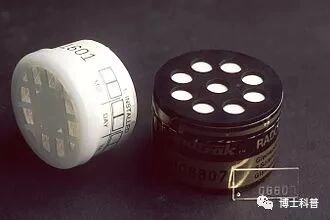
Figure 1: A radon detector.
References
1. Theodore Gray. The Elements: A Visual Exploration of Every Known Atom in the Universe (color collector’s edition, Chinese edition), Kindle Locations 2770–2789. Posts & Telecom Press. Kindle Edition.
2. Editorial group of The Story of Chemical Elements. The Story of Chemical Elements (Youth Science Museum series). China Publishing Group, World Book Publishing Company. Kindle Edition.
3. Baidu Baike: Radon
4. Wikipedia: Radon
5Wikipedia, Radon
Additional References
The text was recovered from the matching article retained in the WeChat account, with the original website’s publication record retained. The old WeChat promotional layout has been removed. Available original illustrations have been restored.
Editorial revision note: Recovery revision dated 2026-10-10: Corrected the historical information for 1900 and 1908 and qualified the isotope half-life. Removed the density multiplier, the unverified claim of a radon–xenon compound, and the wording equating radon exposure with lead poisoning.


