
English translation of the original Chinese article. Publication dates and the extent of recovered text are preserved. Figures retain their original labels. Read the Chinese original.
PhDSciNet elements team
Nitrogen is the most abundant component of Earth’s atmosphere; liquid nitrogen offers prospects for developing human cryopreservation technology.
What Kind of Element Is Nitrogen?
PhDSciNet answers: Nitrogen has atomic number 7 and chemical symbol N. Nitrogen gas is its most common form in nature. Under standard conditions, it is colorless, tasteless, and odorless, an inert gas that does not support combustion. Nitrogen makes up 78.09% of air by volume, making it Earth’s most abundant gas.
At one atmosphere, molecular nitrogen liquefies at −195.79 °C and solidifies at −210.01 °C.Liquid nitrogen is a widely used refrigerant, with many applications and prospects for developing human cryopreservation technology.
A nitrogen atom has five electrons in its outermost shell, so its highest oxidation state is +5. The triple bond in a nitrogen molecule is very strong, so converting N2 into useful nitrogen-containing compounds is difficult, whether in industry or in living organisms. Industrial nitrogen compounds include ammonia, nitric acid, organic nitrates, cyanides, and Kevlar fiber. Most chemical drugs contain nitrogen. In living organisms, amino acids—and therefore proteins—and nucleic acids, DNA and RNA, contain nitrogen. Nitrogen accounts for 3% of human body mass, following oxygen, carbon, and hydrogen.
How Was Nitrogen Discovered?
PhDSciNet answers: While producing oxygen by heating potassium nitrate (KNO3), the Swede Carl Wihelm Scheele demonstrated that air consisted of oxygen and another unreactive component.
The scientific community generally credits the Scottish chemist Dr. Daniel Rutherford with discovering nitrogen. In 1772, while studying at the University of Edinburgh, he investigated the combustion of carbon-containing substances in sealed vessels for his doctoral thesis. After removing the carbon dioxide produced, he found another substance remained. Dr. Rutherford discovered that the remaining gas was extremely unreactive, neither combustible nor able to support combustion, and could suffocate mice. This gas made up four-fifths of air and was named “Noxious Air.”
The French scientist Antoine-Laurent de Lavoisier called nitrogen “Azote,” from Greek, originally meaning “unable to sustain life.”
The name “nitrogen,” which we use today, was coined by the French chemist Jean-Antoine Chaptal in 1790 and means “produced from niter.”
Putting Death “on Pause”: Crossing Between Life and Death in a Liquid-Nitrogen Tank
PhDSciNet answers: According to Science Daily, at 4:01 a.m. on May 8, 2017, China’s first human cryopreservation experiment was completed by clinical experts from the Shandong Yinfeng Life Sciences Research Institute and Qilu Hospital of Shandong University. The process took 55 hours, using a 2,000-liter liquid-nitrogen tank at the extremely low temperature of −196 °C. A major difficulty is that ice crystals form during freezing, destroying cell membranes and damaging bodily functions. Adequate cryoprotectant and freezing procedures seek to minimize this damage. Scientists can currently freeze cells for several years and preserve their viability after revival. Tissue cryopreservation and revival are also being actively developed. Techniques for cryopreserving whole humans and animals, however, are not yet mature, and revival experiments remain exploratory. Perhaps one day humans will be revived from a frozen state, as depicted in science-fiction films such as Realive and Interstellar.
Figure 1: Preparations before human cryopreservation
Goldfish Frozen in Liquid Nitrogen: “Coming Back to Life”
PhDSciNet answers: After reading about the first human liquid-nitrogen cryopreservation case, some readers may recall a video circulating online: a goldfish is placed in liquid nitrogen for several dozen seconds until it becomes rigid, but after about a minute in water it starts swimming happily again. Such apparent revival is astonishing. Could humans do the same?
Many animals hibernate, slowing their metabolism. Although they tolerate low temperatures better than humans, they too have a lethal temperature threshold. When water inside the body freezes, the formation of ice crystals, destroys cells, thereby damaging tissues. In theory, under rapid low-temperature freezing, water molecules freeze before they can form ice crystals, avoiding cellular destruction.
In fact, we see only the beginning of the experiment and do not know its ending. Repeated experiments show that goldfish do indeed “revive” after liquid-nitrogen freezing. However, because the freezing is not fast enough, some tissues are still damaged, causing these goldfish to die within a day. The videos do not show this.
Why Are There So Few Chips in a Bag That Looks Full?
PhDSciNet answers: Have you ever bought a large, seemingly full bag of potato chips, opened it, and thought, “Why are there so few? Has someone eaten them?” No one has. Manufacturers add nitrogen when producing potato chips because nitrogen is an inert gas, that delays food spoilage, allowing the chips to be stored longer. Many canned foods are likewise filled with nitrogen to extend their shelf life.
The Nitrogen Cycle: The Power of Lightning
As mentioned earlier, nitrogen gas does not readily react with other substances. Lightning is one of the main natural routes by which nitrogen–oxygen compounds form. Extremely high temperatures around lightning provide enough energy to separate the two nitrogen atoms in a nitrogen molecule. The free nitrogen atoms can be oxidized to form NO and NO2:
N2 + O2 —– 2NO
2NO + O2 —- 2NO2
NO2 dissolve in rainwater and enter the soil. Meanwhile, some nitrogen-fixing bacteria take up nitrogen molecules and use enzymes to convert them into nitrogen-containing compounds that plants can absorb, accomplishing nitrogen fixation.
Colorful Nitrogen
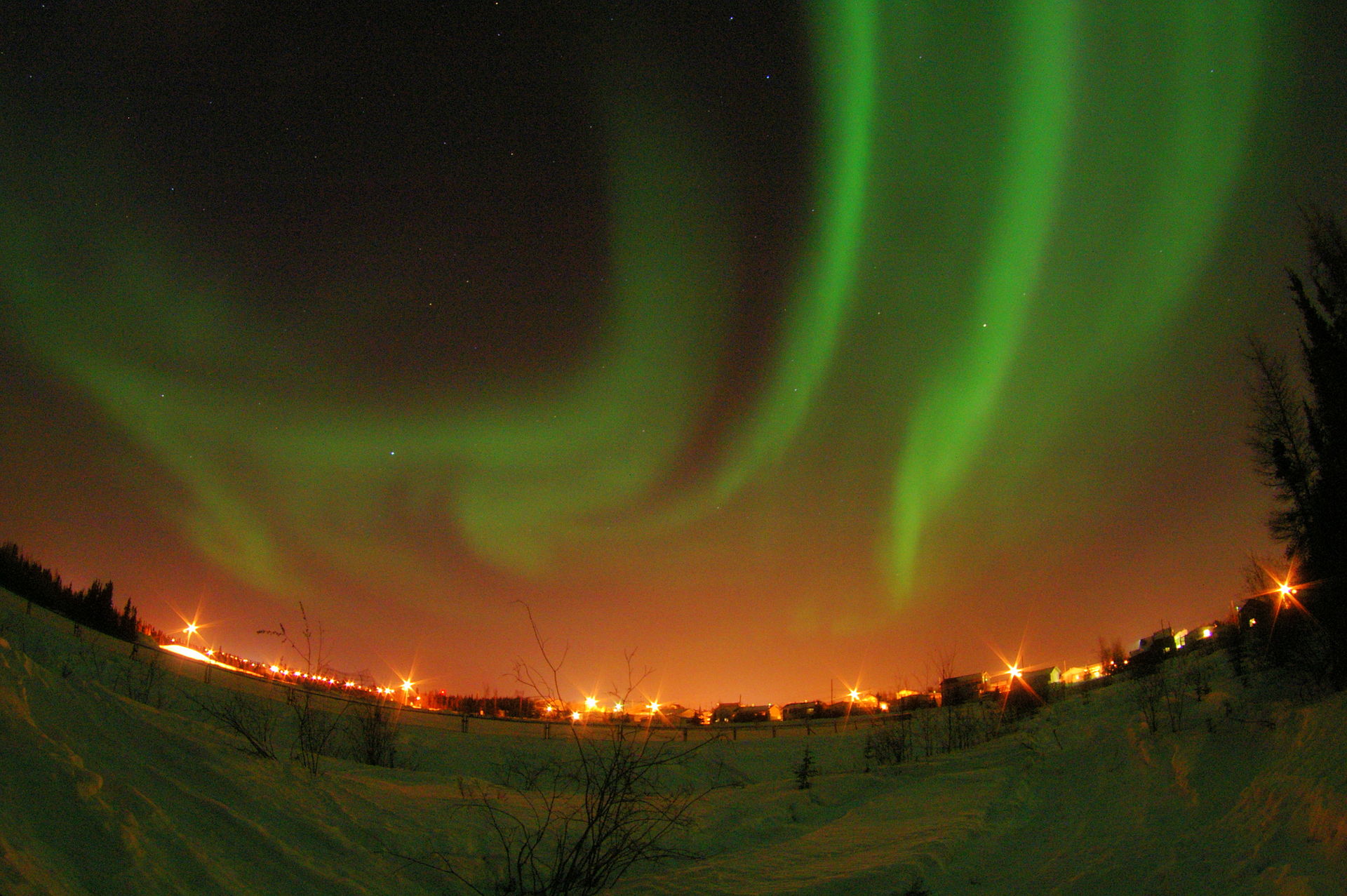
Auroras, or polar lights, are luminous phenomena in the sky at high geomagnetic latitudes, such as the beautiful auroras in Yellowknife, Canada.
Figure 2: An aurora in the night sky
What causes auroras? Atmospheric molecules or atoms absorb energy when excited by streams of high-energy charged particles from the Sun, becoming high-energy particles. They do not remain excited indefinitely, however: they emit photons of particular energies and return to a stable ground state. Different excited particles have different energies, so the emitted photons differ in energy and wavelength. The gases absorbing energy from these high-energy particles therefore determine the aurora’s colors. If nitrogen atoms regain electrons after ionization, they emit blue light; if they instead return directly to the ground state, they emit red light. Oxygen emits green or brownish-red light.
*This article represents the authors’ personal views and does not represent the views of this website. Other media, websites, or individuals reusing or republishing it must acknowledge the source and assume responsibility for copyright and other legal matters. Authors who do not wish to have their work republished, or who wish to discuss remuneration or other republication matters, should contact us.
References
2Science and Technology Daily Putting Death “on Pause”: Crossing Between Life and Death in a Liquid-Nitrogen Tank http://digitalpaper.stdaily.com/http_www.kjrb.com/kjrb/html/2017-08/14/content_375890.htm?div=0
3https://www.youtube.com/watch?v=BwQ_56gNFho
4Wikipedia Yellowknife


