
Historical science article: This text was restored from the complete same-title public-account manuscript with minimal factual corrections. Historical statistics and policy targets retain their original context.
Periodic Table Series: Element 6 — Carbon
PhDSciNet Elements Team / Cao Xun (曹逊)
Carbon's name comes from a Latin word associated with charcoal. The Latin word for coal is Carbo, from which the English name Carbon is derived. The original manuscript cited a historical count from Chemical Abstracts in the United States: of more than four million compounds counted worldwide at the time, only about 100,000 did not contain carbon. That figure does not represent the total number of compounds known today.
1 What Kind of Element Is Carbon?
PhDSciNet's answer: Carbon is a nonmetal in period 2 and group 14 of the periodic table, formerly called group IVA, and is insoluble in water. At atmospheric pressure, carbon sublimes; the Royal Society of Chemistry lists a sublimation temperature of 3825°C. A melting or boiling point given without a pressure condition therefore cannot be treated as a universal constant for carbon. Carbon occurs widely in living organisms and the Earth's crust in various forms, and people recognized and used elemental carbon long ago. Many carbon compounds—organic compounds—form the basic constituents of life. Carbon can combine with other elements to form an enormous range of compounds that are important in biology and commerce. Countless carbon compounds are closely connected to everyday life, in products including perfumes, plastics, nylon, petrol, and shoe polish.

2 How Was Carbon Discovered?
PhDSciNet's answer: Carbon was known in prehistoric times, and people used forms such as soot and charcoal very early on. In 1722, scientists studied how iron could absorb certain substances and turn into steel; carbon was the key element involved. In 1772, Antoine Lavoisier investigated the combustion of diamonds, demonstrating that diamond was a form of carbon and that equal masses of diamond and charcoal produced equal amounts of carbon dioxide when burned. In 1786, two French chemists oxidized graphite using a similar method and showed that graphite consisted almost entirely of carbon. In 1789, Lavoisier included carbon in the table of elements in his textbook.
3 How Does the Carbon Cycle Work in Nature?
PhDSciNet's answer: Exchanges of carbon among the Earth's different reservoirs form the carbon cycle. Plants absorb carbon dioxide through photosynthesis and synthesize organic matter; the Calvin cycle participates in this carbon-fixation process. Respiration by organisms, by contrast, releases carbon dioxide. Carbon in organic matter can be transferred to other organisms through feeding, and some of it is exhaled by animals as carbon dioxide. Some carbon dioxide dissolves in the oceans. Some ancient biological remains also formed coal, oil, and natural gas through long geological processes, and burning these fuels releases carbon dioxide again.
4 What Allotropes Does Carbon Have?
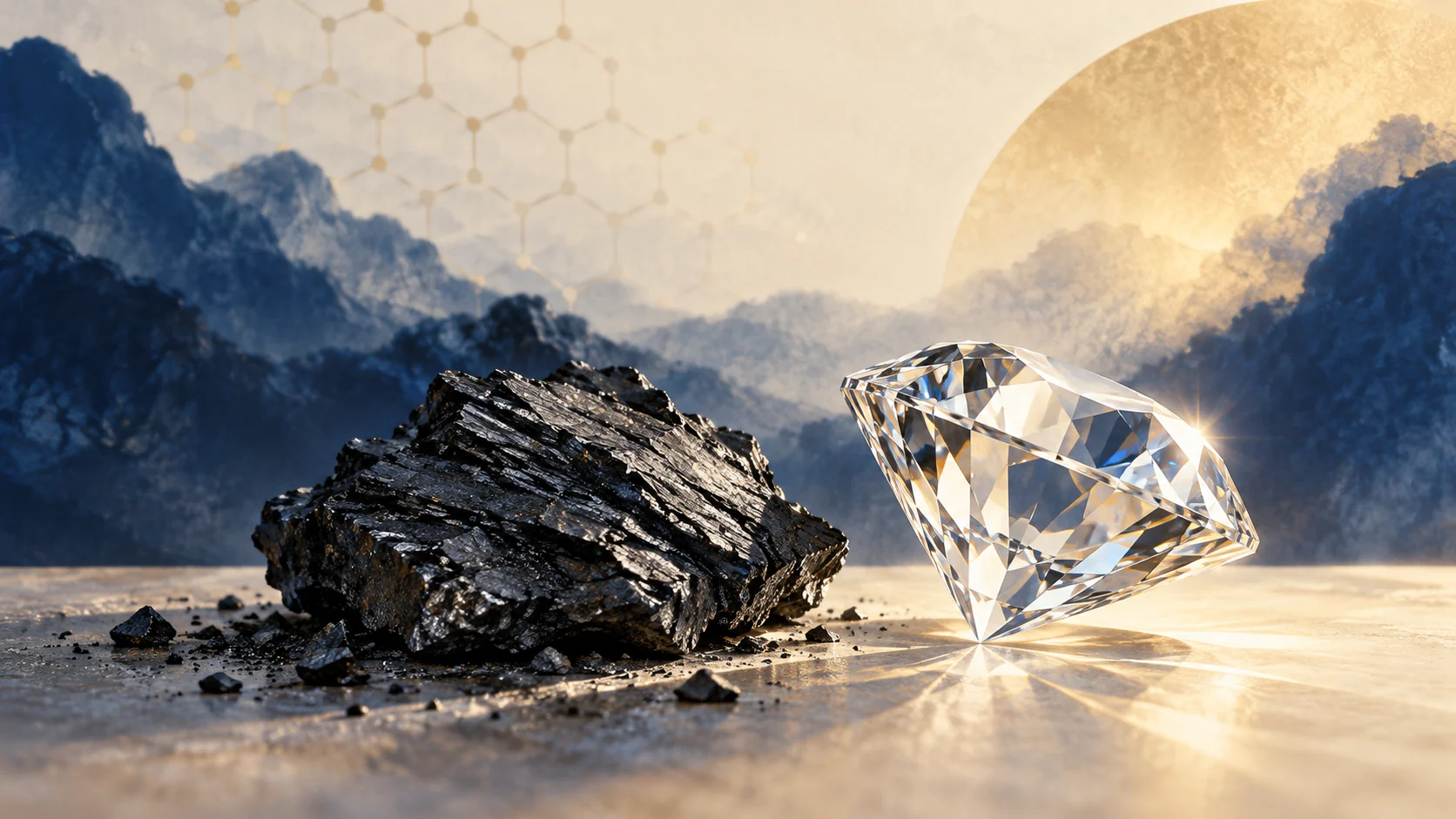
PhDSciNet's answer: Carbon's allotropes include diamond, graphite, fullerenes, and graphene. Carbon aerogels and carbon nanofoams are material forms or structures, and their names alone do not justify classifying them as independent allotropes. Diamond has very high hardness: each carbon atom bonds with four others to form a three-dimensional crystal structure. It can be used in jewelry and drill-bit materials, among other applications. Unlike transparent, hard diamond, graphite is a dark-gray solid made of fine flakes with a metallic luster. It can be used in pencils, electrodes, tram overhead wiring, and other products. A molecule of the football-shaped fullerene C60 contains 60 carbon atoms and forms 32 faces: 20 regular hexagons and 12 regular pentagons. Graphene is a two-dimensional crystal that can be obtained by exfoliating layered graphite into a single layer only one carbon atom thick.
5 What Makes Graphene Such a Remarkable Material?
PhDSciNet's answer: Graphene is a two-dimensional nanomaterial consisting of a hexagonal honeycomb network of carbon atoms with sp2 hybridization. Thanks to its physical structure, graphene has excellent optical, mechanical, and electrical properties, with broad potential applications in energy, biomedicine, nanomaterials, drug delivery, and other fields. Physicists Andre Geim and Konstantin Novoselov at the University of Manchester in the United Kingdom used mechanical exfoliation to separate graphene from graphite and jointly received the 2010 Nobel Prize in Physics. Graphene can be prepared using mechanical exfoliation, oxidation–reduction routes, oriented epitaxial growth, silicon-carbide epitaxy, and chemical vapor deposition. The Hummers method prepares graphite oxide and is an early step in some oxidation–reduction routes; the resulting graphene oxide and reduced graphene oxide cannot simply be equated with defect-free graphene. Its excellent physical and chemical properties and potential applications have encouraged researchers in different fields, both in China and elsewhere, to try various methods of producing high-quality graphene over large areas. Continual improvements to preparation processes aim to reduce the cost and gradually bring graphene into industrial production.

6 Is Carbon Toxic?
PhDSciNet's answer: The health risks of carbon materials depend on their form, particle size, dose, and route of exposure. Neither 'pure carbon' nor 'activated charcoal' can be described broadly as safe to eat. Medical activated charcoal may be used by healthcare professionals to treat certain cases of poisoning. That does not mean industrial graphite, ordinary activated charcoal, or other carbon powders can be taken on your own. Inhaling dust such as graphite or coal dust can harm the lungs. The US Centers for Disease Control and Prevention notes that graphite-dust exposure can cause pulmonary fibrosis and impaired lung function; inhaling relevant dusts can also cause pneumoconiosis. Avoid dust exposure and follow the safety requirements for the particular material.
7 What Challenges Did China Face in Reducing Carbon Emissions?
PhDSciNet's answer: As China developed rapidly, industrialization and urbanization accelerated, consumption of fossil fuels rose sharply, environmental problems became increasingly serious, and emissions of the greenhouse gas carbon dioxide continued to increase. Energy and environmental issues had become major constraints on China's economic and social development. Under international pressure to reduce carbon emissions, the Chinese government pledged that, relative to 2005, carbon-emissions intensity would fall by 40%–45% by 2020, non-fossil energy would account for about 15% of primary energy consumption, and forest stock would increase by 1.3 billion cubic meters. This represented a very substantial challenge for China.
References in the original manuscript
1. The Story of Chemical Elements editorial group. The Story of Chemical Elements, Young People's Science Museum series. China Publishing Group; World Publishing Corporation. Kindle edition.
2. Baidu Cloud Encyclopedia: Carbon.
3. Baidu Encyclopedia: Graphene.
4. Wang Yanan et al. A GWR-model study of spatial differences in China's carbon emissions. China Population, Resources and Environment, 2016, 26(2).
Revised on 2026-10-10: Corrected the description of carbon sublimation at atmospheric pressure, the distinction between photosynthesis and respiration, allotrope classification, and carbon-material exposure risks. Removed an unverified early date for diamonds in China and identified the old compound count as historical data; and identified the Hummers method as an early step in oxidation–reduction routes.
Supplementary references
- Royal Society of Chemistry: Carbon
- CDC/NIOSH: Graphite exposure information
- CDC/NIOSH: Pneumoconioses
- NHS: Poisoning
Sources and editorial history
Restored from a complete historical article exported from the PhDSciNet Official Account.
Editorial revision: Revised on 2026-10-10: Corrected the description of carbon sublimation at atmospheric pressure, the distinction between photosynthesis and respiration, allotrope classification, and carbon-material exposure risks. Removed an unverified early date for diamonds in China and identified the old compound count as historical data; and identified the Hummers method as an early step in oxidation–reduction routes.


