English translation of the original Chinese article. Publication dates and the extent of recovered text are preserved. Figures retain their original labels. Read the Chinese original.
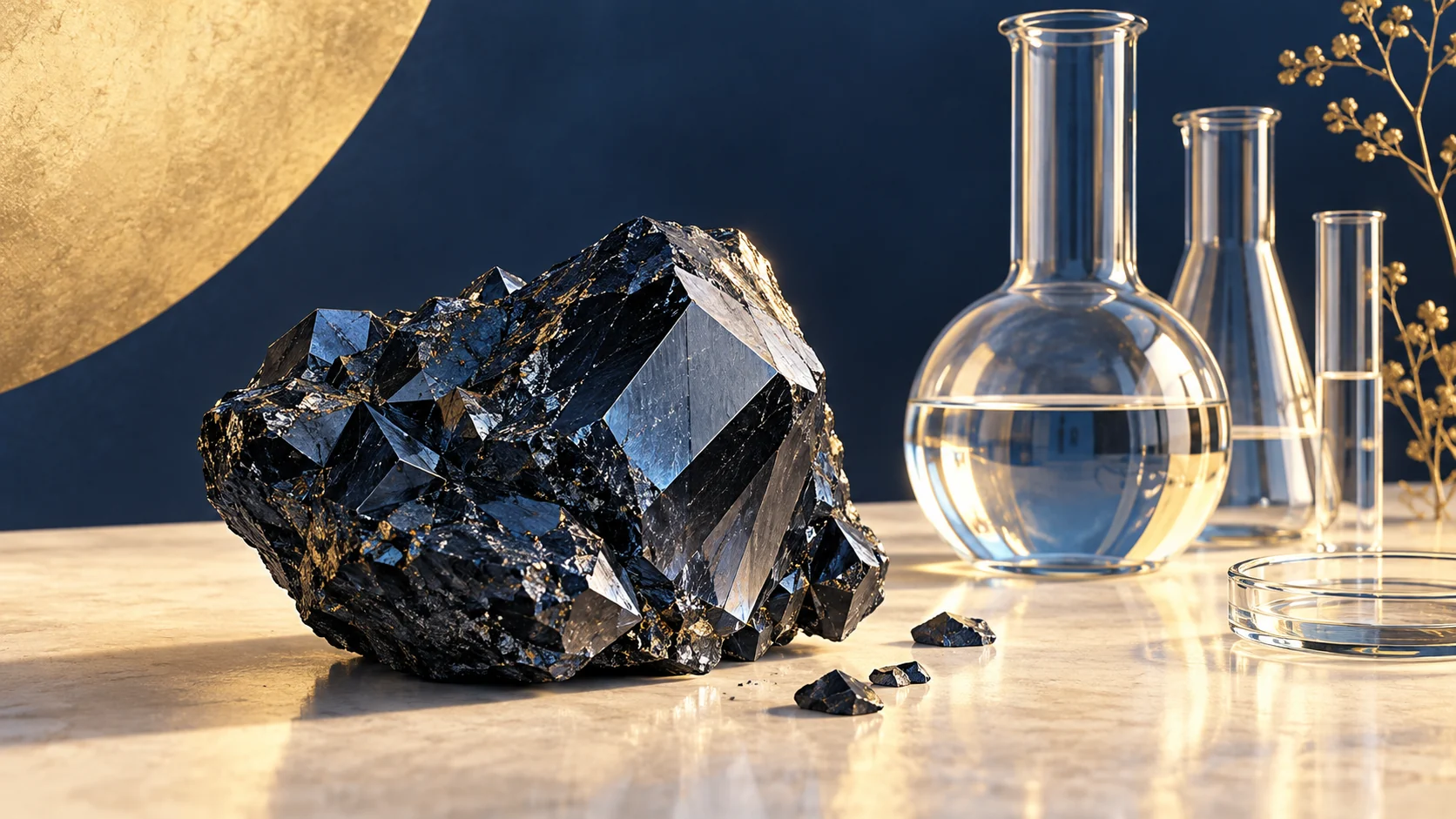
For an element so near the beginning of the periodic table, boron seems to have a surprisingly low profile. Does it really have nothing remarkable about it? You may not know that boron is a dark horse in the study of very hard materials.
What Kind of Element Is Boron?
PhDSciNet’s short answer: Boron is the fifth element in the periodic table and belongs to Group 13 (traditionally Group IIIA), with a relative atomic mass of about 10.81. It is a metalloid, with two main stable isotopes in nature: boron-10 and boron-11. It can appear as a dark amorphous powder or as a crystalline solid.
In nature, boron occurs mainly in compounds such as borates. Minerals including borax are important sources.
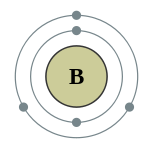
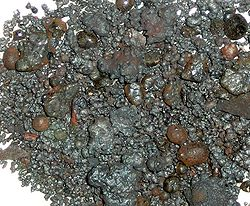
The simplified diagram shows three electrons in the outermost shell of a boron atom. Boron has several allotropes. In some crystalline forms, 12 boron atoms form an icosahedral structural unit, but neither an entire crystal nor all boron compounds can be equated with a single icosahedron. Boron has a rich variety of chemical bonds and structures and can form many compounds, including boranes and carboranes. This illustrates the complexity and diversity of boron chemistry.
Where Does Boron’s Name Come From?
PhDSciNet’s short answer: The name “boron” is related to borax. Borax can act as a flux, assisting welding or melting processes; it does not directly melt metals by itself.
In 1808, Humphry Davy and the French chemists Louis-Joseph Gay-Lussac and Louis-Jacques Thénard independently obtained impure boron from boron compounds. Subsequent research gradually improved its purity.
How Does Boron Enter Our Everyday Lives?
PhDSciNet’s short answer: The uses of elemental boron, a relatively inconspicuous element, are not always widely known. Its compounds, however, have many applications. Borax (whose common decahydrate is Na₂B₄O₇·10H₂O) and boric acid (H₃BO₃) are different substances: their names, chemical formulas and uses must not be confused. Some boron-containing compounds are used in cleaning products, glass, ceramics and other materials. Their specific uses depend on the substance and formulation; industrial raw materials must not be treated directly as medical disinfectants or ordinary food additives.
What Is the World’s Hardest Material?
PhDSciNet’s short answer: Your immediate answer might be “Diamond, of course!” Diamond, an allotrope of carbon, element No. 6, is indeed very hard. Boron nitride, formed from boron and nitrogen, also has several crystal structures. A 2009 first-principles study predicted that wurtzite boron nitride might show greater indentation strength than diamond under particular indentation-compression conditions. This is a conditional theoretical result and cannot simply be generalized to mean that every form of boron nitride is harder than diamond in actual tests.
Boron carbide is a hard compound of boron and carbon. Boron-containing materials can also absorb neutrons. Boron-10, in particular, absorbs neutrons effectively and can therefore be used in nuclear-reactor control and neutron detection. Specific performance must be assessed according to isotopic composition and operating conditions.
Boron Really Can Help Us Fly
PhDSciNet’s short answer: Boron-containing materials also have a role in aerospace materials research.
Boron-fibre-reinforced composites are one example. Early studies of aircraft structures used boron/epoxy composites to reinforce metal components, drawing on the mechanical properties of the composites to meet design requirements. Specific performance depends on the material’s composition, structure and manufacturing process.
Boron and Life
Boron occurs widely in foods such as fruit and vegetables. Its relationship with human bones and metabolism is still being studied. It has not been established as an essential nutrient for humans, so possible effects must not be described as proven essential functions. Ingested boron is excreted mainly in urine.
Plants’ dependence on boron is more clearly established: boron contributes to plant cell-wall structure and plays important roles in growth, pollination and seed formation. Agriculture therefore pays attention to boron supply and deficiency. Whether supplementation is needed, and in what amount, should be assessed for the particular crop and soil.
Is Boron Toxic?
PhDSciNet’s short answer: Boron’s health effects depend on its chemical form, dose and route of exposure. Not all boron-containing substances can be considered equally safe or equally toxic. Excessive ingestion of boric acid or borax can cause adverse effects; boron hydrides such as diborane also pose inhalation-toxicity and flammability hazards.
Different boron compounds do not cause exactly the same symptoms, and poisoning cannot be diagnosed solely from general symptoms such as loss of appetite or headache. As an element with many uses in production and daily life, boron needs to be used scientifically, with attention to the specific substance and application.
References in the Original Manuscript
The Story of Chemical Elements editorial group. The Story of Chemical Elements (Youth Science Museum series). China Publishing Group, World Publishing Corporation. Kindle Edition.
[United States] Theodore Gray. The Elements: A Visual Exploration of Every Known Atom in the Universe (colour collector’s edition). Posts & Telecom Press.
https://baike.baidu.com/item/%E7%A1%BC/400485?fr=aladdin
https://wenku.baidu.com/view/4aaca19a9b6648d7c0c7467e.html
https://baike.baidu.com/item/%E7%A1%BC%E7%A0%82/687227?fr=aladdin
http://www.ew9z.com/pengsha-yongtu-zuoyong.html
https://zh.wikipedia.org/wiki/%E7%A1%BC
https://zh.wikipedia.org/wiki/%E7%A1%BC%E7%9A%84%E5%90%8C%E4%BD%8D%E7%B4%A0
Additional References
- Royal Society of Chemistry: boron’s properties, uses and discovery
- NIH Office of Dietary Supplements: evidence on boron in human nutrition and safety
- 2009 original paper: crystalline structures of elemental boron and B12 units
- 2009 original paper: conditional prediction of indentation strength in wurtzite BN
- Original NASA research: strengthening aircraft structures with boron-fibre composites
- CDC NIOSH: diborane toxicity and chemical hazards
The body text has been restored from a local Word manuscript with the same title, with factual corrections and abridgements. The original website’s title, date and team credit have been retained. The local manuscript may differ from the final version published on the original website; the illustrations come from the manuscript.
Editorial note: Restoration edited on 2026-10-10: Based on the local original manuscript with the same title, with factual corrections and abridgements. Corrected statements about borax versus boric acid, crystal structure, the 1808 discovery, conditional hardness, and human nutrition and safety. Removed unverifiable claims about mummies, Chernobyl and numerical aircraft-performance figures. The original question-and-answer sequence and verifiable central narrative have been retained; the manuscript has not been replaced with a newly written story.


