English translation of the original Chinese article. Publication dates and the extent of recovered text are preserved. Figures retain their original labels. Read the Chinese original.
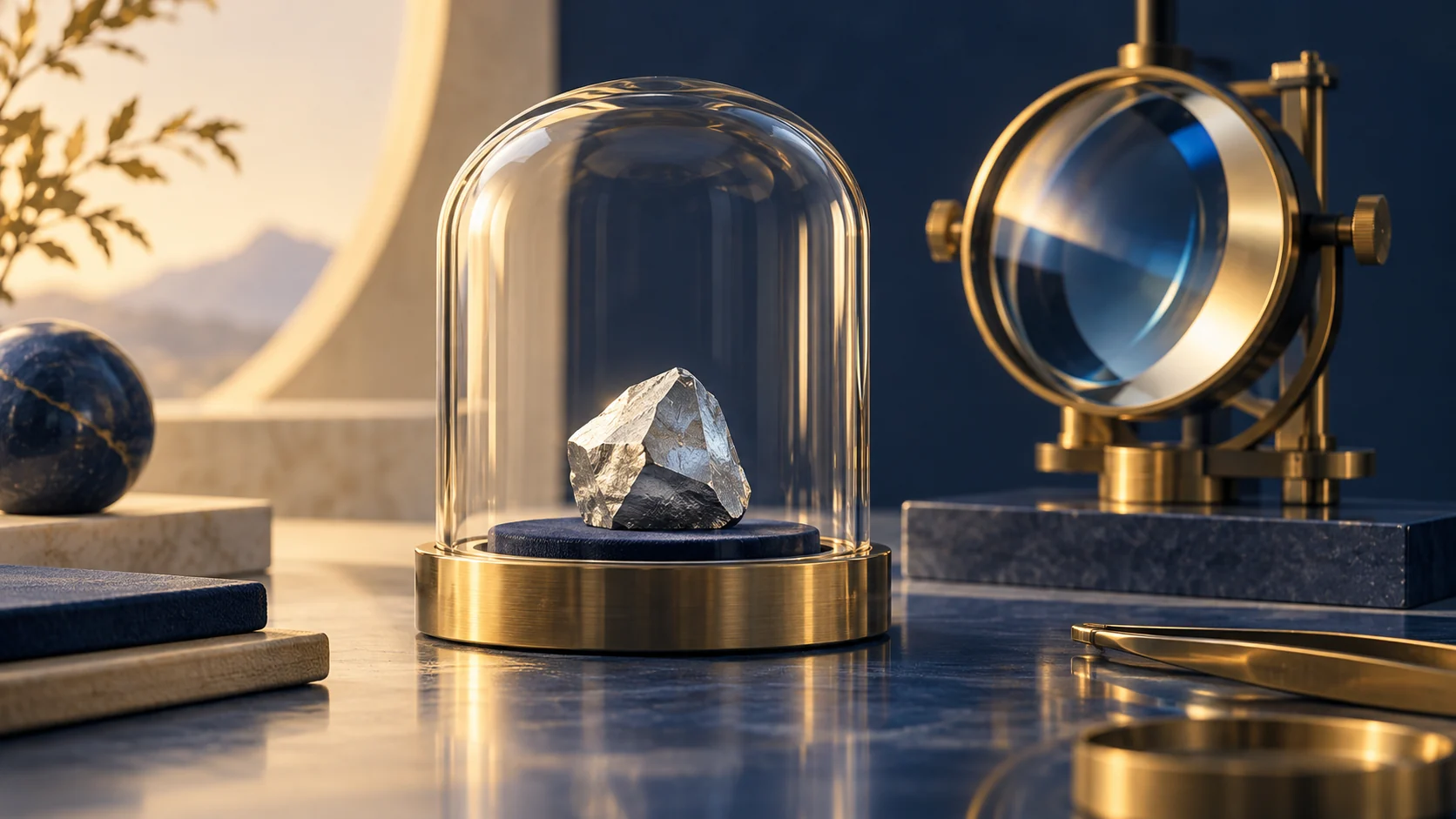
Beryllium: the metal that lives inside emeralds. In nature, beryllium usually combines with other elements to form minerals such as beryl and chrysoberyl. Beryl includes aquamarine and emerald; elemental beryllium, meanwhile, is a lightweight, relatively hard but brittle metal.
What Kind of Element Is Beryllium?
PhDSciNet’s short answer: Beryllium has the symbol Be and atomic number 4, and belongs to the alkaline-earth metals. It is a relatively scarce element in the universe. Fragmentation following collisions between cosmic rays and heavier atomic nuclei is an important source of light elements such as beryllium. In nature, beryllium generally occurs in compounds within minerals.[1][2]
Adding beryllium to alloy materials, including aluminium and copper alloys, can improve their physical properties. Its high strength, high melting point and marked corrosion resistance make it useful for strong, lightweight components in missiles, rockets and spacecraft.
Because of its low density and low atomic number, beryllium absorbs relatively little X-ray radiation. It is therefore often used as a window material in X-ray instruments and particle-physics experiments.[1]
What Are Beryllium’s Physical and Chemical Properties?
PhDSciNet’s short answer: Beryllium is a greyish-white, low-density metal. It is relatively brittle at room temperature and has high stiffness. Its ground-state electron configuration is [He] 2s², with two valence electrons. In common compounds, beryllium usually has an oxidation state of +2.[1]
Beryllium oxide (BeO) has a very high melting point and is also used in ceramics and other applications.[1]
Where Can Beryllium Be Found?
PhDSciNet’s short answer: Beryllium usually occurs combined with other elements. Important beryllium-bearing minerals include beryl (Be₃Al₂Si₆O₁₈) and bertrandite (Be₄Si₂O₇(OH)₂), as well as chrysoberyl (BeAl₂O₄). Gem varieties of beryl include aquamarine and emerald, and they are not all the same colour.[1]
Do You Know How Beryllium Was Discovered?
PhDSciNet’s short answer: In 1798, the French chemist Louis-Nicolas Vauquelin discovered a new element while analysing beryl and emerald. In 1828, Friedrich Wöhler and Antoine Bussy independently isolated metallic beryllium by reducing beryllium chloride with potassium metal. The name “beryllium” is related to the mineral name “beryl”.[1]
Is Beryllium Toxic?
Beryllium and its compounds are toxic. Inhaling beryllium-containing dust or fumes can cause beryllium sensitization and chronic beryllium disease; the latter can seriously damage the lungs. Inhaled beryllium is also associated with lung-cancer risk. Risk depends on factors including the route of exposure, chemical form, particle characteristics, exposure level and individual susceptibility. A particular number of milligrams cannot be treated as a universal safe limit.[3][4]
Where Can Beryllium Be Used?
Aerospace structural materials: Because beryllium is lightweight, relatively stiff and dimensionally stable over a certain temperature range, it and its alloys can be used in components for aircraft, missiles, spacecraft and satellites.[1]
Telescope mirrors: The primary mirror of the James Webb Space Telescope consists of 18 hexagonal, gold-coated beryllium mirror segments. Beryllium was chosen for its combination of high strength relative to weight and good dimensional stability at low temperatures.[5]
Electrical and mechanical components: Alloys of beryllium with metals such as copper and nickel can be used in springs, electrical contacts, spot-welding electrodes and other components.[1]
References in the Original Manuscript
- Theodore Gray. The Elements: A Visual Exploration of Every Known Atom in the Universe (colour collector’s edition) (Kindle Locations 2770–2789). Posts & Telecom Press. Kindle Edition.
- https://zh.wikipedia.org/zh-cn/铍#.E5.8C.96.E5.AD.B8.E6.80.A7.E8.B3.AA
- Emsley, John. Nature' s Building Blocks: An A–Z Guide to the Elements. Oxford, England, UK: Oxford University Press. 2001. ISBN 0-19-850340-7.
- Mackay, Kenneth Malcolm; Mackay, Rosemary Ann; Henderson, W. Introduction to modern inorganic chemistry 6th. CRC Press. 2002. ISBN 0-7487-6420-8.
- Weeks, Mary Elvira; Leichester, Henry M. Discovery of the Elements. Easton, PA: Journal of Chemical Education. 1968. LCCCN 68-15217.
- ATSDR Case Studies in Environmental Medicine: Beryllium Toxicity (US Department of Health and Human Services)
Sources for This Factual Revision
- Royal Society of Chemistry: Beryllium
- NASA: Cosmic Rays — Cosmic-ray secondaries
- CDC/NIOSH: Preventing Beryllium Sensitization and Chronic Beryllium Disease
- ATSDR: Beryllium ToxFAQs
- NASA: Webb’s Mirrors
Editorial note: Restored from a local original manuscript and factually revised on October 10, 2026. Removed the incorrect assertion that “up to 35 milligrams is safe”, corrected the electron configuration and the element’s origins, and removed unverified material rankings, reserves and application details. The historical publication date and author credit have been retained.


