English translation of the original Chinese article. Publication dates and the extent of recovered text are preserved. Figures retain their original labels. Read the Chinese original.

PhDSciNet Elements Team
Did you know? Chlorine, a highly toxic gas, protects people against waterborne diseases every day. Using chlorine to disinfect tap water is effective and relatively inexpensive.
What Kind of Element Is Chlorine?
PhDSciNet's short answer: Chlorine has an atomic weight of 35.45. It is a nonmetallic element with atomic number 17 and belongs to Group VIIA, the halogens. Its elemental form is yellow-green chlorine gas. Its name, Chlorine, derives from the Greek word for “green”; its Chinese name also sounds like the Chinese word for green, for the same reason. Chlorine is very common. Table salt, or sodium chloride, is an essential chlorine-containing compound in daily life. Chlorine occurs as ions in seawater; on land, it is found in chloride deposits. It is also essential to living organisms.
What Properties Does Elemental Chlorine Have?
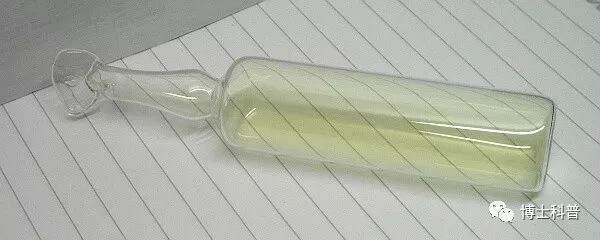
PhDSciNet's short answer: Elemental chlorine is chlorine gas (Cl2). It is a yellow-green, toxic gas with a strong, irritating smell. At one atmosphere, it has a melting point of -101.1°C and a boiling point of -33.4°C. Chlorine gas is denser than air and dissolves in water and alkaline solutions. It is readily compressed and can be liquefied into a yellow-green, oily liquid: liquid chlorine1. Chlorine has strong oxidizing power and can support combustion. Many reducing substances, such as various metals and hydrogen, can burn in chlorine. Adding chlorine to water can provide bleaching and disinfection.
Figure 1: Yellow-green chlorine gas.2
How Was Chlorine Discovered?
PhDSciNet's short answer: People had long isolated chlorine and produced chlorine gas, but were slow to recognize it as a chemical element. In the thirteenth century, people made aqua regia, which can dissolve gold; its decomposition produces a mixture containing chlorine gas. In 1774, the Swiss chemist Carl Wilhelm Scheele produced pure chlorine gas by reacting manganese dioxide with hydrochloric acid and studied its properties. Unfortunately, contemporary understanding held that acid radicals must contain oxygen atoms, so scientists, including Scheele, did not consider the resulting gas an elemental substance2. In 1809, scientists tried unsuccessfully to separate oxygen from this yellow-green gas. In 1810, Sir Humphry Davy announced that it was a newly discovered elemental substance and named it.
What Important Compounds Contain Chlorine?
PhDSciNet's short answer: Hydrochloric acid is an aqueous solution of hydrogen chloride (HCl), with many important applications in the chemical industry. It is used to pickle steel and as a reagent for the large-scale production of numerous inorganic and organic compounds, including vinyl chloride, the precursor to PVC plastic. It also has many smaller-scale uses, such as household cleaning, making gelatin and other food additives, removing scale, and processing leather3. Hypochlorous acid, chloric acid, perchloric acid and their salts each have their own uses.
There are also many organic chlorine compounds. Well-known pesticides such as hexachlorocyclohexane, DDT, chloropicrin, trichlorfon, dimethoate and Ceresan are all chlorine-containing organic compounds. Trichloromethane, commonly called chloroform, is a frequently used environmental disinfectant in hospitals. Carbon tetrachloride is a commonly used solvent and fire-extinguishing agent4.
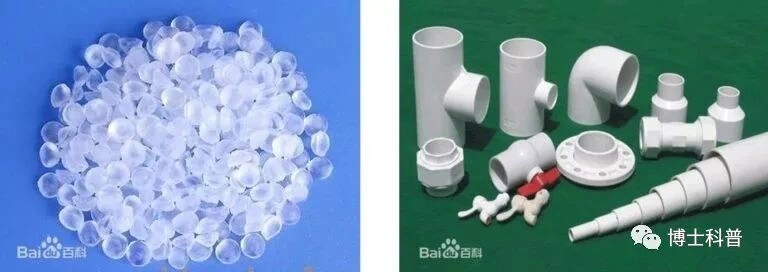
Polyvinyl chloride(PVC) is a polymer formed by polymerizing vinyl chloride monomers. It was once the world's most widely produced general-purpose plastic, with a very broad range of applications. PVC in its original form is slightly yellow, translucent and glossy; it is stable, resists corrosion by acids and alkalis, and is relatively heat-tolerant. The amounts of additives can be adjusted to change properties such as hardness and transparency. Although residual vinyl chloride monomer in PVC is carcinogenic, current manufacturing and processing technologies can reduce its residual concentration to meet health standards5.
Figure 2: Raw PVC resin (left) and PVC pipes (right).5
Chlorine and Life Processes
Chlorine is a macronutrient element. In humans and other organisms, it occurs as chloride ions (Cl–). Chloride ions are highly stable and seem not to participate directly in chemical reactions in living organisms. However, cells can rapidly move chloride ions through active transport, maintaining charge balance and regulating osmotic pressure and turgor pressure—the pressure exerted by intracellular water on the cell wall—to regulate water uptake by roots or the opening and closing of stomata, respectively. Chloride ions can also promote photosynthesis and certain enzyme-catalyzed reactions6.
*This article represents the author's personal views, not those of this website. Other media, websites or individuals reproducing material from this website must acknowledge its source and assume responsibility for copyright and other legal matters. Authors who do not wish their work to be reproduced, or who wish to discuss reproduction fees or related matters, should contact us.
References
1 Baidu Encyclopedia: Chlorine Gas
2 Chlorine, Wikipedia
3 Baidu Encyclopedia: Hydrochloric Acid
4Editorial group for The Story of the Chemical Elements. The Story of the Chemical Elements (Young People's Science Museum series). China Publishing Group, World Publishing Corporation. Kindle Edition.
5 Baidu Encyclopedia: Polyvinyl Chloride
6 Baidu Encyclopedia: Chlorine
Images from the matching WeChat article
The following images were recovered from the matching article retained by the WeChat account and restored in their original order.
Additional images were recovered from the matching article retained by the WeChat account and grouped after the main text. The historical archive text and existing editorial corrections are preserved.


