English translation of the original Chinese article. Publication dates and the extent of recovered text are preserved. Figures retain their original labels. Read the Chinese original.
Liquid Helium
—A Remarkable Quantum Liquid (Part II)
郑攀
Institute for Quantum Computing, University of Waterloo
Liquid helium, bosons, fermions, superfluidity
……Last time, we discussed the discovery of helium and its liquefaction. This time, let us hear the stories of helium-4 and helium-3…
Brothers with Very Different Characters
So far, we have been discussing one isotope of helium, helium-4 (4He). Its nucleus contains two protons and two neutrons, and the “4” corresponds to the total number of nucleons. Helium has another stable isotopic brother, helium-3 (3He), whose nucleus contains two protons and one neutron. Although they belong to the same family and neither decays, their relative abundances are enormously different. In nature, helium-3 is usually much rarer than helium-4, and its abundance depends on the sample's origin. This makes helium-3 even harder to obtain than already expensive helium-4.
Why emphasize the distinction between these two helium isotopes? Isotopes are commonplace among many elements. Apart from differences in physical properties such as radioactivity, half-life, magnetism and mass, different isotopes are often treated much the same. Separating them can sometimes be a formidable challenge. For example, separating fissile uranium-235 from uranium-238—uranium enrichment—requires advanced technology and substantial resources. For helium, however, a single neutron makes an enormous difference in physical properties. Helium-3 and helium-4 have entirely different phase diagrams at low temperatures (Figure 1), and their liquid forms obey different thermodynamic behavior. For example, the solid–liquid coexistence line, or melting curve, of helium-4 is monotonic, whereas helium-3's has a minimum at approximately 0.3 K.
Below 0.8 K, a mixture of liquid helium-3 and helium-4 can even spontaneously separate into two regions with different helium-3 concentrations. These are called the dilute phase—helium-4 containing a small amount of helium-3—and the concentrated phase, consisting almost entirely of helium-3. This spontaneous isotopic separation underlies the operation of dilution refrigerators, which achieve extremely low temperatures of 10 mK. A millikelvin is one thousandth of a kelvin. Dilution-refrigerator technology is now well established and is standard equipment in laboratories requiring ultralow temperatures.
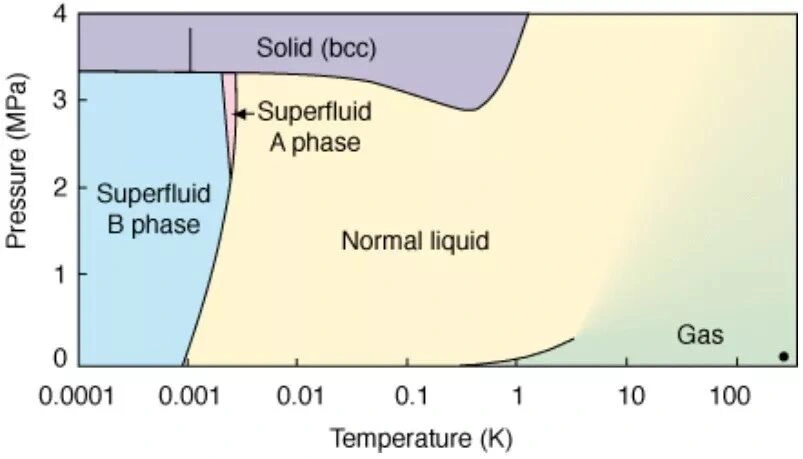
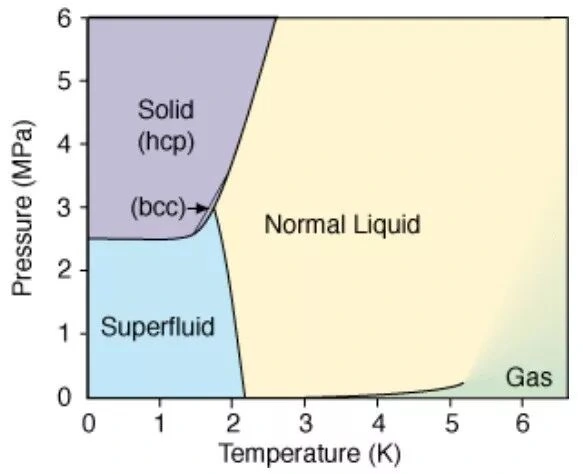
Figure 1: Pressure–temperature phase diagrams of helium-3 (top) and helium-4 (bottom).
Note the large difference in temperature ranges.
Image source: http://ltl.tkk.fi/research/theory/helium.html
The Difference of One Neutron
Why does a difference of one neutron produce such radically different physical properties? We need to consider quantum effects in microscopic particles. In quantum mechanics, electrons of the same kind, or photons, are identical particles: we cannot assign them observable individual identities as we would to two basketballs. Exchanging the labels of two identical particles does not change observable probabilities, but a many-particle wavefunction can either remain unchanged or change sign. Boson wavefunctions are symmetric under exchange; fermion wavefunctions are antisymmetric. These two exchange properties correspond to different quantum-statistical laws.
Particles with antisymmetric exchange behavior are called fermions. Examples include protons, neutrons and electrons, basic constituents of matter. Their statistics follow the Fermi–Dirac distribution. Antisymmetry leads to their most important property: they are constrained by the Pauli exclusion principle. Two identical fermions cannot simultaneously occupy the same quantum state, even though lowering the temperature favors occupation of the lowest-energy states.Imagine a tower with a rule: each room represents a complete single-particle quantum state, including spin. A room must be either empty or occupied by only one person, even if everyone wants the convenience of living on the first floor. Let us call this the “tower rule.”.
Particles with symmetric exchange behavior are called bosons. Examples include photons, gluons and Z bosons, which mediate interactions. Their statistics follow the Bose–Einstein distribution. Symmetry means bosons are not constrained by the Pauli exclusion principle, so when temperature falls they can all move into lower-energy states.Imagine another tower without that special rule. Any number of bosons can occupy the same quantum state, just as several people can share a room. When many people do not want to climb the stairs, they can all occupy the ground-floor hall. We may call this the “hall rule.”.
Besides elementary particles, their composite objects can also be either fermions or bosons. This resembles the difference between odd and even numbers: the sum of an odd number of odd numbers is odd, that of an even number of odd numbers is even, and any sum of even numbers is even. A composite containing an odd number of fermions is a fermion; one containing an even number is a boson. Thus, one neutron makes helium-3 atoms fermions and helium-4 atoms bosons. They obey the contrasting “tower rule” and “hall rule,” producing different physical properties.
Any two isotopes differing by one neutron belong to different categories—boson and fermion. At sufficiently high temperatures, however, both occupy different floors sparsely, making their differences inconspicuous. Only at sufficiently low temperatures do the “tower rule” and “hall rule” reveal their contrast. Most elements have already condensed and solidified before this difference becomes apparent, as if the tower itself had disappeared. At low pressures, such as saturated vapor pressure, strong zero-point motion allows helium-3 and helium-4 to remain liquid even at extremely low temperatures, revealing differences caused by quantum statistics. Applying sufficient pressure can still solidify helium.
Helium-4: An Early Arrival in the Spotlight
Helium, whether used directly as a coolant or as the working substance of a dilution refrigerator, provides experimental conditions for many low-temperature studies. Its extraordinary and distinctive low-temperature properties also make helium itself a subject of fundamental research and physicists' curiosity. To understand this story, we must return to the history of efforts to obtain solid helium after successful liquefaction.
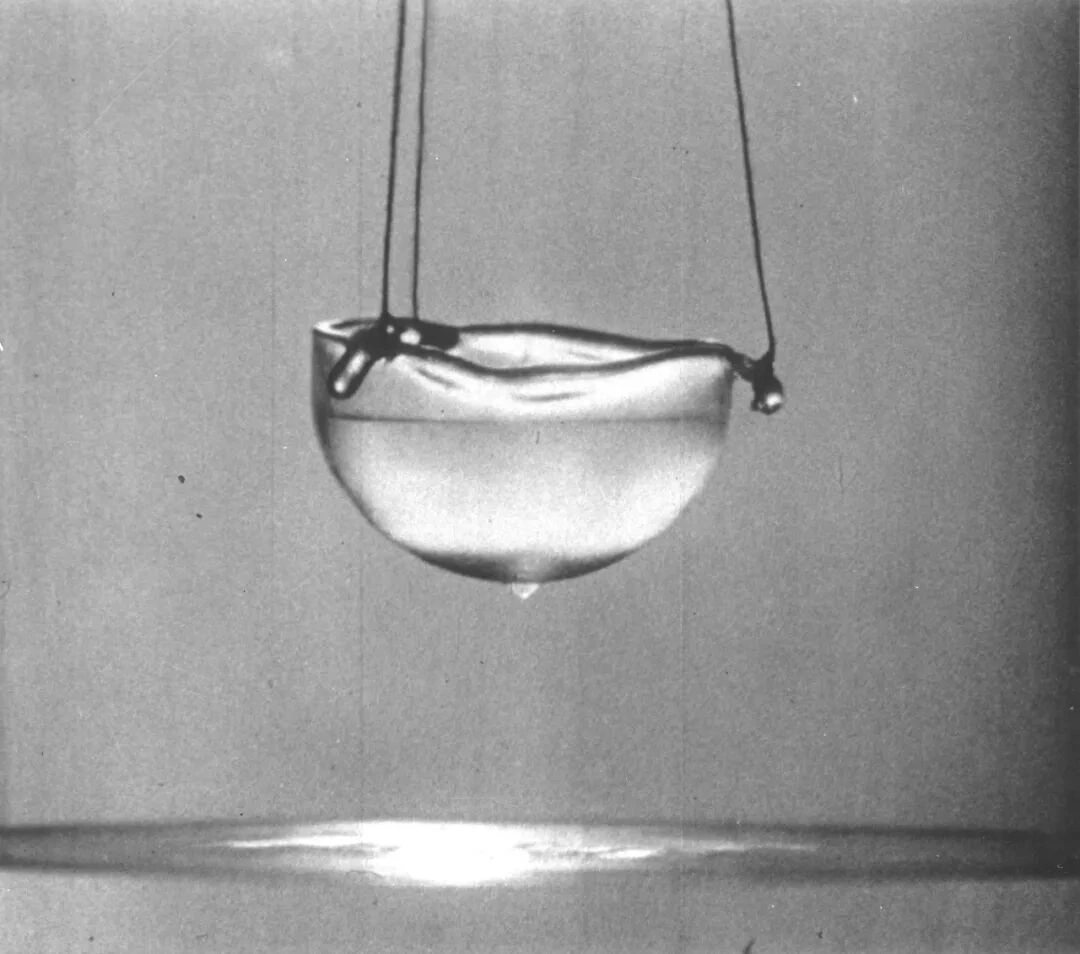
As mentioned earlier, researchers at the time did not recognize the need to increase pressure. They tried only to lower the saturated vapor pressure of helium-4 gas to reduce the liquid's temperature. Yet this mistaken direction opened another door to a wholly new field. During evaporative cooling, researchers found that below 2.2 K, liquid helium-4 displayed unprecedented behavior.A vigorously boiling liquid suddenly became calm, and its specific heat peaked at this characteristic temperature. If the liquid helium was placed in a suspended vessel, droplets continually fell from the vessel's underside until all the helium had disappeared, as though the vessel were leaking (Figure 2). If passed into a capillary, it could flow through without obstruction. Researchers did not immediately realize they had obtained an entirely new state of matter—a superfluid, a quantum liquid with a component that flows without viscosity.
Figure 2: Superfluid helium-4. The small droplet beneath the glass vessel forms as liquid in the vessel climbs over its rim and flows downward.
What happens around 2.2 K to cause the superfluid transition? Helium-4's transition is associated with Bose statistics and macroscopic quantum coherence, but strongly interacting liquid helium is not an ideal, noninteracting Bose gas. In the two-fluid model, its motion can be separated into a superfluid component and a normal component. The superfluid component has no viscosity or entropy; the normal component carries entropy. These describe collective responses of the same liquid, not a mixture of two different kinds of atoms. In particular, the superfluid fraction must not be equated with the condensate fraction occupying the lowest single-particle state. In liquid helium-4 at saturated vapor pressure below 1 K, the condensate fraction is about 7.5%, not “almost all the atoms falling into the same lowest state.”
The superfluid component's special flow properties help explain the phenomena described above. On the one hand, helium II transfers heat efficiently, with the normal and superfluid components capable of counterflow. This heat transfer cannot simply be attributed to the entire liquid having “absolutely no viscosity.” On the other hand, the superfluid component can flow along the liquid film wetting a vessel, allowing liquid to pass over its rim. Conditions such as exceeding a critical velocity can still generate vortices and dissipation; not every flow is without resistance. As temperature falls, the superfluid-density fraction increases and approaches 1 near absolute zero. This still does not mean that the single-particle condensate fraction also approaches 1. The Soviet physicist Kapitsa received the 1978 Nobel Prize in Physics for inventions and discoveries in low-temperature physics. Landau received the 1962 Nobel Prize in Physics for theoretical work on condensed matter, particularly liquid helium.
Bose–Einstein condensation (BEC) occurs in bosonic systems other than helium-4. Dilute gases of cold alkali-metal atoms, for example, can also undergo BEC at extremely low temperatures. Scientists confined a cloud of 87Rb atoms—each with 37 protons, 50 neutrons and 37 electrons, making it a composite boson of 124 fermions—in a magnetic potential trap. Laser cooling and evaporative cooling lowered the small cloud of rubidium atoms into the submicrokelvin range. 1 µK is one millionth of a kelvin. A macroscopic number of atoms then occupied the same quantum state: the “hall rule” had taken effect. Cold-atom research led to two Nobel Prizes in Physics. The Americans Steven Chu and William Phillips and the French physicist Claude Cohen-Tannoudji received the 1997 prize for developing laser cooling. Four years later, the Americans Eric Cornell and Carl Wieman and the German physicist Wolfgang Ketterle received the 2001 prize for experimentally realizing Bose–Einstein condensation in cold alkali atoms and related developments.
*This article represents the author's personal views, not those of this website. Other media, websites or individuals reproducing material from this website must acknowledge its source and assume responsibility for copyright and other legal matters. Authors who do not wish their work to be reproduced, or who wish to discuss reproduction fees or related matters, should contact us.
About the Author郑攀
Hello everyone! I am 郑攀 from the PhDSciNet team:
Workplace: Institute for Quantum Computing, University of Waterloo, Canada; postdoctoral researcher.
Research area: Experimental development of quantum-computing processors, specifically an error-correctable logical qubit using two three-dimensional superconducting microwave cavities with the same resonance frequency.
Thoughts on Science Communication: Science communication bridges frontier research and the general public. It can also inspire more young people to become interested in scientific research and pursue it. I have long gained scientific nourishment from many popular-science articles. As a researcher, I also feel a responsibility to introduce the research I know to the public, dispelling its sense of mystery and allowing more interested people to get close to the latest scientific advances..
References
[1] 冯端, 冯少彤. Tracing Origins and Exploring Mysteries: The World of Entropy. Science Press, Beijing, 2005.
[2] 章立源. Beyond Freedom: Remarkable Superconductors. Science Press, Beijing, 2005.
[3] A. M. Guénault, Basic Superfluids, Taylor & Francis,London and New York, 2003.
[4] T. M. Flynn, Cryogenic Engineering, Marcel Dekker,New York, 2005.
[5] F. Pobell, Matter and Methods at Low Temperatures,Springer, Berlin, 2007.
[6] E.R. Dobbs, Helium Three, Oxford, NewYork, 2000.
[7] D.Vollhardt and P. Wölfle, The SuperfluidPhases of Helium 3, Taylor & Francis, London, 1990.
[8] M.Tinkham, Introduction toSuperconductivity, 2nd ed, McGraw-Hill Book, 1996.
[9] M.R. Norman, The Challenge of Unconventional Superconductivity. Science, 332,196 (2011).
[10] T.Mizushima, Y. Tsutsumi, T. Kawakami, M. Sato, M. Ichioka and K. Machida,Symmetry-Protected Topological Superfluids and Superconductors – From the Basicto 3He. J. Phys. Soc. Jpn.,85,022001 (2016).
[11] Y.Okuda and R. Nomura, Surface Andreev bound states of superfluid 3Heand Majorana fermions. J. Phys.: Condens.Matter, 24, 343201 (2012).
[12] Theofficial website of the Nobel Prize. https://www.nobelprize.org/nobel_prizes/physics/
Editorial Note: October 10, 2026
Correction on 2026-10-10: revised the wording on exchange symmetry of identical particles, distinguished the superfluid fraction from the single-particle condensate fraction, and clarified the two-fluid model and critical flow velocity. Corrected the rubidium isotope symbol from 87Ru to 87Rb and replaced “eutectic line” with “solid–liquid coexistence line.” Removed an unverified fixed abundance for cosmic helium-3. The isotope story, main-text figures and references are retained.
Additional References
- MIT: Introductory Quantum Mechanics I, Section 11(Exchange of identical particles, symmetric and antisymmetric wavefunctions, and helium-3/helium-4 statistics)
- NIST: Liquid helium pumps, NBSIR 73-316(The two-fluid model of liquid helium, superfluid and normal components, and dissipation at finite flow velocities)
- NIST: The Momentum Distribution of Liquid 4He(A condensate fraction of approximately 7.5% at saturated vapor pressure below 1K; the condensate fraction is not the same as the superfluid fraction)
- NIST: Atomic Data for Rubidium (Rb)(Rubidium's symbol Rb, atomic number 37, and the 87Rb isotope)
- Nobel Prize 2001: The first rubidium condensate(Cold-atom BEC experiments with 87Rb and the history of the Nobel Prize)
- Nobel Prize 1978: Press release(Kapitsa's contributions to low-temperature physics and the historical scope of Landau's prize for liquid-helium theory)
The text was recovered from the matching article retained by the WeChat account, with the original site's publication record preserved. The old WeChat promotional layout has been removed, and available original illustrations have been restored.
Editorial note: Correction on 2026-10-10: revised the wording on exchange symmetry of identical particles, distinguished the superfluid fraction from the single-particle condensate fraction, and clarified the two-fluid model and critical flow velocity. Corrected the rubidium isotope symbol from 87Ru to 87Rb and replaced “eutectic line” with “solid–liquid coexistence line.” Removed an unverified fixed abundance for cosmic helium-3. The isotope story, main-text figures and references are retained.