English translation of the original Chinese article. Publication dates and the extent of recovered text are preserved. Figures retain their original labels. Read the Chinese original.

Institute of Mechanics, Chinese Academy of Sciences
Keywords: lasers
The laser was a major invention of the twentieth century, called the “fastest knife,” the “most precise ruler” and the “brightest light”[1]. The English name LASER is an acronym for “light amplification by stimulated emission of radiation,” describing the principle by which laser light is produced. Let us explore how this happens.
The Theoretical Foundation of Lasers
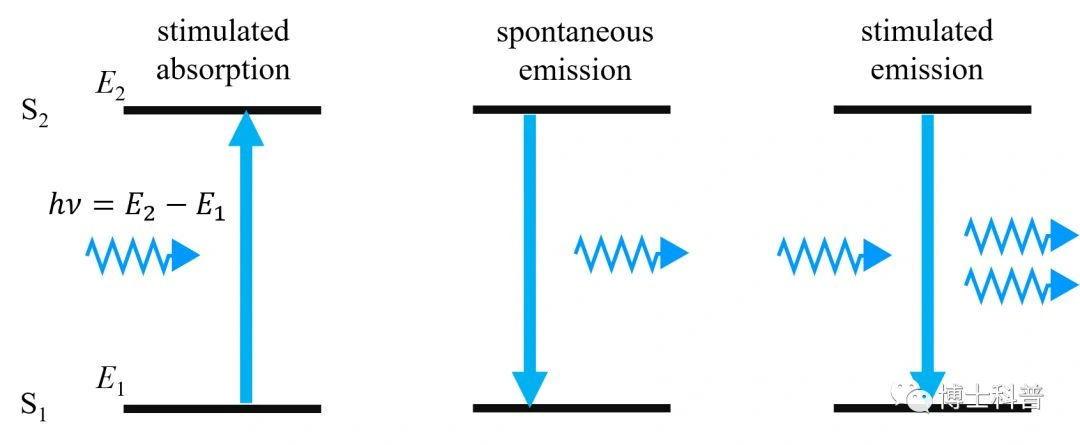
The theory of stimulated emission provides the basis for laser generation. Einstein proposed it in 1917. Figure 1 shows two energy levels in a laser gain medium, S1 and S2, corresponding to the lower and upper states of the laser transition. The energy difference between them, E2–E1, equals hν—Planck's constant multiplied by the frequency of the light. When a system is in energy level S1 and is illuminated by a photon with energy hν, there is a certain probability that it will absorb the photon and move to level S2. This process is called stimulated absorption. When the system is in level S2, there is a certain probability that it will move to level S1 and emit a fluorescence photon, hν. This process is called spontaneous emission. If the system is in energy level S2 and is illuminated by hν, it has a certain probability of emitting another photon with the same frequency and phase1 as the incident photon, and traveling in the same direction. This process is called stimulated emission.
Figure 1: Schematic of a two-level system interacting with photons.
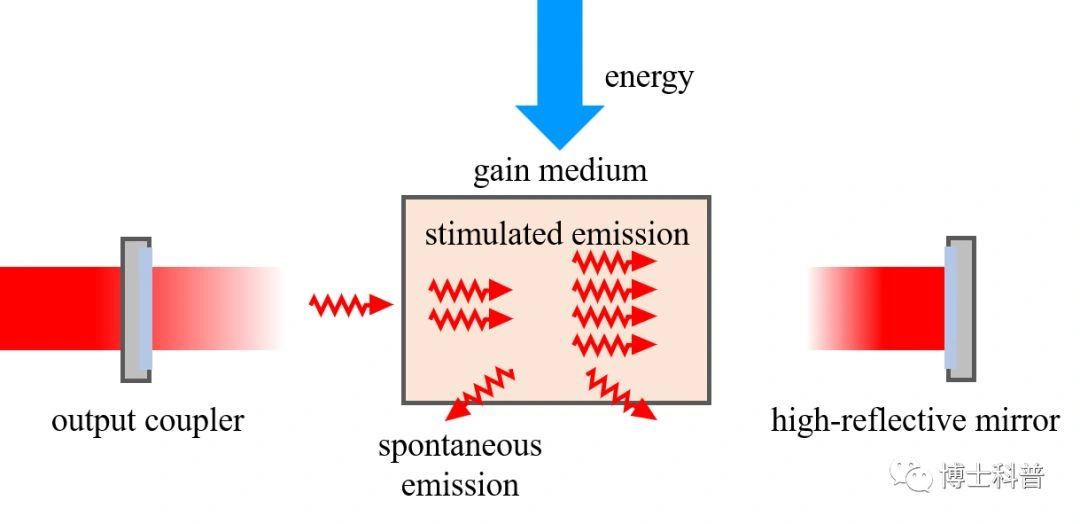
If a gain medium containing many molecules in energy level S2 is placed between two opposing parallel mirrors (Figure 2), some fluorescence photons traveling perpendicular to the mirrors can be amplified through stimulated emission. Self-sustaining oscillation develops, producing laser light. The optical component on the left of this resonator is called the output coupler. It is effectively a reflecting surface with a certain transmission, providing the outlet for laser light inside the cavity.
Figure 2: Schematic of a laser resonator in operation.
The Key to Producing Laser Light
Although the underlying theory had long been published, the world's first laser was not built until 1960. The difficulty was the lack of an effective way to inject energy into the levels involved in stimulated emission. Under ordinary conditions, stimulated emission is extremely weak and may be difficult even to observe, let alone use to generate laser light. In thermal equilibrium, molecular populations among energy levels follow a Boltzmann distribution. The particle population in the lower state S1, N1, is much larger than that in the upper state S2, N2. Absorption of hν photons greatly exceeds stimulated emission, preventing macroscopic amplification of the optical signal.
The key to producing laser light is population inversion, so that N2>N1. Lasers require an appropriate excitation, or pumping, method to achieve population inversion between particular energy levels. Pumping methods include optical pumping for Nd: YAG (neodymium-doped yttrium aluminum garnet), Ti: Sapphire (titanium-doped sapphire) and dye lasers, and discharge pumping for HeNe (helium–neon) and excimer lasers.
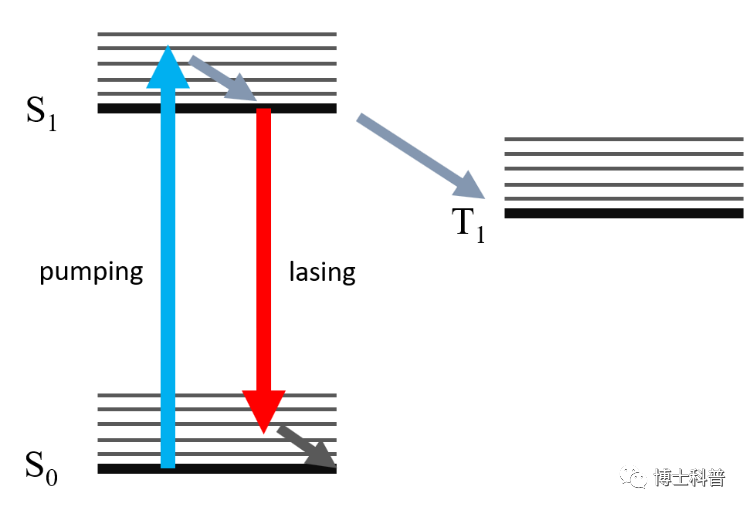
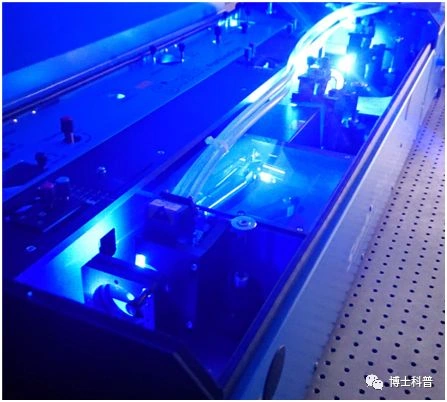
Let us use a dye laser to illustrate how population inversion is achieved. Its gain medium is a solution of an organic dye. Common dyes include coumarin for blue and violet wavelengths and rhodamine for red and yellow wavelengths. As Figure 3 shows, laser transitions in organic dyes occur mainly between the singlet bands S0 and S1. Each band contains many rotational and vibrational levels. Collision broadening in solution allows these bands to be treated as continuous. During laser generation, pumping light excites dye molecules from the lowest level of the S0 band into the S1 band. They rapidly undergo a nonradiative transition to the lowest level of S1, the upper state of the laser transition. During that transition, the molecule falls to a particular level in the S0 band and emits a photon, then rapidly drops to the lowest level of the S0 band. Because the upper laser state S2 has a relatively long lifetime, whereas S1 has a very short lifetime, and pumping excites many molecules into the upper state S2, population inversion is achieved. While lasing occurs, some dye molecules in the S1 band undergo intersystem crossing into the longer-lived triplet system T1, leaving the laser-transition cycle and reducing efficiency. Dye solution must therefore be circulated during operation. Figure 4 shows a dye laser in use, with the tubing of its circulation system visible.
Figure 3: Energy-level diagram of a dye laser.
Figure 4: A dye laser in operation.
The Wavelength of Laser Light
Many lasers have good monochromaticity: their output has a narrow spectral bandwidth. Several factors determine whether the output spectrum is narrow. First, the gain medium and pumping method determine which wavelengths can be amplified. Gain media with sparse energy levels and narrow energy distributions, such as those in gas, excimer and Nd: YAG lasers, naturally produce narrow linewidths.
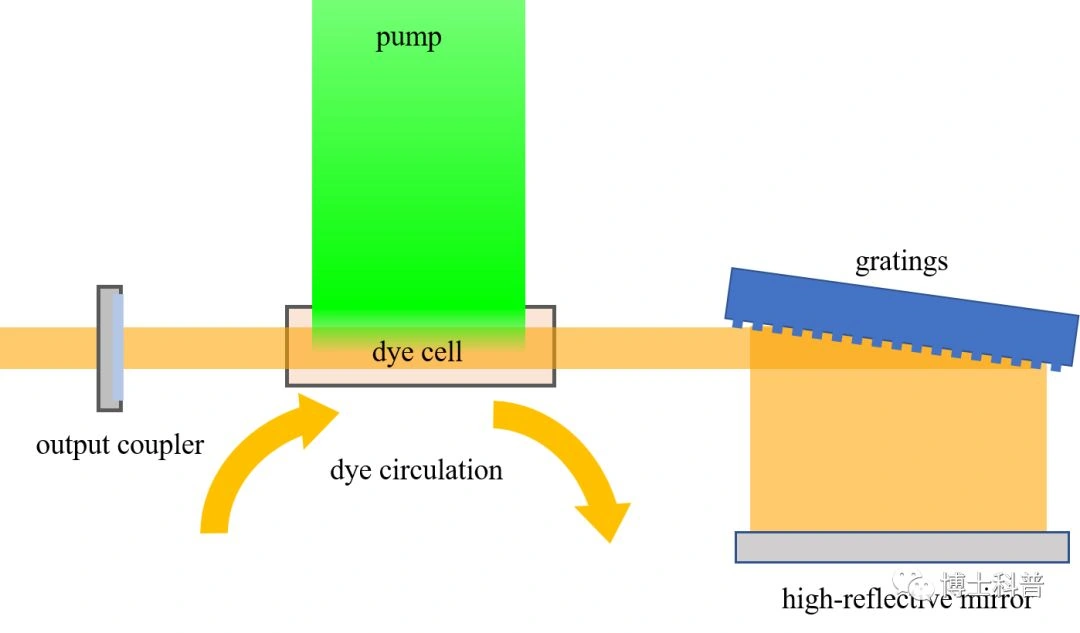
Monochromaticity can also be adjusted through the resonator. Laser dyes and Ti: Sapphire crystals have broad energy levels and operating wavelength ranges spanning tens of nanometers. To generate highly monochromatic light, the cavity must attenuate different spectral components selectively, amplifying a chosen component. Figure 5 shows a dye-laser resonator. Dye solution is held in a transparent dye cell within the laser beam path, and pumping light illuminates it perpendicular to the cavity's optical path. Wavelength tuning is achieved through dispersive optics inside the cavity. The dye-laser resonator contains a 3000 g/mm grating. When cavity light strikes the grating, different wavelengths leave at different angles. Only light at a particular wavelength, with a bandwidth of about 2 pm, returning along the perpendicular direction can oscillate in the cavity and produce laser light. Rotating the grating selects the laser wavelength.
Figure 5: Schematic of a dye-laser resonator.
The output wavelength can also be adjusted by injecting seed light. Its spectral bandwidth is usually narrower than the cavity's operating wavelength band. During emission, different frequency components compete with one another. Early in laser generation, the seed has much more energy than other wavelengths, so it takes up most of the energy in the gain medium and suppresses amplification of nonseed components. A highly monochromatic seed can reduce the bandwidth of the cavity's output.
1How can we understand phase? Consider marching drills: to make the formation look orderly, each participant must have the same speed, direction and stepping frequency, while leg and arm movements must also be synchronized. This synchronization corresponds to having the same phase.
*This article represents the author's personal views, not those of this website. Other media, websites or individuals reproducing material from this website must acknowledge its source and assume responsibility for copyright and other legal matters. Authors who do not wish their work to be reproduced, or who wish to discuss reproduction fees or related matters, should contact us.
References:
[1] Baidu Encyclopedia: Laser
Images from the matching WeChat article
The following images were recovered from the matching article retained by the WeChat account and restored in their original order.
The text was recovered from a public archive of the original site's RSS feed. The first schematic was restored using the original site's actual thumbnail; other original images are still missing. Additional images were recovered from the matching article retained by the WeChat account and grouped after the main text. The historical archive text and existing editorial corrections are preserved.