Historical compilation: This article preserves the scientific biography in the original manuscript. The English material is credited to Famous Scientists. No named author or translator could be verified from the export, and the original publication date remains unverified.
This father and son were a legendary pair in Nobel Prize history!
In 1896, six-year-old Lawrence Bragg fell from a tricycle while playing and badly injured his left elbow. Doctors nearly gave up on treating it. His devoted father, Henry Bragg, used homemade X-ray equipment to take an image of the fracture and help the doctors treat his son. This was young Lawrence Bragg's first encounter with X-rays, beginning a lifelong connection.
In 1906, sixteen-year-old Lawrence Bragg entered the University of Adelaide, where his father taught, to study mathematics and physics. The father and son worked together on X-ray range research. In 1912, Lawrence and Henry Bragg established a new field: analyzing crystal structures with X-rays. The application of this technique laid a foundation for discovering the DNA double helix.
In 1915, Lawrence Bragg, just twenty-five years old, shared that year's Nobel Prize in Physics with his father, Henry Bragg!
An X-ray Image of a Fracture
William Lawrence Bragg was born on March 31, 1890 in Adelaide, capital of the British colony of South Australia.
His father was William Henry Bragg, Professor of Mathematics and Physics at the University of Adelaide. His mother was Gwendoline Todd, an accomplished watercolor artist. They enrolled him in a convent school at the age of five.
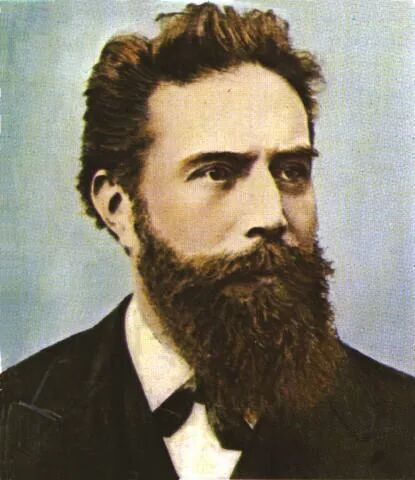
In late 1895 Wilhelm Röntgen in Würzburg, Germany stumbled upon an incredible new phenomenon – X-rays. In January 1896 news of the discovery began spreading in the popular press.
Soon after Röntgen’s announcement, six-year-old Lawrence had his very first encounter with the mysterious rays, the same rays that 19 years later would bring him the Nobel Prize in Physics.
Lawrence’s father was fascinated by Röntgen’s work and built his own X-ray equipment; he used it to take Australia’s first X-ray photographs. Shortly after his father built the equipment, Lawrence broke his elbow falling from his tricycle. His father took an X-ray photograph of the broken elbow to help doctors treat his son. This was one of the first medical X-rays taken in Australia.
In 1901, just before reaching his eleventh birthday, he started high school at St Peter’s College, Adelaide. The school followed a mainly classical curriculum of English, French, Latin, and Greek literature. Lawrence also studied Mathematics and Chemistry.
Lawrence was so far ahead of other students, particularly in Mathematics and Chemistry, that he was quickly placed into senior classes. He completed high school aged 15.
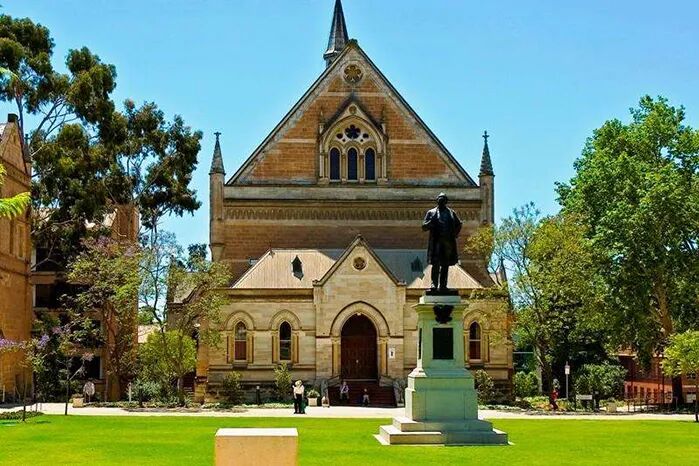
Early in 1906 he began studying Mathematics, Physics, and Chemistry at the University of Adelaide. He graduated at age 18 with a Bachelor’s degree in Mathematics with first-class honors.
Despite his remarkable academic successes, high school and university were unhappy times for Lawrence Bragg. He was so much younger than his fellow students that he always felt like an outsider. For the rest of his life he would be a reserved, private man, often preferring his own company to that of others.
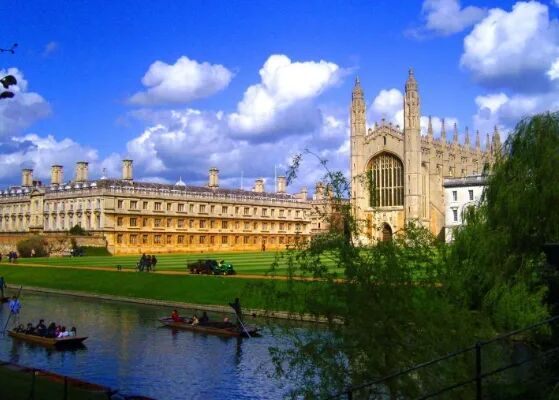
In 1909, aged 19, Bragg began studying for a Mathematics degree at the University of Cambridge. In fact, his whole family had moved to England because his father had been appointed Cavendish Chair of Physics at the University of Leeds.
Slowly Bragg began making friends at Cambridge: for the first time in his life he felt he was moving among kindred spirits. Heeding the advice of his father, he decided to major in Physics rather than Mathematics.
In 1911, aged 21, Lawrence graduated with a first class honors degree in Physics.
The Discovery of the Law of X-ray Diffraction
Upon completing his degree, Bragg became a graduate student in J. J. Thomson’s laboratory at Cambridge.
In 1912, aged just 22, he made a momentous discovery that became known as Bragg’s law of X-ray diffraction.
Earlier in the same year Max von Laue in Munich had discovered that X-rays can be diffracted by crystals, and were therefore waves; he would receive the 1914 Nobel Prize in Physics for this discovery. Prior to Laue’s work, many scientists – including Lawrence Bragg’s father – believed X-rays were particles and could not be diffracted.
Diffraction happens when a wave, such as an X-ray, meets an obstacle or gap. The wave bends around the corners of the obstacle or gap. Diffraction is particularly noticeable if the size of the obstacle and the wave’s wavelength are similar. In the case of Laue’s work, the atoms in the crystal had similar spacings to the wavelengths of the X-rays.
If a wave meets obstacles whose spacing is similar to the wave’s wavelength, an interference pattern can be produced. Interference patterns contain areas where the diffracted waves have reinforced one another and others where they have canceled one another. Reinforcement is called constructive interference. Canceling is called destructive interference.
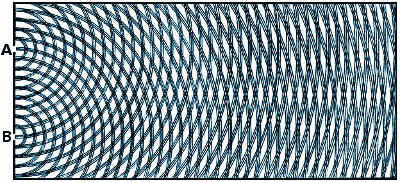
In the image above, it would be possible to deduce the exact spacing between A and B by analyzing the interference pattern.
Lawrence Bragg scrutinized Laue’s X-ray diffraction paper. Although still only a young graduate student, he drew the bold conclusion that Laue had misunderstood both the X-rays’ properties and the likely arrangement of atoms in crystals.
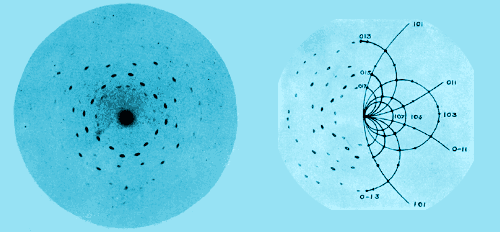
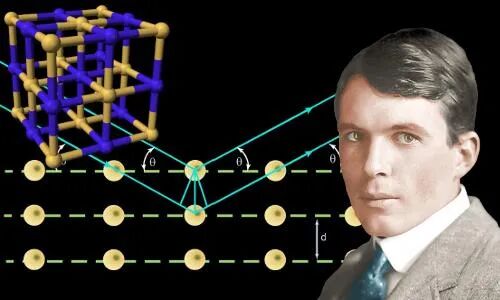
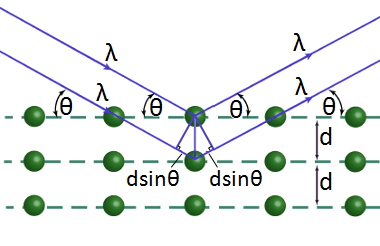
In a masterstroke that dramatically simplified analysis, Bragg realized that Laue’s diffraction photo was the interference pattern of reflections from flat sheets of atoms within the crystal. This revelation came to him as he walked alone one day along the banks of Cambridge’s River Cam. Waves reflecting from sheets of atoms at different depths in the crystal interfere with one another, leading to the diffraction pattern.
Bragg’s Law is:

The dark spots on Laue’s photo show where constructive interference has taken place. Bragg deduced that this happens when the distance d equals an integer multiple n of the X-ray’s wavelength.
Thus Bragg now had a method for finding d, the exact distance between atoms in crystals. Taking X-ray diffraction photos of a crystal from different positions would allow the full structure of the crystal to be found.
This was one of the most crucial breakthroughs in the history of science. For the first time ever scientists could now potentially see what a substance looks like on the scale of its atoms, enabling them to build 3D models of the substance’s atomic structure.
Bragg’s father was very impressed by his son’s work and began experiments in Leeds, which his son participated in, to make the first determinations of crystal structures.
Even today, over a century after the Braggs’ pioneering work, X-ray crystallography, albeit with more sophisticated equipment and computational methods, is still by a huge margin the method of choice for determining the atomic structure of solid materials.
A Father and Son Sharing a Nobel Prize
The Braggs – father and son – shared the 1915 Nobel Prize in Physics for their work. Lawrence Bragg remains the youngest ever winner of a science prize – he received it aged 25 for work he carried out aged 22.
Lawrence served in the British Army in World War 1, winning the Military Cross for gallantry. During the war he carried out field research to discover the location of enemy artillery by sound ranging.
In 1938 Lawrence Bragg succeeded the recently deceased Ernest Rutherford to the Cavendish Chair of Physics at Cambridge. During Bragg’s early years in this role, World War 2 disrupted the normal work of the laboratory.
When the war ended Bragg made X-ray crystallography one of the Cavendish laboratory’s priorities, beginning a major study of protein structure in 1948.
In 1954, aged 64, Bragg left Cambridge for London, where he became director of the Royal Institution and director of the Davy-Faraday Research Laboratory.
William Lawrence Bragg died aged 81 on July 1, 1970 in Ipswich, England. He was buried in the chapel of Trinity College, Cambridge.

Lawrence Bragg and his father Henry created a memorable episode in Nobel Prize history. At just twenty-five, Lawrence became the youngest Nobel laureate in physics ever!
Behind that fame were rumors that troubled him for much of his life. Claims that he had benefited from his father's status or did not deserve his position left Lawrence in his father's shadow. Many people marveled at his prominent family and early fame, without seeing his consistent perseverance and effort.
Fortunately, the young Nobel laureate remained true to his purpose and was not deterred by gossip. The honors he won in youth did not stop him from moving forward. Lawrence Bragg remained devoted to research, loved art, and enjoyed life, persistently pursuing his goals. The far shore of your dreams lies in the direction in which you keep running!
Original source:
https://www.famousscientists.org/lawrence-bragg/
Source: Famous Scientists
Some material in this article comes from the internet. Please contact us for removal if it infringes your rights.
Editorial note
Editorial note: Bragg's record as the youngest laureate applies to the Nobel Prize in Physics. The broader wording 'youngest Nobel laureate' in the title and Chinese text has been corrected accordingly. The original English account concerning a science prize and the rest of his life story are retained.
Supporting references
Nobel: Facts on the Physics Prize
Sources and editorial history
Restored from a complete historical article exported from the PhDSciNet Official Account.
Editorial revision: Editorial note: Bragg's record as the youngest laureate applies to the Nobel Prize in Physics. The broader wording 'youngest Nobel laureate' in the title and Chinese text has been corrected accordingly. The original English account concerning a science prize and the rest of his life story are retained.