
Historical compilation: This article preserves the scientific biography in the original manuscript. The English material is credited to Famous Scientists. No named author or translator could be verified from the export, and the original publication date remains unverified.
One hundred and three years ago, chemistry and materials science underwent a revolutionary change.
On June 12, 1920, an organic chemist at ETH Zurich published a paper that permanently changed our understanding of chemistry and decisively influenced materials synthesis: On Polymerization (Über Polymerisation). It first proposed that small molecules could be linked by covalent bonds to form long macromolecular chains.
In 1936, the chemist made this prediction: in the near future, a method for making artificial fibers from synthetic substances would no longer seem fanciful, because natural fibers owe their mechanical properties and elasticity to their structure—numerous long-chain molecules.
A century later, just as the prediction suggested, the achievements of polymer chemistry have penetrated every aspect of human life and become inseparable from production and everyday living.
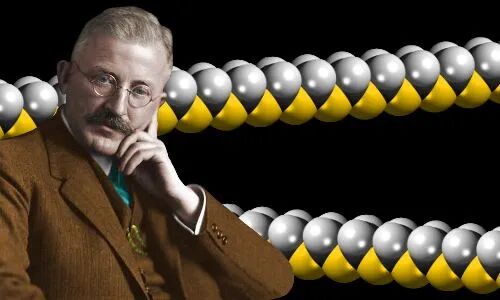
In 1953, German chemist Hermann Staudinger, who had proposed this creative theory, was awarded that year's Nobel Prize in Chemistry for pioneering the field of macromolecular chemistry!
A Legendary Figure in Chemistry
Hermann Staudinger was born on March 23, 1881 in the German city of Worms.
His father was Franz Staudinger, a grammar school teacher, philosopher, and socialist. His mother was Auguste Wenck, active in campaigning for women’s rights.
In 1899, at age 18, Hermann graduated from the Grand Ducal High School in Worms. A lover of the natural world, he planned to study botany at college, but one of his teachers persuaded him to study chemistry instead, arguing that all biology was based on chemistry.
Four years later, in 1903, Hermann Staudinger graduated from the University of Halle with a doctorate in chemistry for his investigations of organic chemical reactions.

In 1903, Staudinger moved to the University of Strasbourg to carry out postdoctoral research as an organic chemist. In 1905, he discovered diphenylketene, the first ketene. In spring 1907, age 26, he qualified as a university lecturer by passing further examinations.
In 1907, Staudinger became an assistant professor of chemistry at Karlsruhe’s Technical High School.
In 1912, age 31, he moved to Switzerland as Chair of General Chemistry at the Technical High School of Zurich. Here he began diverting his research focus away from classical organic chemistry into macromolecules. Nobody knew if macromolecules actually existed.
In 1914, when World War 1 broke out, Staudinger did not return to Germany. As a pacifist, he refused to carry out war-related research work for Germany.
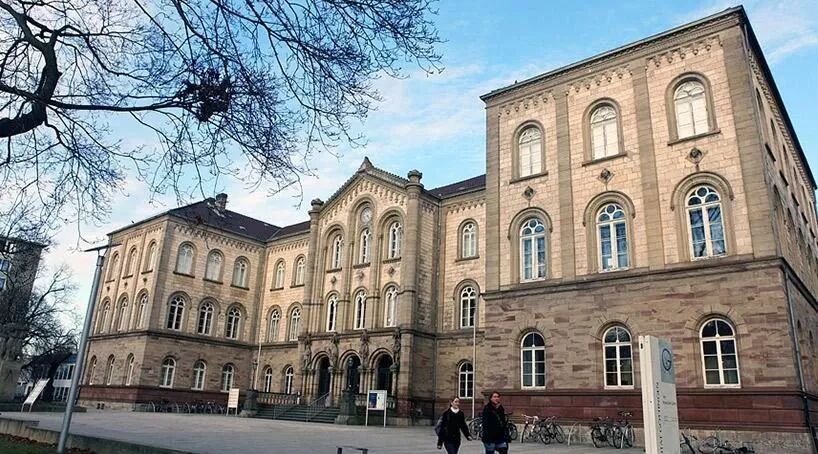
In 1926, he returned to Germany as director of the Chemical Laboratory at the University of Freiburg. Some of the faculty opposed his appointment, objecting to his pacifism in World War 1.
In 1940, he founded Freiburg’s Institute of Macromolecular Chemistry.
In 1943, he founded the first journal of polymer chemistry, Journal für Makromolekulare Chemie.
Macromolecules That 'Should Not Exist'
The idea that small, unsaturated molecules could react together to create larger molecular chains was not Staudinger’s.

In 1863, Marcellin Berthelot used the word ‘polymer’ to describe larger chains formed by the reaction of smaller molecules and proposed the general principle that unsaturated compounds could react with one another to form polymers.

In 1869, Berthelot described his polymerization experiments on molecules such as ethene, propene, and pentene. Starting with these lower boiling point hydrocarbons, and using a catalyst such as sulfuric acid to push the reaction along, he produced higher boiling point hydrocarbons.
Starting with ethylene, whose boiling point is −103.7 °C, Berthelot produced a mixture of hydrocarbons with a boiling range of 280-300 °C. This boiling range indicated the products had about 16 carbons per molecule compared with ethylene’s 2 carbons per molecule. Berthelot described his product as polyethylene.
Berthelot’s early experiments showed it was possible to increase the length of the carbon chain from 2 to 16, with an average of 8 ethylene molecules reacting to form a larger hydrocarbon molecule.

Later workers found they could produce higher molecular weight hydrocarbons with longer chains. Reaction conditions can be found so that n is a large number and the product is polyethylene.

In 1920, in his famous paper Über Polymerisation, Staudinger stated that substances such as polystyrene, polyvinylchlorides, and rubber, were composed of polymer chains with very high molecular weights. Each chain in these ‘high polymers’ could contain over 100,000 atoms. He said the bonds within these chains were exclusively covalent.
The scientific consensus at the time was that Staudinger’s claims of 100,000 atoms in polymer chains were absurd.
In 1922, Staudinger coined the word macromolecule to describe natural, long-chained polymeric substances such as rubber, cellulose, and proteins.
While Staudinger promoted the concept of macromolecules, most chemists continued to believe it was impossible for such molecules to exist.
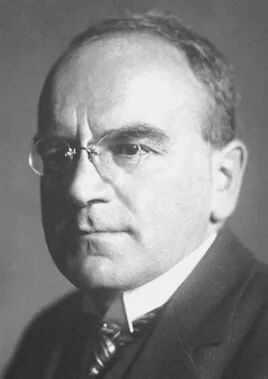
When Staudinger took over at Freiberg in 1926, the previous director, Heinrich Otto Wieland, soon to be awarded the Nobel Prize in Chemistry (1927), told him: “Dear colleague, abandon your idea of large molecules; organic molecules with molecular weights exceeding 5,000 do not exist. Purify your products such as rubber, they will crystallize and turn out to be low molecular weight compounds.”
A Revolution in Chemistry
At Freiburg, Staudinger focused all his energy on polymers. The tide began to turn in his favor as chemists increasingly saw that Staudinger’s experimental evidence and their own experimental results were better explained by the existence of high molecular weight polymers than the behavior of colloids of low molecular weight polymers.
Staudinger’s discovery of polyoxymethylene and his proof in 1927 that its crystallographic unit cell was much smaller than its polymer chain were crucial milestones.
In 1927, Staudinger and Gustav Mie proved that polymers made in the laboratory could yield fibers similar to natural fibers. Until then scientists believed that only Nature in the shape of plants (e.g. cotton and flax) and animals (e.g. wool and silk) could make fibers. Staudinger’s discovery paved the way for the discovery of nylon – the first synthetic fiber – by Wallace Carothers in 1935.
“The only difference between macromolecules and the small molecules of low molecular substances is one of structural size.”—Hermann Staudinger

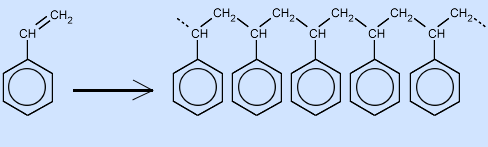
A macromolecule, also often known as a polymer molecule, is made by linking together molecules of smaller substances into a long, chemically bonded chain. For example, styrene molecules can react together to form polystyrene:Large numbers of individual styrene molecules react together in a polymerization reaction to form giant chain molecules of polystyrene.
A macromolecule:
·may be a natural molecule – for example DNA or protein. All life on Earth is based on natural macromolecules.
·may be a synthetic molecule – for example nylon or polypropylene. Without synthetic macromolecules there would be no laptops, smartphones, monitors, computers, televisions, speakers, credit cards, cars, etc. Our modern information age is possible only by virtue of synthetic macromolecules.
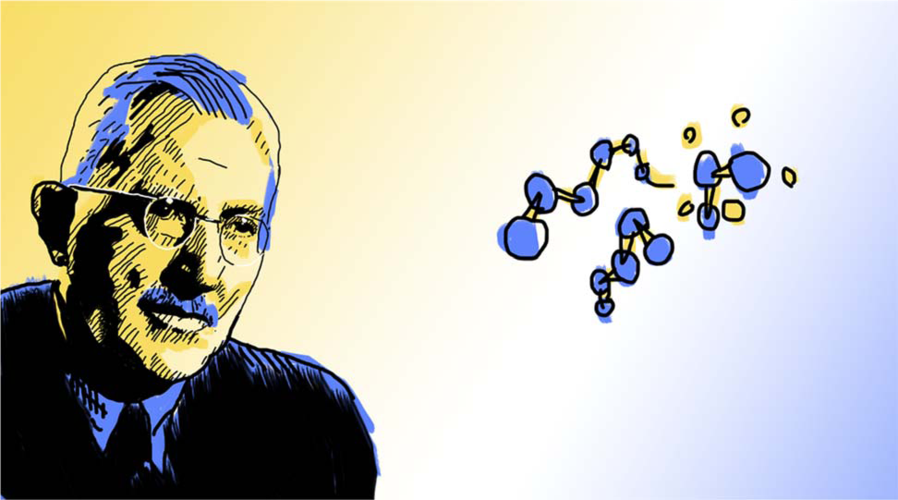
Hermann Staudinger brought about a revolution in our understanding of chemistry, establishing that molecules made of hundreds of thousands of atoms exist: he described them as high polymers or macromolecules, stating that starch, cellulose, and proteins are examples of natural macromolecules.
Today we know that long DNA molecules can contain many billions of atoms. Molecules this big could not be envisaged until Staudinger triggered a paradigm shift.
Staudinger was the sole recipient of the 1953 Nobel Prize in Chemistry for his breakthroughs in macromolecular chemistry.
In 1950, annual global plastics production reached 1.5 million tonnes. In 2022, the figure was about to exceed 400 million tonnes.
This chemical revolution, which began sweeping across the world a century ago, brought unimaginable convenience to human life and an unparalleled driving force for social development. Today, however, visible plastic pollution is worsening climate change, threatening marine life, and leaving deep and enduring effects on the environment.
Yet countless chemists also carry forward Hermann Staudinger's legacy, developing new biodegradable and environmentally friendly polymers so that polymer chemistry continues to shine in a new era!
Science's original purpose is always to benefit humanity. The vision of creating a better life together is the goal that keeps science moving forward!
Original source:
https://www.famousscientists.org/hermann-staudinger/
Source: Famous Scientists
Some material in this article comes from the internet. Please contact us for removal if it infringes your rights.
Editorial note
Editorial note: In the reaction equation, n is the number of repeating units; the manuscript's label 'molecular weight' has been corrected. The Chinese and English scales for DNA atom counts have been aligned with the original English and limited to long DNA molecules. '103 years ago' in the opening and the closing plastics-production projection for 2022 retain the manuscript's historical viewpoint. They do not establish an exact publication date or represent current statistics.
Supporting references
IUPAC: Degree of Polymerization
Sources and editorial history
Restored from a complete historical article exported from the PhDSciNet Official Account.
Editorial revision: Editorial note: In the reaction equation, n is the number of repeating units; the manuscript's label 'molecular weight' has been corrected. The Chinese and English scales for DNA atom counts have been aligned with the original English and limited to long DNA molecules. '103 years ago' in the opening and the closing plastics-production projection for 2022 retain the manuscript's historical viewpoint. They do not establish an exact publication date or represent current statistics.