

Historical compilation: This article preserves the scientific biography in the original manuscript. The English material is credited to Famous Scientists. No named author or translator could be verified from the export, and the original publication date remains unverified.
The ancient Greek philosopher Democritus proposed an innovative atomic theory: the universe consists of atoms and empty space, and atoms are indivisible particles of matter.
As science and technology developed and experimental equipment improved, modern scientists gradually revised and refined atomic theory. In 1910, British chemist Soddy proposed the celebrated isotope hypothesis: variants of a chemical element could differ in atomic weight and radioactivity, have similar chemical properties, and differ in other physical or nuclear properties. These variants should occupy the same place in the periodic table, and were therefore called isotopes.
In 1897, British physicist Joseph John Thomson demonstrated the existence of electrons through a series of experiments. He later developed a method for separating atoms of different masses, providing an effective way for later researchers to verify the existence of isotopes.
In 1931, American chemist Harold Urey discovered deuterium, or heavy hydrogen, an isotope of hydrogen, through spectroscopic analysis. Three years later, this major discovery earned him the 1934 Nobel Prize in Chemistry!
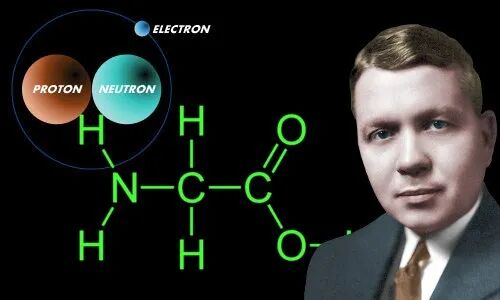
The Hard Road to Education of a Nobel Laureate
Harold Clayton Urey was born on April 29, 1893 in the small town of Walkerton, Indiana, USA.
His father, Samuel Clayton Urey, was a small-scale farmer, schoolteacher. His mother, Cora Rebecca Reinoehl, was a housewife and farmer. Like Harold’s father she had a college degree.
When Harold was six years old, in October 1899, his father died, plunging the family into poverty. Harold attended a single-room country school, where he received a limited education.
When he was 11, his grandmother died. His mother moved her children deeper into rural Indiana where they grew onions to sell.
Harold attended high school in Kendallville, Indiana. He was able to do this only because his father had left money from his life insurance policy to be used exclusively for his children’s education.
Harold prospered at high school, learning some biology and physics (but no chemistry) and joining the school’s debating team. He was top in all of his classes and his nickname was Professor.
In later life, Harold Urey described the profound effect his father’s legacy had on his future: “If it hadn’t been for that, I’d still be in Indiana, working as an unsuccessful farmer – I just can’t see me being a successful farmer.”

Urey graduated from high school in 1911, aged 18, and attended Earlham College in Richmond, Indiana, where he received a teaching certificate. He then did some teaching in Indiana’s small country schools before enrolling at the University of Montana in 1914, aged 21. Three years later, he received a B.S. degree with a major in Zoology and a second major in Chemistry.
By this time America had joined the western allies in World War 1 and Urey’s chemistry skills were highly sought after. He began working for Barrett Chemical Company, an explosives manufacturer in Philadelphia, Pennsylvania. His work convinced him his future lay in chemistry or perhaps biological chemistry.
In 1919 Urey returned to the University of Montana as a chemistry instructor. He worked in this role for two years, then moved to the University of California, Berkeley, in August 1921.
There it took him just two years to earn his Ph.D. in the laboratories of the great physical chemist Gilbert N. Lewis, famous for his work in the field of chemical bonding. At Berkeley, Urey became increasingly fascinated by the newly emergent field of quantum chemistry.

The Major Discovery of Deuterium, a Hydrogen Isotope
In August 1923, aged 30, Urey traveled to Denmark to spend a year carrying out postdoctoral research at Niels Bohr‘s Institute of Theoretical Physics in Copenhagen. In the previous year Bohr had been awarded the Nobel Prize in Physics for his discovery that electron energy levels in atoms are not continuous – they come in steps.
Bohr had also shown that an atom’s outermost electrons – its valence electrons – are of overwhelming importance in determining its chemical properties. In doing so Bohr invented quantum chemistry – a highly mathematical field – and Urey wanted a piece of this action.
In an enormously enjoyable year in Copenhagen Urey learned a lot, including the fact that, although his ability in mathematics was very high, it was not as high as Bohr’s or some of Bohr’s best theoretical physicists. Urey decided his opportunities to get to the front of the scientific pack would be found in experimental rather than theoretical chemistry.

Returning to the USA in 1924, Urey became a research associate at John Hopkins University in Baltimore, Maryland. In 1929, aged 36, he moved to Columbia University in New York City as an associate professor of chemistry.
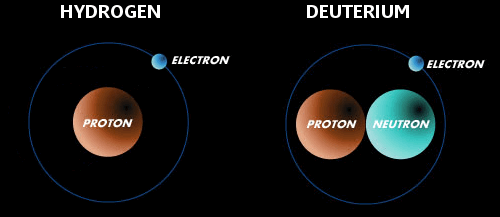
In 1913 J. J. Thomson had found that atoms could have different masses, even though they were atoms of the same element. Today we call such atoms isotopes.
Isotopes exist because atoms of the same element can have different numbers of neutrons. This was not known until 1932, when James Chadwick discovered the neutron.
In the year 1931 Urey already knew of the possibility that hydrogen could exist in a heavy form whose mass was double that of its usual form. He then read a paper suggesting that about one hydrogen in every 4,500 might be heavy. Urey decided he would try to find ‘heavy hydrogen.’
His calculations suggested its boiling point would be higher than normal hydrogen’s, which meant that the proportion of heavy hydrogen in a sample could be increased by removing normal hydrogen in a low temperature distillation.
He asked Ferdinand Brickwedde of the United States Bureau of Standards to distil 4 liters of liquid hydrogen until just 1 ml remained unevaporated. In this small sample, Urey had calculated the proportion of heavy hydrogen would be 100-200 greater than normal.
Using Bohr’s mathematical model of the hydrogen atom, Urey had also calculated how the spectrum of heavy hydrogen would differ from normal hydrogen. In the fall of 1931 Urey and his assistant, George Murphy, measured the spectrum of the 1 ml sample, finding exactly the spectral lines he had predicted for heavy hydrogen. The discovery was made on Thanksgiving Day, 1931. Urey named the new form of hydrogen deuterium.
Urey received the 1934 Nobel Prize in Chemistry “for his discovery of heavy hydrogen.”
Although he was the sole winner of the prize, in an act of generosity that was typical of him, he shared part of his prize money with the two others who had played important parts in the discovery – George Murphy and Ferdinand Brickwedde.
In 1932 Urey founded the Journal of Chemical Physics and served as its editor between 1932 and 1940.
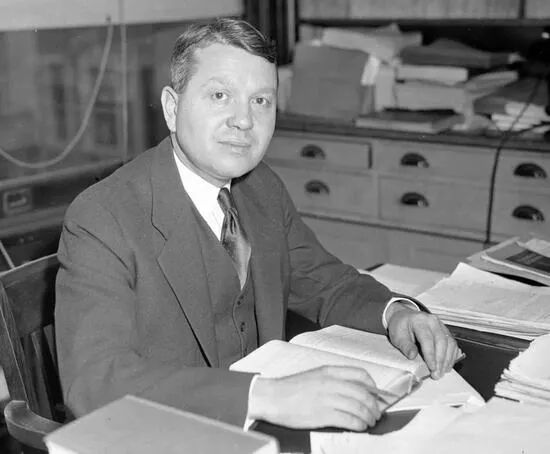
A Nuclear-Weapons Pioneer Who Sought Peace
When the United States took the decision to build an atomic bomb, one of the men clearly destined to take part was Harold Urey. To make a bomb, isotopes of uranium would need to be separated and nobody knew more about isotope separation than Urey.
In May 1941 he was appointed to the important S-1 Executive Committee. By late 1943 he had over 700 people working for him on a project to separate uranium’s isotopes by gaseous diffusion. By early 1945 Urey had been driven to a state of nervous exhaustion by the work and a bad political atmosphere from people working both above and below him. He handed control of the project to Ray Crist. Urey was awarded the Medal for Merit for his work on the project. Before and during the war he also played a large part in helping Jewish scientists escape from areas of Europe that were under Nazi control.
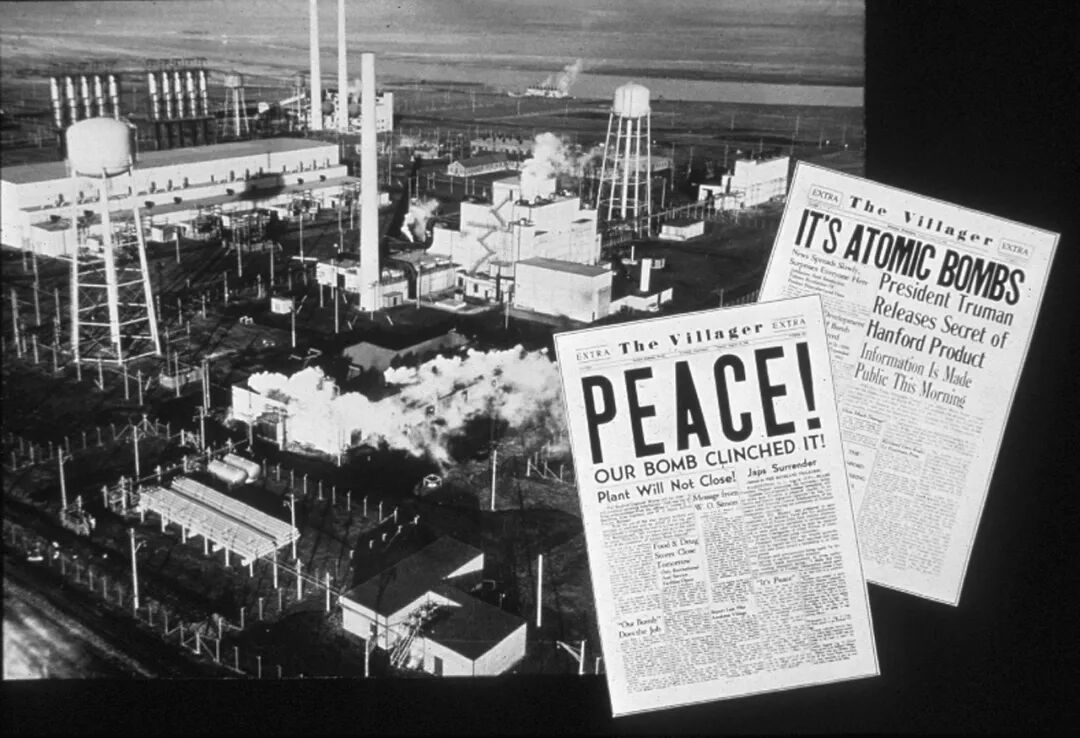
In 1945 Urey became Professor of Chemistry at the University of Chicago’s Institute for Nuclear Studies.
In late 1946 he realized that natural process could produced isotope-enriched matter.
Creatures such as shellfish, whose shells were formed from carbonates, tended to favor the oxygen-18 isotope over the more common oxygen-16 isotope in building their shells. Moreover, the ratio of these oxygen isotopes in the shell depended on the average temperature when the shell was made.
By early 1949 Urey had built mass spectrometers sensitive enough to measure oxygen isotope ratios with great precision, which enabled him to discover average temperatures millions of years ago.
Harold Urey died on January 5, 1981, aged 87, at La Jolla, California.

Through the successive contributions of several Nobel laureates, the discovery and confirmation of isotopes provided an important impetus to scientific development.
American chemist Harold Urey, discoverer of the hydrogen isotope deuterium and a major participant in the Manhattan Project, indirectly helped bring atomic weapons into existence. The enormous destructive power of nuclear warfare brought terrible disaster to people living in war zones.
Yet Harold Urey was also a firm opponent of atomic weapons. During the last decade or more of his life, he repeatedly used public lectures and articles to call for their prohibition. Even before his death, he insisted that atomic energy should be used only for peaceful purposes.
Scientific development may be a double-edged sword, but as long as we guide it in the right direction, science and technology will ultimately benefit human society!
Original source:
https://www.famousscientists.org/harold-urey/
Source: Famous Scientists
Some material in this article comes from the internet. Please contact us for removal if it infringes your rights.
Editorial note
Editorial note: Thomson's discovery of the electron is corrected to 1897. The manuscript's statement that isotopes have 'exactly the same other physical and chemical properties' has been corrected to similar chemical properties, with potentially different physical or nuclear properties. The remaining research experiences and views on peace retain their historical context.
Supporting references
U.S. Department of Energy: Isotopes
Sources and editorial history
Restored from a complete historical article exported from the PhDSciNet Official Account.
Editorial revision: Editorial note: Thomson's discovery of the electron is corrected to 1897. The manuscript's statement that isotopes have 'exactly the same other physical and chemical properties' has been corrected to similar chemical properties, with potentially different physical or nuclear properties. The remaining research experiences and views on peace retain their historical context.