Historical compilation: This article preserves the scientific biography in the original manuscript. The English material is credited to Famous Scientists. No named author or translator could be verified from the export, and the original publication date remains unverified.
Why Is the Sea Deep Blue?
The British physicist Lord Rayleigh once offered this explanation: the blue of the deep sea was not the color of the seawater itself, but merely the reflection of the blue sky. Most of the scientific community accepted this account, and it became the prevailing explanation.
An Indian scholar questioned it. Aboard a passenger ship traveling to Britain, he observed the sea with a simple set of optical instruments and found that its blue was deeper than the sky's. After a series of observations and investigations, he challenged the accepted explanation: the sea's color did not simply come from the sky, but was also a property of seawater itself.
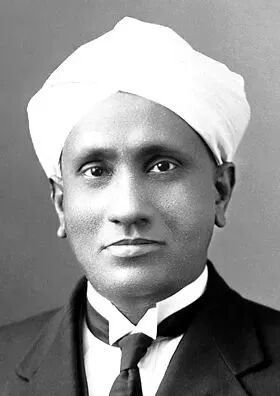
That Indian scholar was Chandrasekhara Venkata Raman. Born in India, Raman overcame repeated setbacks in his research career, retained an inexhaustible enthusiasm for scientific exploration, and became the first Asian recipient of the Nobel Prize in Physics!
An Exceptionally Gifted Young Physicist
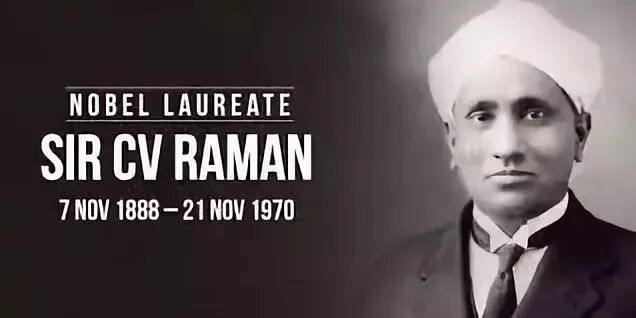
Chandrasekhara Venkata Raman was born on November 7, 1888 in the city of Trichinopoly, Madras Presidency, British India. Today the city is known as Tiruchirappalli and sits in the Indian state of Tamil Nadu.
Raman’s father was Chandrasekaran Ramanathan Iyer, a teacher of mathematics and physics. At the time of Raman’s birth, the family lived on a low income. Raman was the second of eight children.
Raman’s family were Brahmins, the Hindu caste of priests and scholars. When Raman was four years old his father got a better job, becoming a college lecturer, and the family moved to Waltair (now Visakhapatnam).
From a very young age Raman was interested in science, reading the books his father had used as a student. As he grew older, he started borrowing mathematics and physics books from his father’s college library. Entering his teenage years, he began learning from books his father had bought when he had intended taking a master’s degree in physics.
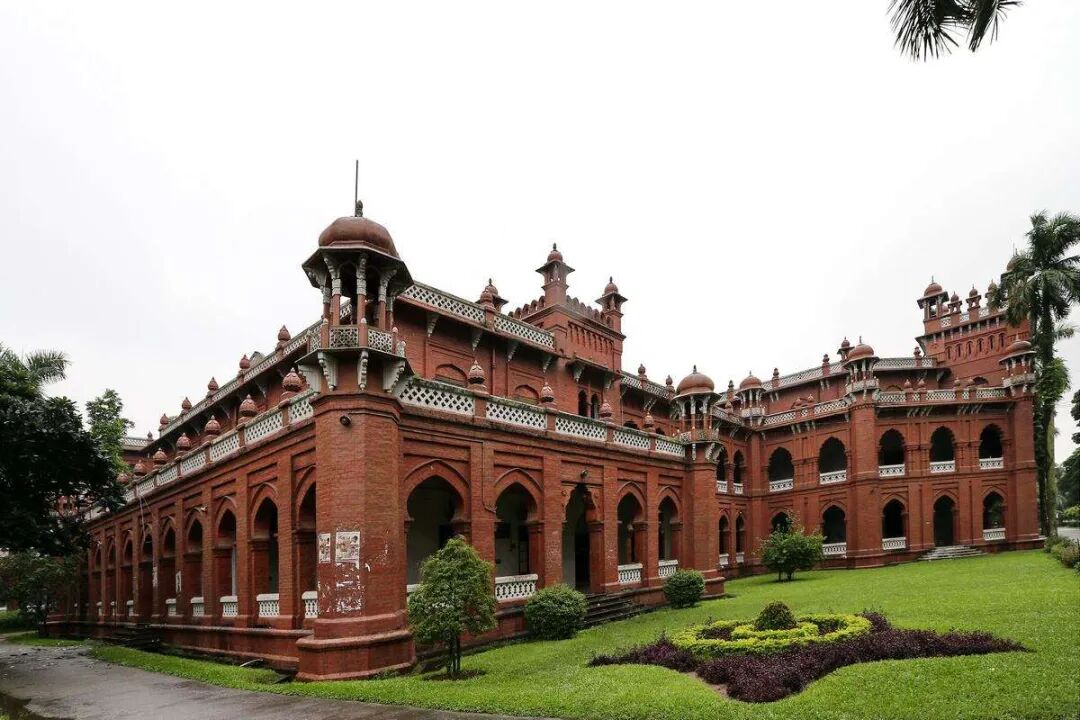
In 1903, aged just 14, Raman set off for the great city of Madras (now Chennai) to live in a hostel and begin a bachelor’s degree at Presidency College.
He completed his degree in 1904, winning medals in physics and English. His British lecturers encouraged him to study for a master’s degree in the United Kingdom. Madras’s civil surgeon, however, told him that his health was not robust enough to withstand the British climate; he advised Raman to stay in India.
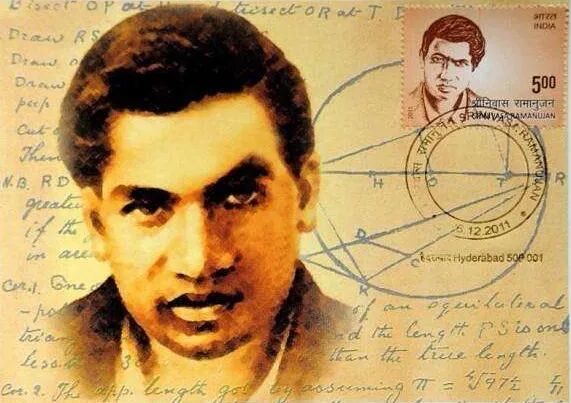
This was probably excellent advice. The brilliant mathematician Srinivasa Ramanujan, traveled from Madras to work at the University of Cambridge in 1914. Although this led to the creation of some exceptional mathematics, it had a severe impact on Ramanujan’s health.
Raman remained at Presidency College to study for his master’s degree. His outstanding potential was recognized, and he was given unlimited access to the laboratories, where he pursued investigations of his own design.
In November 1906, aged 18, Raman had his first academic paper published. He had initially given it to one of his professors to read, but the professor had not bothered. Raman sent his paper directly to Philosophical Magazine and it was accepted. Its title was Unsymmetrical diffraction-bands due to a rectangular aperture.
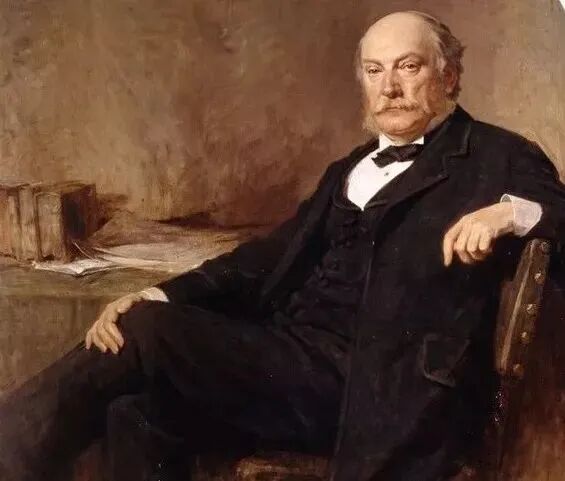
Following the publication of his second paper in Philosophical Magazine, Raman received a letter from Lord Rayleigh, the eminent British physicist. Rayleigh, unaware that Raman was just a teenage student, sent his letter to “Professor Raman.”
In 1907, aged 19, Raman graduated with a master’s degree in physics, awarded with the highest distinction.
A Civil-Service Career, Without Giving Up Science
Although Raman was intent upon a scientific career, his brother persuaded him to take the civil service exams. Civil service jobs were highly paid and Raman’s family was deeply in debt.
For 10 years Raman worked as a civil servant in the Indian Finance Department in Calcutta (now Kolkata), rising quickly to a senior position. In his free time he carried out research into the physics of stringed instruments and drums. He did this work at the Indian Association for the Cultivation of Science (IACS).
The IACS had been in a state of hibernation until Raman stumbled upon it and set about reviving it. In addition to his research work, Raman gave public lectures in Calcutta popularizing science.

Raman’s part-time research work and his lectures were impressive, establishing his reputation as a highly talented physicist. In 1917, the University of Calcutta sought him out and offered him the Palit Chair of Physics. Although it meant a substantial cut in pay, Raman, now aged 28, accepted – the prospect of devoting all of his time to science was worth more to him than money.
Although it was a research professorship, Raman also chose to give lecture courses: he was an exciting lecturer and he inspired his students.
The Science of the Blue Sea
One day, in the summer of 1921, Raman was on the deck of a ship in the Mediterranean Sea en route to the Congress of Universities of the British Empire at Oxford. He looked at the beautiful blue color of the Mediterranean Sea and began to doubt Rayleigh’s explanation of its color.
Lord Rayleigh, who had believed the teenage Raman’s papers were the work of a professor, had been one of the great physicists of his day. He had won the 1904 Nobel Prize in Physics.
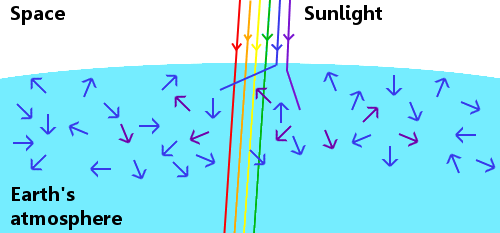
Rayleigh had correctly explained that the sky looks blue because of a phenomenon now called Rayleigh scattering.
If Earth had no atmosphere, anyone who happened to be around in such circumstances would see a white sun and a black sky. However, this is not what we see, because sunlight interacts with the gases in Earth’s atmosphere.
Rather than coming straight to our eyes from the sun, sunlight is scattered in all directions by the atmosphere. Blue light is scattered most, meaning that it comes to our eyes from everywhere in the sky, therefore the sky looks blue. Yellow and red light are scattered least, so we usually see a yellow sun, and sometimes a red sun.
Rayleigh scattering is elastic. This means that photons of light lose no energy when they interact with gas molecules. The light, therefore, stays the same color.
When he sailed back to India in September 1921 Raman, an indefatigable scientist, had with him some simple physics apparatus: a prism, a miniature spectroscope, and a diffraction grating. He used these to study the sky and the sea and concluded that the sea was scattering light.
Hence when Rayleigh said the sea’s color is simply a reflection of the sky’s color, he was not wholly correct. Raman reported his findings in a letter to the journal Nature.
When he returned to his laboratory, Raman and his students began an exhaustive program of research into light scattering.

The Discovery of the Raman Effect
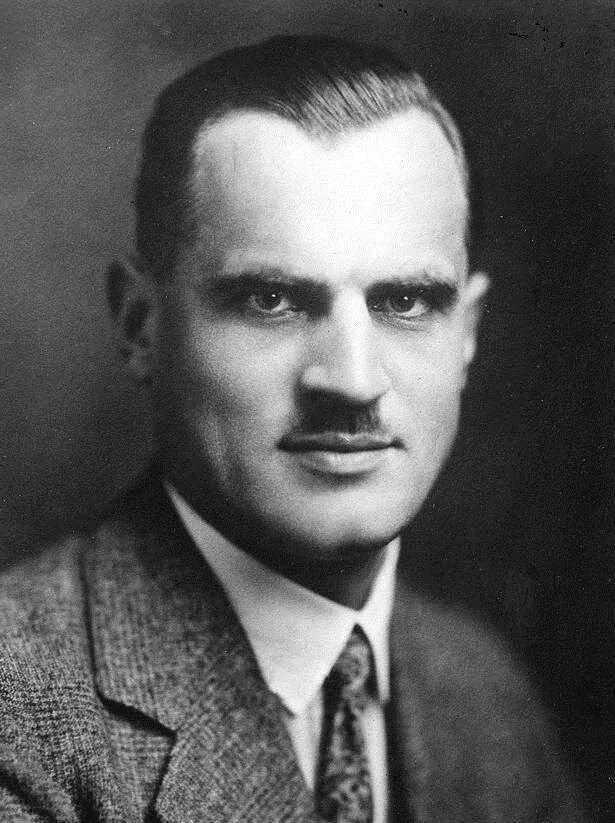
In 1923, Arthur Compton in St. Louis, USA published exciting new work showing that X-rays can lose energy when they interact with electrons. The X-rays donate some of their energy to electrons, then move on carrying less energy. In other words, Compton demonstrated that inelastic scattering is possible.
Compton received the 1927 Nobel Prize in Physics for this discovery, which became known as the Compton effect.
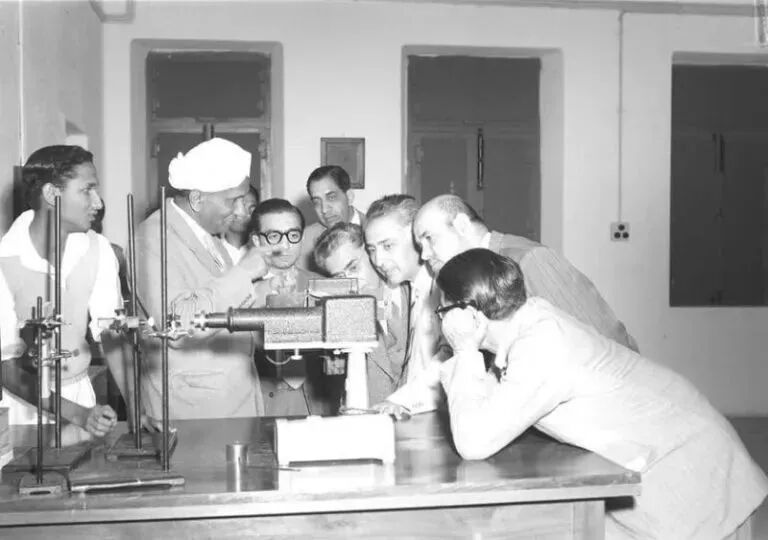
Raman and his students continued researching light scattering in gases, liquids, and solids.
They used monochromatic light – sunlight that had been filtered to leave only a single color – and found that a variety of different liquids – sixty of them – did indeed change the color of the light. They first observed this in April 1923, but very weakly.
In 1928, they found a particularly strong color change in light scattered by glycerol (then called glycerine): “…the highly interesting result that the colour of sunlight scattered in a highly purified sample of glycerine was a brilliant green instead of the usual blue.” ——C. V. Raman
Raman's team observed the effect in gases, crystals, and glass. It was initially suspected to be fluorescence, another phenomenon in which light changes color. The polarization of the scattered light provided an important clue, while later observations of shifted spectral lines helped them identify a new scattering effect.
What came to be known as the Raman effect – a color change accompanied by polarization – had never been seen before. The inelastic scattering at its heart was a further, very strong, confirmation of quantum theory.
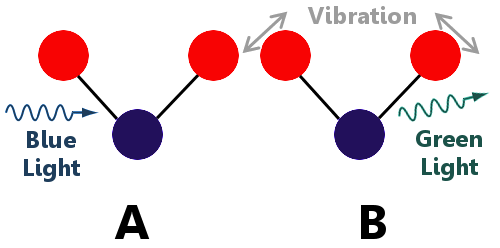
The Raman effect is a very small effect compared with Rayleigh scattering. Only about 1 in ten million photons undergoes inelastic scattering.
Raman and his colleague K.S. Krishnan reported their discovery in March 1928 in Nature.
Raman was awarded the 1930 Nobel Prize in Physics for “work on the scattering of light and for the discovery of the effect named after him.”
“It appears to me that this very beautiful discovery which resulted from Raman’s long and patient study of the phenomenon of light scattering is one of the best convincing proofs of the quantum theory.” ——Robert W. Wood
“[The Raman effect], whose explanation agrees so well with quantum theory, will undoubtedly become a vital source in growing our knowledge of the states of atoms or molecules in transitions, between which their characteristic spectra are emitted.”——Niels Bohr
Recognition and a Lifetime of Service to His Country
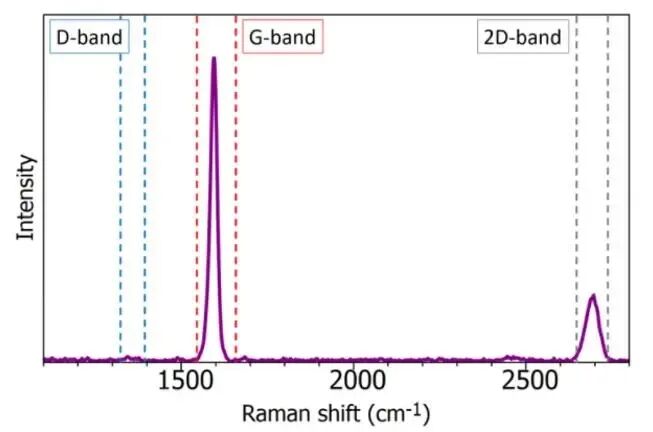
Raman showed that the energy of photons scattered inelastically serves as a ‘fingerprint’ for the substance the light is scattered from. As a result of this, Raman spectroscopy is now commonly used in chemical laboratories all over the world to identify substances. It is also used in medical research to investigate living cells and tissues and explore cancer identification. Whether photodamage occurs depends on the experimental conditions, so harmlessness cannot be guaranteed in general.
Raman was knighted in 1929 for his discovery of the Raman Effect, becoming Sir Chandrasekhara Venkata Raman.
Raman had supreme confidence in his own ability. He was so sure he would win the 1930 Nobel Prize that he booked tickets to Sweden four months before the winner was announced.
In 1933, Raman became the first Indian director of the Indian Institute of Science in Bangalore. In 1947, he became independent India’s first National Professor. In 1948, he founded the Raman Research Institute in Bangalore, where he worked until the end of his life.
Raman was suspicious of governments playing any role in fundamental science, refusing government funding for his work:“I strongly believe that fundamental science cannot be driven by instructional, industrial and government or military pressures. This was the reason why I decided, as far as possible, not to accept money from the government.”
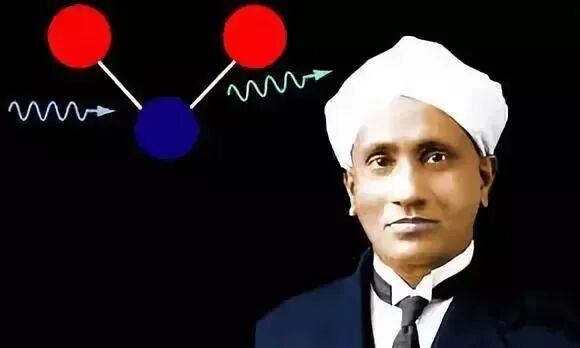
Einstein once described himself this way: 'I have no special talents. I am only passionately curious.' A person who always remains curious is a person who always makes progress.
Born in India before independence, Raman was a gifted youth who was at one point forced to set aside a physics career. With simple experimental equipment and an endless desire to explore, he refused to follow authority blindly or give in to discouragement. He eventually achieved one of the great discoveries in the history of science and became the first Asian scientist to receive the Nobel Prize in Physics.
Even after receiving this great honor, Raman chose to return to his country and devote his life to science. A legend began here, and here it also came to an end!
Original article link:
https://www.famousscientists.org/c-v-raman/
Source: Famous Scientists
Some material in this article comes from online sources. Please contact us for removal if it infringes your rights.
Editorial note
Editorial note: Raman's historical investigation of sea color is retained. Ocean color also depends on wavelength-dependent absorption by water and scattering by material in the water, and should not be reduced to a single scattering mechanism. The strong glycerin observation has been dated to 1928 according to the institute's history. Polarization alone does not rule out fluorescence, and medical applications and claims of harmlessness have been bounded by experimental conditions. The quoted scientists' comments and intensity ratio retain their original context.
Supporting references
Raman Research Institute: life and work of Raman
Original research on Raman cancer identification (2022)
Sources and editorial history
Restored from a complete historical article exported from the PhDSciNet Official Account.
Editorial revision: Editorial note: Raman's historical investigation of sea color is retained. Ocean color also depends on wavelength-dependent absorption by water and scattering by material in the water, and should not be reduced to a single scattering mechanism. The strong glycerin observation has been dated to 1928 according to the institute's history. Polarization alone does not rule out fluorescence, and medical applications and claims of harmlessness have been bounded by experimental conditions. The quoted scientists' comments and intensity ratio retain their original context.