Historical interview: the following preserves the research experiences and personal views expressed in the original manuscript.
Last time, we interviewed Su Xinyang, a student in Donna’s group. Afterwards, we were fortunate to contact Xu Zujun, a current doctoral student in her group, and Bian Siyuan, who had already completed his master’s degree.
Let us see Donna through their eyes. This issue has more practical insights—and a little gossip! Do not forget the bonus at the end!
First, let us look again at the professor’s warm smile.

https://uwaterloo.ca/physics-astronomy/people-profiles/donna-strickland
(Personal profile)
https://uwaterloo.ca/ultrafast-laser-group/
(Group homepage)
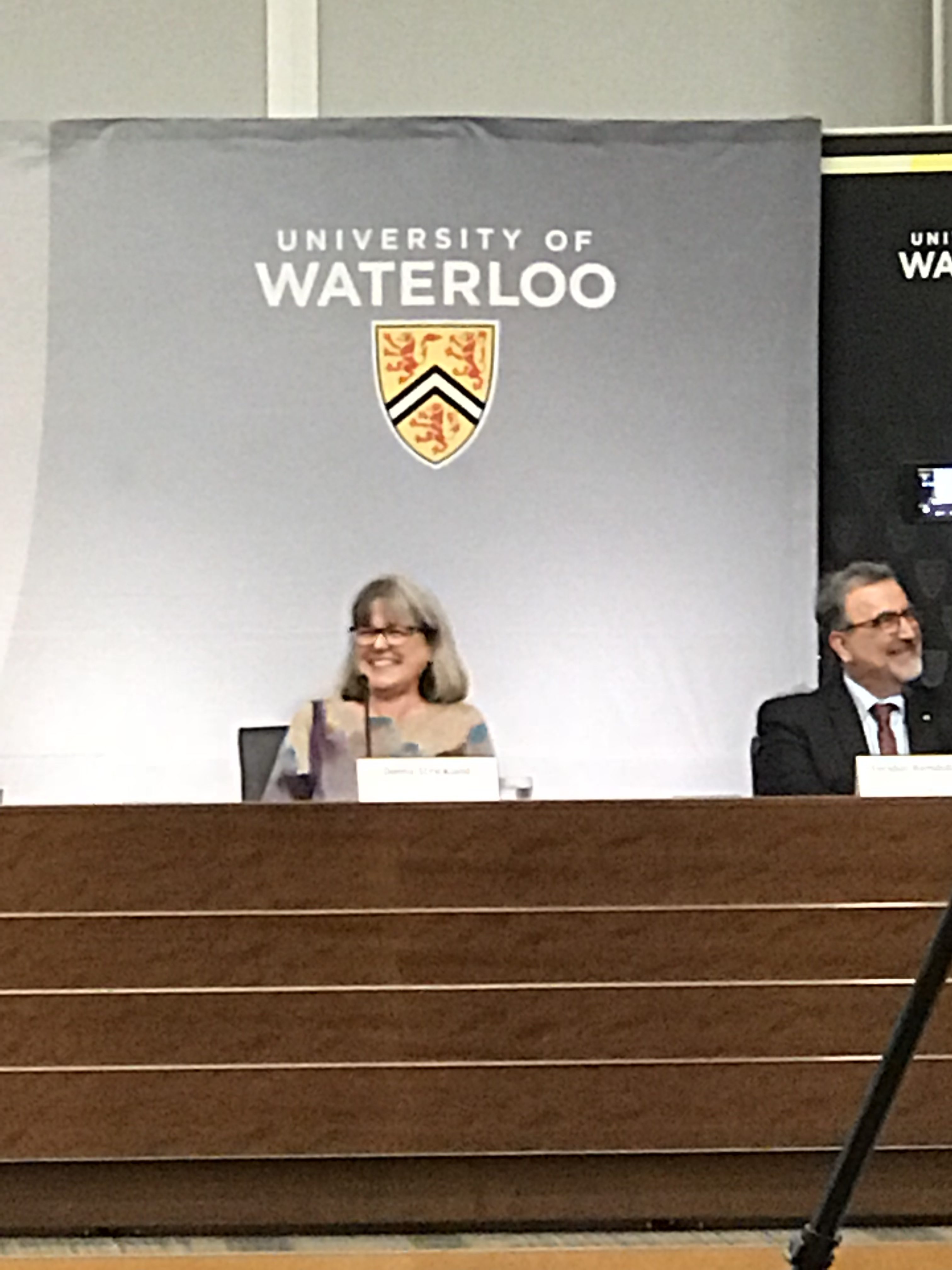
And here is the university’s press conference.

Let us first interview Xu Zujun, currently the senior doctoral student in the group.
PhDSciNet: Please briefly introduce yourself.
Xu Zujun: Hello, everyone. I am Xu Zujun, currently a PhD student in the DNA—that is, Donna—group. My main research is on multispectral Raman phenomena.
PhDSciNet: What is your relationship with Donna?
Xu Zujun: I joined the group in September 2013 and may graduate at the end of this year.
PhDSciNet: We looked at Professor Strickland’s homepage and found it very simple. There is hardly any information about her on social media either. She seems somewhat mysterious and low-key. What is your impression of your supervisor?
Xu Zujun: Personally, I think supervisors who genuinely concentrate on research do not have much time or energy for their personal websites, and DNA is one of them. She knows her research well and cares about it. As for the website, perhaps she will work on it when she has the money and time. In everyday life, DNA is very warm and approachable, but at work she is meticulous and demanding. That rigorous approach to research also means she does not receive high evaluations from undergraduates. Students, after all, do not particularly like strict teachers who give low marks.

PhDSciNet: What kind of supervisor do you think Professor Strickland is?
Xu Zujun: Other students have already mentioned many aspects of how she handles things. She is very easygoing in some ways. Let me give an example. I actually really wanted group meetings: it is awkward if nobody in a group knows what the others are doing, and meetings can also help train students. So I repeatedly asked our supervisor to hold them. DNA would answer, “All right, we will start next month,” or “All right, next semester.” Then I kept waiting… I get the impression that she is not particularly fond of group meetings. But she is very broad-minded and generous. Here is another example. A group two doors away used the same kind of infrared viewer as ours to observe infrared lasers. A student there noticed that the batteries had corroded inside the viewer—he had not used it; he had only seen the problem—and told his supervisor. He was then harshly scolded, which seemed so unfair. Once, I accidentally dropped and broke our group’s infrared viewer. I told our supervisor very timidly, but DNA simply said, “It is all right. These things happen in a laboratory.” She then spent $2000 on a new one. You do not realize the difference until you compare! She is rather pleased with herself, too. For example, in any setting, DNA can happily keep an awkward conversation going for more than half an hour. Yet in the lab, when I ask her to help with an experimental problem, she solves it very quickly. If I compliment her by saying, “You are amazing,” she will reply without hesitation, “Of course. I know everything. I am always right. I tell my children all the time that I am right, but they just do not believe me.” She is also an excellent cook. I remember her inviting us to her home a few days before Christmas. She cooked very quickly, made a whole table of dishes, and prepared her specialty, eggnog. Everyone there praised it…

PhDSciNet: How do you feel about being Professor Strickland’s student?
Xu Zujun: My current project studies the Raman spectra that are generated, using them to investigate the process of quantum-state transitions in greater depth. Research is never entirely smooth. But whenever I go to her feeling defeated and ask where to go next, she says things that immediately fire me up, lift my spirits, and fill me with enthusiasm for research!
Because Xu was busy with his research, we had to pause the interview there. But his words gave us a strong sense of Professor Strickland’s love of research and life. We thank Xu Zujun again for taking part and wish him a smooth graduation!
Interview with Bian Siyuan
After saying goodbye to Xu, we contacted Bian Siyuan, who had already completed his master’s degree. As the saying goes, a thousand people have a thousand Hamlets in their minds. Let us see what kind of supervisor Professor Strickland is in Bian’s eyes.
PhDSciNet: Please briefly introduce yourself.
Bian Siyuan: I am Bian Siyuan. I am now secretary to the general manager of Inner Mongolia Power Group, and I am getting further and further away from academic research, ha-ha.
PhDSciNet: What is your relationship with Donna?
Bian Siyuan: Donna was my supervisor during my graduate studies. I joined the group in September 2012, taking over from Mojtaba—our Iranian senior colleague—to continue research on fiber CPA. When I first joined, Donna had two projects: fiber CPA and Hao’s—that is, Yan Hao’s—MRG, or Multi Frequency Raman Generation. So Donna assigned me to fiber CPA. The basic principles and the system’s underlying design had probably already been developed during Mojtaba’s time. Building on that, I mainly changed the amplification stage to three stages to increase the energy, steadily increase the wavelength separation between the two infrared beams, and ultimately achieve mid-infrared generation. The system has continued to the present, and its fundamentals have not really changed. So I think the best way to understand it is to read our Iranian colleague’s thesis. Donna herself has said that it is very detailed and covers almost everything. After graduating, I also spent some time as an RA—a research assistant—in Donna’s group. I was back in China for Lunar New Year when I received her email, and I immediately returned. At the time, the goal was to achieve two-photon absorption. It was actually a very interesting project, and Donna very much wanted it to succeed. We put a lot into it, but because of limitations in the group’s equipment, we ultimately had to give it up. Anyone interested could give it a try.

PhDSciNet: What kind of person is Professor Strickland in your eyes?
Bian Siyuan: She is quite well known. Wherever you go, people know her name. Donna is very intelligent. Almost everyone tells me that my supervisor is clever, because she really is an exceptionally gifted scientist. She is a little casual and easygoing; perhaps her great skill gives her confidence, and she is bold about hands-on experimental work. In private, Donna is a very good person. I remember burning out a pump once. Although she was unhappy, she did not say much. I was really grateful at the time that she was not overly frugal with laboratory equipment. Donna’s approach to supervision is quite relaxed: she gives you as much freedom as possible to do the work yourself. I therefore really enjoyed that period; she only needed to guide the overall direction. Donna loves telling jokes. At gatherings she can more or less command the room, laughing heartily. She likes crossing her legs and sitting on a table to tell jokes, mostly stories from the different places she has visited for conferences. She really does speak quickly. In her Nonlinear Optics course, many people said she spoke too fast to follow. Donna is very skilled with her hands and enthusiastic about experiments. I really enjoyed working with her. While I was an RA, the two-photon experiment required us to align the optical setup together, and for a while we worked on it every day. She liked saying “shoot.” But Donna is strict with students and has high expectations. After I started working in China, I returned twice: once for my landing, and once to deal with my car, furniture, and other belongings. Each time she organized a meal for everyone, was very welcoming, and shared the latest experimental progress and her ideas for the future.
PhDSciNet: Does Professor Strickland have any particular habits?
Bian Siyuan: When I was there, we did not have many group meetings. It felt as though we were simply free to get on with things. So I felt mentally quite relaxed during that period, although the experiments themselves gave us a hard time. Donna really likes coffee. It seems that without it she cannot think, just as some people cannot do without cigarettes, ha-ha. Donna is very busy, but she deals with students’ matters very well. When she revised my thesis before graduation, she would give me feedback within three days. My graduation went smoothly thanks to her efficiency. Many students have mentioned her safety awareness. Yes, she often told us that we must wear protective goggles in the lab and shoe covers on entering. The main reason for the shoe covers was that the fiber was very expensive and dust often caused problems. After experiments, our group therefore switched everything off, protected the optical bench, and took care of our own safety.
PhDSciNet: What skills did you learn while working with Professor Strickland?
Bian Siyuan: Donna has great trust in her students. I am very grateful that she let us work independently, and I learned a lot. Even today, although I may have forgotten other things, aligning an optical setup is a skill I will never forget for the rest of my life.
PhDSciNet: After Professor Strickland won the prize, did you call or email to congratulate her?
Bian Siyuan: I emailed her, but I imagine she has not had time to reply, ha-ha. Just now, CCTV-1 was showing coverage of Donna winning the award, and my family shouted for me to come and watch. I feel that her winning the prize has had a major impact, not just on our university or on us personally, but on the optics community too.
The interview was brief, but it leaves much to think about. Research is a repeated cycle of conjecture, practice, deduction, and further practice. It is hard. Which graduate student has not stayed up all night, been deeply frustrated by disappointing experimental data, or thought about giving up? Yet we have persisted. We have overcome academic obstacles one by one, worked late into the night to test a new discovery, seen the campus at five or six in the morning, and walked the empty path back to our accommodation in the early hours. All of this comes from a sincere devotion to research.
Both interviewees mentioned a mysterious person: Yan Hao. We will conduct an exclusive interview with him next, so stay with us. Here, let us look again at his science article.
From Colliding Balls to Nonlinear Optics
And a substantial science article about color!
Finally, thank you for patiently reading our interview. We hope it helps you along your research path. As a thank-you for supporting PhDSciNet, here is a bonus photograph.

Professor Xue Qikun is also a strong contender for a future Nobel Prize in Physics. Perhaps this photograph will one day have historical significance!
Sources and editorial history
Restored from a complete historical article exported from the PhDSciNet Official Account.