English translation of the original Chinese article. Publication dates and the extent of recovered text are preserved. Figures retain their original labels. Read the Chinese original.
Beihang University
Keywords: dog's nose, graphene, gas detection, nitrogen dioxide
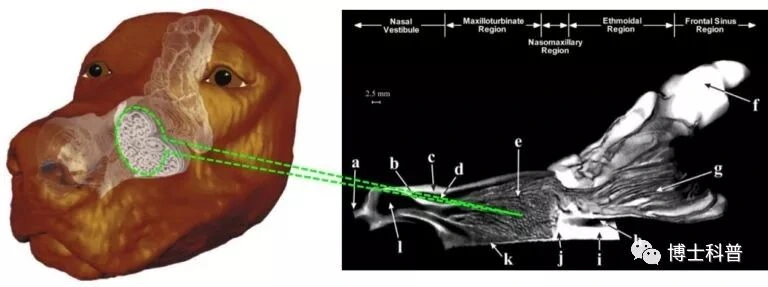
Dogs are renowned in nature for their extraordinary sense of smell. Performance depends on structure, and this sensitivity comes from the distinctive structure inside their noses. Research shows that the maxilloturbinate contains many folded sheets. Their large specific surface area greatly enhances gas-molecule adsorption, providing a solid foundation for olfactory cells to detect gases [1].
Figure 1: A three-dimensional model of the inside of a dog's nose and a nasal cross-section; region e is the maxilloturbinate [1].
Here is the problem: dogs cannot precisely communicate the composition and concentration of a gas, nor can they obediently monitor it around the clock. Could we make a highly sensitive “artificial dog's nose” to replace them?
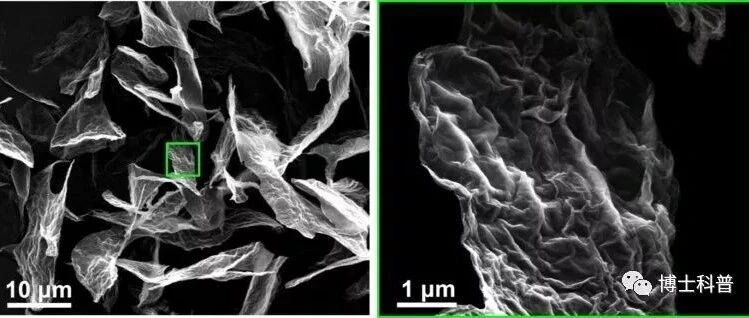
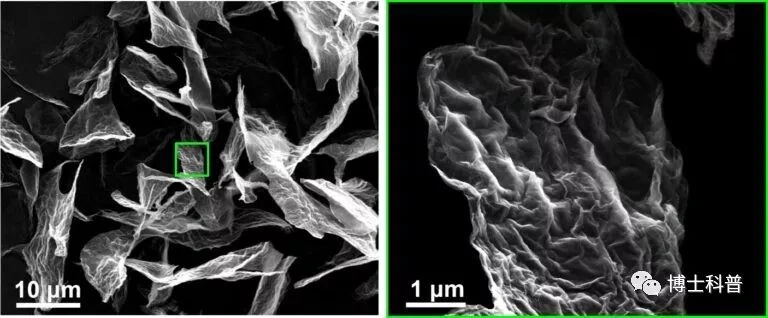
Inspired by the folded structure of a dog's nose, our research group developed a similarly structured “artificial dog's nose”: three-dimensional crumpled graphene nanosheets. Their special structure adsorbs and senses toxic gases more effectively, improving gas detection [2]. Another piece of good news is that this “nose” is easy to make. First, we use graphene and a functional organic molecule called NA as the starting materials. NA not only improves nitrogen dioxide sensing but also effectively prevents graphene sheets from restacking, promoting the later formation of the crumpled structure. The aromatic NA molecules then spontaneously combine with graphene's two-dimensional conjugated structure through π–π interactions, forming a supramolecular self-assembly. Finally, freeze-drying twists the graphene sheets during dehydration, producing large quantities of three-dimensional crumpled graphene nanosheets.
Figure 2: Scanning electron micrograph of three-dimensional crumpled graphene nanosheets [2].
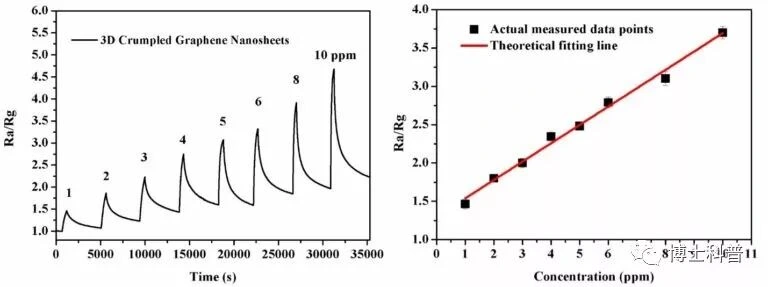
The three-dimensional crumpled graphene nanosheets described here are typical p-type semiconductors. When the oxidizing gas nitrogen dioxide approaches, the material's resistance decreases. This change provides a signal for detecting nitrogen dioxide, and the relative resistance change can accurately reflect the gas concentration. Gas-sensing tests showed high sensitivity even at very low nitrogen dioxide concentrations of 1–10ppm. Sensors made from the material also showed good stability and linear detection, meeting practical needs for toxic-gas detection and offering an important route toward precise, efficient and highly sensitive biomimetic gas sensors.
Figure 3: Continuous detection curves for 1–10 ppm nitrogen dioxide using three-dimensional crumpled graphene nanosheets, and their sensitive linear detection response [2].
*This article represents the author's personal views, not those of this website. Other media, websites or individuals reproducing material from this website must acknowledge its source and assume responsibility for copyright and other legal matters. Authors who do not wish their work to be reproduced, or who wish to discuss reproduction fees or related matters, should contact us.
References:[1] Craven, B. A.; Neuberger, T.; Paterson, E. G. et al. Reconstruction and Morphometric Analysis of the Nasal Airway of the Dog (Canis Familiaris) and Implications Regarding Olfactory Airflow. Anat. Rec. 2007, 290, 1325-1340.
[2] Chen, Z.; Wang, J.; Umar, A. et al. Three-Dimensional Crumpled Graphene-Based Nanosheets with Ultrahigh NO2 Gas Sensibility. ACS Appl. Mater. Interfaces 2017, 9, 11819-11827.
Images from the matching WeChat article
The following images were recovered from the matching article retained by the WeChat account and restored in their original order.
Additional images were recovered from the matching article retained by the WeChat account and grouped after the main text. The historical archive text and existing editorial corrections are preserved.