
English translation of the original Chinese article. Publication dates and the extent of recovered text are preserved. Figures retain their original labels. Read the Chinese original.

Information cutoff: July 25, 2026. The following retains the investigation's status and regulatory context at the time of the original manuscript; it does not describe the latest developments in October 2026.
Initiated by researchers, supported by institutions, with national involvement—how can a treatment designed for just one patient be given both an opportunity and clear boundaries?
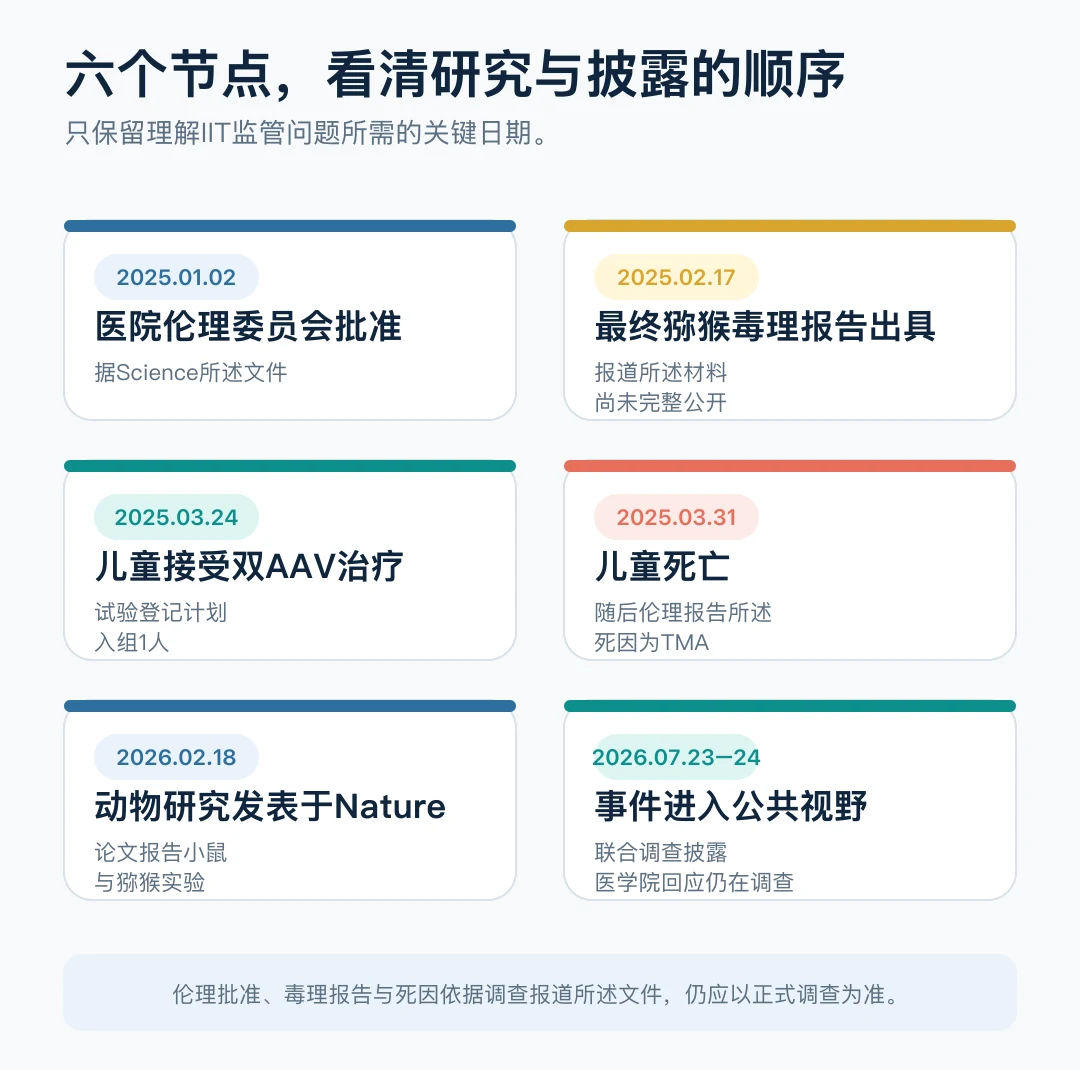
In March 2025, a six-year-old girl with Snijders Blok–Campeau syndrome underwent experimental gene editing in the brain in Shanghai. Seven days later, she died from thrombotic microangiopathy (TMA).
In July 2026, Science and Retraction Watch reported on this study. Related animal experiments had previously been published in Nature. The girl's family reportedly provided more than US$800,000 for development of the treatment, and ClinicalTrials.gov registered the project as an early Phase I study planning to enroll one participant. [1][2][3][5]
The death of a child is, first and foremost, an irreparable loss for her family. At the same time, this event raises a question that cannot be answered by emotion alone:
When a therapy is designed for a single rare-disease patient, companies have little incentive to develop it, and the treatment window may rapidly close, through what framework should medical innovation enter human use?
This is where understanding IIT begins.
Publicly Available Developments as of July 25, 2026
The latest public response from Shanghai Jiao Tong University School of Medicine remained its July 24 statement that the matter was “still under investigation.” No new formal investigation finding had been located. The ClinicalTrials.gov page still showed Recruiting, with the status last verified in March 2025 and no public results. The Nature paper remained online, with no editorial notice found addressing the disclosure of this human experiment. [3][4][5]
An unchanged registry page does not, by itself, prove that no internal institutional report or report to authorities was ever made. Subsequent conclusions should still be based on the formal investigation and original records.
To understand the sequence of the research, publication and public disclosure, we can first look at six key milestones:
1. Why IIT Deserves Encouragement
IIT stands for investigator-initiated trial, commonly described in Chinese as a clinical study initiated by researchers.
Its importance lies in the fact that companies and researchers do not necessarily focus on the same questions.
Companies are better placed to bring standardized, scalable products to market. Clinical researchers are more likely to identify problems affecting small numbers of patients, offering limited commercial returns but genuinely shaping patients' lives. Rare diseases, drug repurposing, surgical optimization, rehabilitation approaches and highly individualized treatments all rely on IIT.
China's Measures for the Administration of Investigator-Initiated Clinical Research Conducted by Medical and Healthcare Institutions, which took effect in 2024, likewise defines IIT as clinical research conducted by medical and healthcare institutions without the purpose of registering a pharmaceutical or medical-device product. [6]
This framework preserves research opportunities for many noncommercial medical questions.
However, “IIT” primarily identifies who initiates a study; it does not automatically indicate its level of risk. Understanding an IIT requires distinguishing at least three questions:
- Who proposes the scientific question?—The researcher, hospital or company?
- Who assumes the sponsor's responsibilities?—Who is responsible for preparation quality, study monitoring, safety reporting and participant protection?
- Who reviews the study before the first human administration?—An institutional committee or a national regulatory authority?
Clearly, comparisons of routine treatment regimens and first-in-human gene editing cannot be subject to the same threshold.
Which Rules Were in Force in China When This Case Occurred?
The girl received treatment in March 2025. The institutional context must therefore be assessed against rules already in force in March 2025, rather than directly applying new rules introduced in 2026.
| Effective date | Principal rules in force | Requirements relevant to this case |
|---|---|---|
| 2019 | Revision of the Drug Administration Law | If a project constitutes a clinical drug trial, information on pharmaceutical development, quality, pharmacology and toxicology must be submitted to the national drug authority. The trial may proceed after approval or implied authorization. [9] |
| 2023 | Measures for Ethical Review of Life Sciences and Medical Research Involving Humans | Human research involving new technologies requires prior ethics review. Research information must be uploaded to the national medical research registration and filing information system before implementation. Serious adverse events must be reported immediately to the ethics committee, with risks and benefits reassessed. [23] |
| October 1, 2024 | Measures for the Administration of Investigator-Initiated Clinical Research Conducted by Medical and Healthcare Institutions | Established requirements for primary institutional responsibility, scientific review, ethics review, institutional project approval, public domestic registration, funding and safety management throughout the research process. [6] |
| May 1, 2026 | Regulations on the Administration of Clinical Research and Clinical Translation of New Biomedical Technologies | Created a national filing and professional-assessment pathway for new biomedical technologies. It was not in force when this case occurred and cannot be applied retroactively. [7] |
The table shows that in 2025 there was more than an ethics committee procedure alone; the situation cannot simply be described as “unregulated.” At least three layers of rules needed to work together:
- If managed as an investigational drug, clinical drug trial authorization applies. Whether the research has a commercial purpose does not directly replace the assessment of the product's regulatory nature;
- if managed as an IIT, the medical institution is responsible and must conduct scientific review, ethics review and institutional project approval. Where legally required administrative approval or filing has not been completed, the institution must not approve the study;
- regardless of the research pathway, research involving new technologies in humans requires ethics review, continuing review and serious-adverse-event reporting.
The 2024 IIT measures also require research information, scientific-review opinions, ethics-review opinions and institutional-review opinions to be uploaded to the national medical research registration and filing information system when institutional project approval is granted. In principle, the relevant information should be publicly accessible. [6]
Although this case was registered on ClinicalTrials.gov, registration outside China does not directly answer whether information was also uploaded to China's national medical research registration and filing information system. Available public information is insufficient to confirm this; the formal investigation could clarify it.
Article 12 of the same IIT measures also requires clinical research using biomedical technologies or similar interventions to use approved drugs and medical devices within their approved scope or relevant clinical application guidelines. [6]
The formal investigation should therefore clarify which framework was used at the time to determine the regulatory nature of this dual-AAV in vivo gene-editing study customized for one patient, and which reviews took place inside and outside the institution.
A more accurate description is that drug, IIT and ethics rules already existed, but the dedicated national pathway for new biomedical technologies introduced from 2026 onward had not yet been established. What needs clarification is how this technology was classified under the existing rules and how each procedural layer was actually fulfilled.
Asking these questions does not prejudge that any individual or institution acted unlawfully. The aim is to clarify how high-risk IIT can obtain a stable, reproducible lawful pathway.
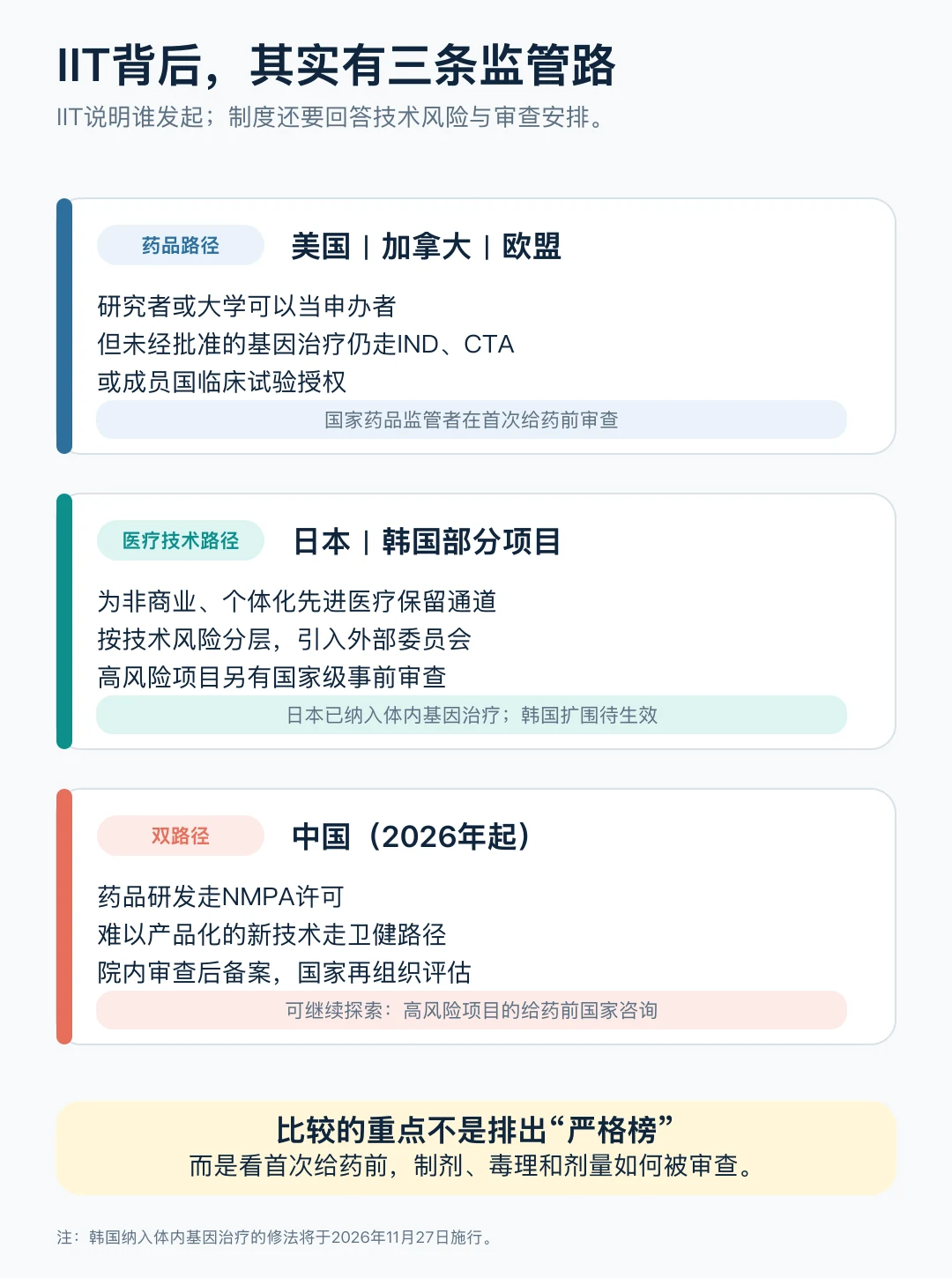
2. International Comparison: Three Regulatory Pathways Behind IIT
| Regulatory structure | Representative jurisdictions | Role of IIT | Principal arrangements before first human administration |
|---|---|---|---|
| Investigational-drug pathway | United States, Canada, European Union | Researchers or universities can act as sponsors but assume full sponsor responsibilities | Unapproved gene therapies generally require an IND, CTA or member-state clinical trial authorization |
| Advanced-medical-technology pathway | Japan; some programmes in South Korea | Preserves a pathway for noncommercial, individualized advanced medical care while classifying projects by risk | External professional committees and national authorities participate, with higher requirements for high-risk projects |
| Dual pathways | China from 2026 onward | Projects suitable for product development follow the drug pathway; some innovations difficult to develop into products follow the new-biomedical-technology pathway | Drugs require NMPA authorization; new technologies undergo institutional review, national filing and subsequent professional assessment |
These three frameworks cannot simply be ranked from best to worst.
The drug pathway offers clear boundaries for product quality and national review, at the cost of higher expense and longer timelines. The medical-technology pathway can address single-patient and noncommercial needs, but must ensure equivalent capacity in pharmaceutical quality, toxicology and long-term follow-up.
The meaningful comparison is not which country is “strictest,” but rather:
Can a framework allow innovators to propose solutions while enabling people who do not depend on the project's success to assess the risks independently?
3. North America, the European Union and Australia: Researchers Can Become Sponsors
United States: Success, Failure and Reform
In the United States, a physician can serve as both sponsor and investigator. This combines responsibilities rather than reducing them: the researcher must fulfill sponsor obligations such as FDA submissions, preparation documentation, study monitoring and safety reporting. [10][11]
Unapproved gene therapies generally require an IND. Even for one patient, a single-patient expanded-access IND may be used; nonemergency use still requires FDA authorization, IRB review and informed consent. [10][12]
“Baby KJ,” who received individualized base editing in 2025, is an instructive example. KJ had CPS1 deficiency, with a high risk of early death. Treatment was authorized through a single-patient expanded-access IND, with multidisciplinary oversight and staged dosing. The paper also explicitly acknowledged that follow-up remained short at publication and that long-term safety and efficacy were uncertain. [12][22]
The institutional lesson is to distribute development, ethics, product review and subsequent dosing decisions among different responsible parties.
US gene-therapy regulation has also evolved through failure.
In 1999, 18-year-old Jesse Gelsinger died in an academic gene-transfer study at the University of Pennsylvania. Subsequent investigations identified problems beyond the severe immune response caused by the adenoviral vector, including serious-adverse-event reporting, informed consent, trial monitoring and investigators' conflicts of interest. The event prompted stronger US requirements for adverse-event reporting, information sharing and public oversight in gene therapy. [24]
Considering Jesse alongside Baby KJ does not mean using a failure to cancel out a success. It shows that national authorization and institutional review cannot eliminate uncertainty. What a framework can truly build is the capacity to report failures promptly, review them independently and turn the lessons into rules for subsequent research.
Canada and the European Union: Academic Sponsors Still Bear Product Responsibilities
Canada takes a similar approach: individual researchers and universities can act as sponsors, but unapproved drugs, biological products and gene therapies generally still require a CTA submitted to Health Canada before research begins. [13]
The European Union places gene therapies within the advanced therapy medicinal product (ATMP) framework. From January 31, 2025, clinical trials in the EU and European Economic Area operate through CTIS. Academic and noncommercial sponsors likewise require clinical trial authorization from member states. [14][15]
The EU also provides a “hospital exemption” for highly individualized ATMPs. However, it is a special clinical-use mechanism subject to member-state conditions, not permission to bypass clinical trial authorization. [16]
The principal lesson from European and North American frameworks is:
IIT can change who the sponsor is without necessarily lowering quality standards for an investigational product.
Australia: Distributed Oversight in a Notification-Based Pathway
Australia offers a different version of the investigational-product pathway. Clinical trials using unapproved gene, cell or tissue therapies must enter the Clinical Trial Notification (CTN) or Clinical Trial Approval (CTA) process. Under CTA, the Therapeutic Goods Administration (TGA) reviews limited scientific information. CTN is a notification system: TGA does not assess the full trial dataset upon receiving notification. The main scientific, risk–benefit and ethical judgments are made by the Human Research Ethics Committee (HREC) and the implementing institution, while the Australian sponsor ensures that all required permissions are in place. [25][26]
This does not mean that gene therapy needs “only a filing.” If viral vectors or other components constitute genetically modified organisms, the project generally also requires institutional biosafety committee review and authorization from the Office of the Gene Technology Regulator (OGTR), depending on vector release and transmission risks. Australia's experience shows that national pre-review of each project is not the only model. Notification, professional ethics review, institutional responsibility and gene-technology-specific authorization can form distributed oversight, provided each party's duties and capabilities are sufficiently clear. [27]
4. Japan and South Korea: Dedicated Pathways for Individualized Technologies
Japan and South Korea address a problem closer to China's circumstances: how to give advanced medical technologies that are difficult to commercialize a nationally recognized research pathway within hospitals.
Japan: Placing In Vivo Gene Therapy in the Highest-Risk Category
From May 31, 2025, Japan amended the Act on the Safety of Regenerative Medicine to formally include nucleic-acid-based medical technologies such as in vivo gene therapy and in vivo genome editing. [17]
Official rules classify specified nucleic-acid technologies as Class I regenerative medicine and related technologies, the highest-risk category. Projects must be reviewed by a specified certified committee with third-party independence. Plans must be submitted in advance to the Minister of Health, Labour and Welfare, with a 90-day restriction on implementation so that national authorities can obtain expert opinions, confirm safety and request changes. [18][19]
An instructive feature of Japan's system is that noncommercial or highly individualized projects still undergo professional review outside the institution, while not every single-patient technology is required to replicate the entire commercial drug-development process.
South Korea: Regulatory Boundaries Continue to Expand
South Korea's advanced-regenerative-medicine framework requires medical institutions to obtain the appropriate qualifications first. Research plans undergo review by a national deliberation committee; high-risk projects also require approval from the Ministry of Food and Drug Safety, with arrangements for adverse-event reporting and long-term follow-up. [20]
As of July 25, 2026, the relevant definitions in South Korea's current law still primarily concerned human cells. An amendment passed in May 2026 added “genetic material and related substances” to cover in vivo gene therapy, but takes effect only on November 27, 2026. [21]
Japan has completed its expansion, South Korea is in transition, and China also introduced its new-biomedical-technology framework in 2026. This shows that countries are seriously addressing the same emerging question:
As gene therapy develops from “modify cells and return them to the body” to “deliver editing tools directly into the body,” existing frameworks must evolve alongside the technology.
5. What Progress Do China's New Rules Bring?
This case occurred in March 2025. The Regulations on the Administration of Clinical Research and Clinical Translation of New Biomedical Technologies, effective May 1, 2026, are not retroactive and cannot be used directly to assess this case. [7]
The new rules nevertheless represent an important step toward establishing a pathway for noncommercial advanced medical technologies in China.
They explicitly require:
- Implementation by eligible Grade III, Class A medical institutions;
- Academic review and ethics review;
- Filing with the national health authority within five working days after review is approved;
- National authorities may arrange professional assessment of filed studies and require suspension, modification or termination;
- Research must be suspended after a serious adverse reaction, undergo renewed ethics assessment and be reported to national authorities;
- Participants must not be charged research-related fees;
- Original records should, in principle, be retained for 30 years. [7]
The accompanying classification principles preserve the pharmaceutical regulatory pathway for projects intended for product registration, while leaving room for highly individualized technologies that have not yet been, or are difficult to be, developed into drugs. Viral-vector gene therapy and in vivo gene editing using vectors such as AAV are included in determining regulatory attributes. [8][9]
This framework deserves recognition because it does not simply send rare-disease innovation back to the commercial market. It acknowledges that hospitals and research institutions can also drive medical-technology innovation.
A possible next step is “risk-triggered prior review” for a small number of particularly high-risk projects:
- First use in humans;
- In vivo genome editing;
- Dual viral vectors or high vector doses;
- Administration to critical organs such as the central nervous system;
- Child participants;
- Irreversible or potentially long-lasting biological changes.
When several conditions are met, a project could undergo joint national consultation or review in pharmaceutical quality, toxicology, clinical practice and ethics before administration, whether it is called an IIT, drug research or a new biomedical technology.
This is not a direct copy of the FDA. It would strengthen risk-proportionate support and oversight within the new-technology pathway China has already established.
6. Six Categories of Records Needed to Clarify the Facts
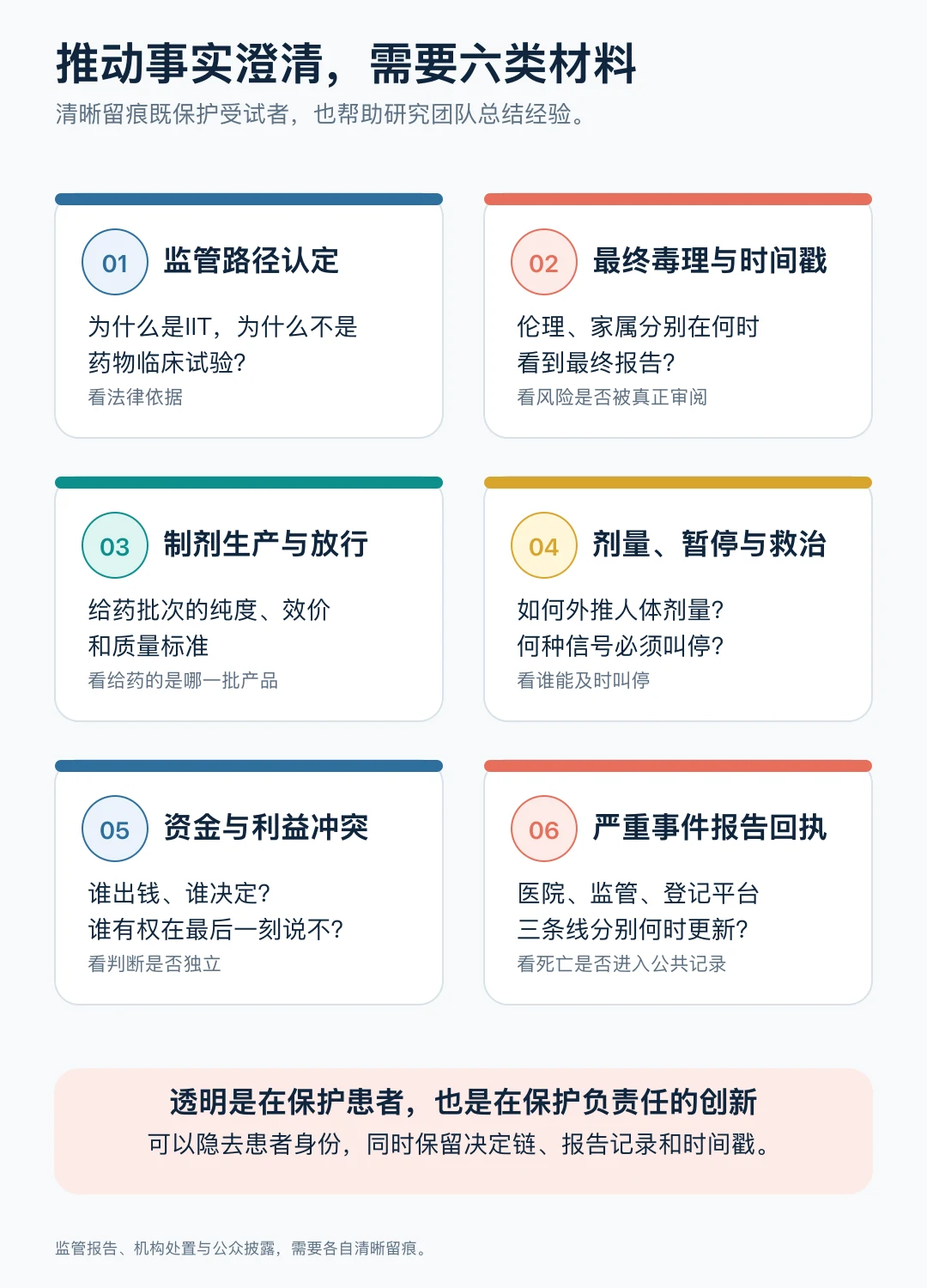
If the subsequent investigation can explain the following six categories of records while protecting patient privacy, it will help the public understand the event accurately and help other research teams learn from it:
- Documents determining the regulatory pathway: why the project was classified as an IIT and whether drug or health authorities were consulted;
- Preclinical materials and timestamps: when the ethics committee and family saw the final monkey toxicology report, and whether risk information was updated;
- Preparation manufacturing and release records: the titer, purity, potency and release specifications of the actual administered batch;
- Human dose, stopping rules and rescue plan: how the dose was extrapolated and which signals required the research to stop;
- Funding agreements and conflict-of-interest management: how funds entered the institution and how research decisions remained independent;
- Serious-adverse-event reporting records: when the institution, regulatory authorities and trial registry each received updates.
Making these records public does not require disclosure of the child's identity or family privacy. Transparency can protect participants and responsible researchers alike, preventing one event from casting indiscriminate suspicion on all IITs.
7. Institutional Capacity Is What Really Needs Strengthening
The relevant scientific work should not be erased entirely because of the outcome in humans.
The research team explained how a CHD3 mutation affected protein levels, designed a corresponding base editor, obtained molecular and behavioral signals in mice, and explored an engineering approach in which a large editor delivered into a monkey's brain through dual AAV vectors could reassemble. For a rare neurodevelopmental disorder without an established treatment, these are valuable scientific advances. [5]
The lesson is that when laboratory findings enter human use, the project must also acquire capacity for clinical sponsorship, preparation quality and safety management.
A mature high-risk IIT framework should gradually develop:
- An institutional sponsor office independent of the research group;
- Capacity for preparation quality assurance and batch release;
- Pharmacovigilance personnel separate from the research team;
- Independent data safety monitoring and stopping mechanisms;
- Statistics, monitoring, insurance and compensation for injury;
- Experts capable of making independent judgments even when the team, hospital and funder all want to continue.
Such capabilities should not exist only in large companies. With more stable public funding, professional personnel and national technical support, university hospitals can also become important providers of high-quality, noncommercial medical innovation.
Closing Thoughts
IIT should neither be seen as a shortcut for lowering standards nor become a negative label for high-risk innovation.
It represents a valuable motivation in medicine: even when patients are few and markets small, some people are still willing to invest their time and knowledge in finding answers.
A framework's task is to ensure that such courage need not bear every risk alone.
The United States, Canada and the European Union emphasize unified standards for investigational products. Japan and South Korea explore risk-classified pathways for advanced medical technologies. China is developing parallel pathways for drugs and new biomedical technologies.
All these pathways will continue to improve. A more constructive shared direction may be:
Initiated by researchers, sponsored by institutions, supported by the state, and traceable by the public.
When innovators receive professional support, participants receive adequate protection, and failures can promptly become public knowledge, IIT can truly sustain hope for rare-disease patients.
Sources and Notes
This article's information cutoff is July 25, 2026. On July 24, Shanghai Jiao Tong University School of Medicine told the media that the event was “still under investigation.” No newer formal conclusion had been located at publication. The article distinguishes published papers, trial registration, documents described in media investigations and regulatory analysis. It does not make determinations of legal or ethical violations or academic misconduct by individuals or institutions.
China's new 2026 rules are not retroactive. South Korea's expansion provisions for in vivo gene therapy, passed in May 2026, take effect on November 27, 2026 and were not in force as of this article's date.
- Science: A fatal reaction(2026-07-23)
- Retraction Watch: summary of the joint investigation
- ClinicalTrials.gov: NCT06860672
- Economic Observer: Shanghai Jiao Tong University School of Medicine responds that the matter is “still under investigation”
- Nature: In vivo base editing of Chd3 rescues behavioural abnormalities in mice
- National Health Commission: Measures for the Administration of Investigator-Initiated Clinical Research Conducted by Medical and Healthcare Institutions
- State Council: Regulations on the Administration of Clinical Research and Clinical Translation of New Biomedical Technologies
- National Health Commission: Guiding Principles for Distinguishing New Biomedical Technologies from Drugs and Medical Devices (Interim)
- National Medical Products Administration: application guide for clinical drug trial approval
- FDA: IND Applications for Clinical Investigations—Overview
- FDA: Sponsor-Investigator IND Guidance
- FDA: single-patient expanded-access IND applications
- Health Canada: Clinical Trial Applications—Sponsor Guidance
- European Commission: Clinical Trials Regulation and CTIS
- EUR-Lex: Regulation (EU) No 536/2014
- EMA: lawful pathways for providing individualized ATMPs
- Japan's Ministry of Health, Labour and Welfare: rules applicable to gene-therapy clinical research after the 2025 legal amendment
- Japan's Ministry of Health, Labour and Welfare: regenerative-medicine provision plans and risk classification
- Japan's Ministry of Health, Labour and Welfare: Class I procedures under the Act on the Safety of Regenerative Medicine
- South Korea's National Law Information Center: Act on Advanced Regenerative Medicine (current version)
- South Korea's National Law Information Center: the 2026 amendment and effective date
- NEJM: Patient-Specific In Vivo Gene Editing to Treat a Rare Genetic Disease
- National Health Commission and other authorities: Measures for Ethical Review of Life Sciences and Medical Research Involving Humans
- US National Academies: the Jesse Gelsinger case and oversight of gene-transfer research
- Australia's TGA: the Clinical Trial Notification (CTN) system
- Australia's TGA: CTN and CTA pathways for advanced therapy products
- Australia's OGTR: authorization for human clinical trials involving GMOs
Image Credits
The cover and infographics in this article were created by this WeChat account. Original figures from the Nature paper are not directly reproduced in the main text.
