English translation of the original Chinese article. Publication dates and the extent of recovered text are preserved. Figures retain their original labels. Read the Chinese original.
Southern Medical University
Keywords: sensory biology, receptors, ion channels
Although I am not a foodie, the question that first drew me to neurobiology was a foodie's question: how do we perceive sour, sweet, bitter, salty and umami? Why not sour, sweet, bitter and spicy? Scientifically, spiciness is a pain sensation rather than a taste. The scientific definition of taste includes the six modalities mentioned above: sour, sweet, bitter, salty and umami.
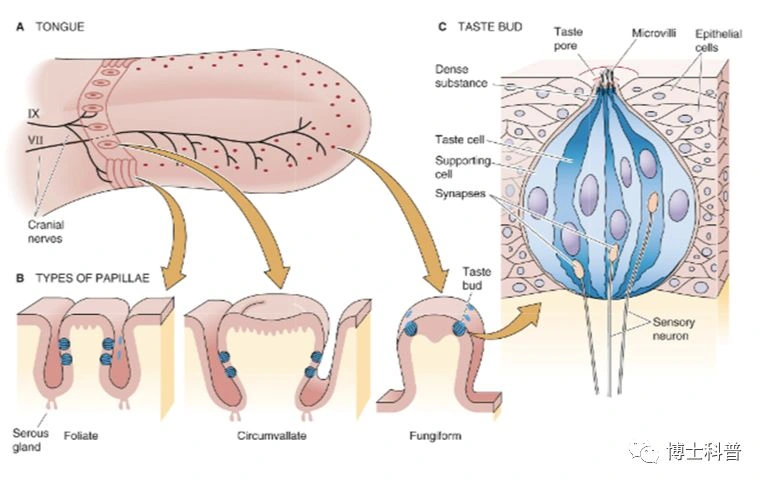
Taste arises when food directly stimulates taste buds (Figure 1). Looking in a mirror, we can see many tiny papillae covering the tongue. Each papilla contains many taste buds. On average, a person has 2000–5000 taste buds, although extreme cases may have as few as 500 or as many as 20000. Each taste bud contains 50–100 taste-receptor cells, and different types of these cells allow us to distinguish different flavors. Different molecules act on different receptors in various taste-receptor cells, which transmit signals through corresponding neural pathways to the cerebral cortex.
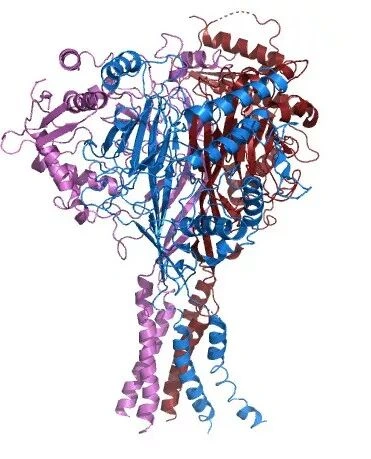
How do we distinguish different tastes? Different receptors in taste-receptor cells are activated by different chemical molecules. For example, an appropriate amount of NaCl activates the sodium-ion channel ENaC, depolarizing the corresponding taste-receptor cells. Action potentials are transmitted through specific nerve impulses to the corresponding cortical regions. Umami arises when L-glutamate in food specifically binds to the T1R1/T1R3 heterodimer. Interestingly, taste and smell are closely related in humans. Without a sense of smell, apples and onions taste much the same: very bland.
Many scientific questions about taste remain unanswered. For example, an appropriate amount of NaCl tastes salty, but why excessive NaCl produces a bitter sensation is still unknown. Which receptor mediates sour taste is also still unknown.
Figure 1: Taste-receptor cells. A, tongue; B, different types of small papillae; C, a taste bud and its taste-receptor cells.
*This article represents the author's personal views, not those of this website. Other media, websites or individuals reproducing material from this website must acknowledge its source and assume responsibility for copyright and other legal matters. Authors who do not wish their work to be reproduced, or who wish to discuss reproduction fees or related matters, should contact us.
Images from the matching WeChat article
The following images were recovered from the matching article retained by the WeChat account and restored in their original order.

Additional images were recovered from the matching article retained by the WeChat account and grouped after the main text. The historical archive text and existing editorial corrections are preserved.