
English translation of the original Chinese article. Publication dates and the extent of recovered text are preserved. Figures retain their original labels. Read the Chinese original.

Nanjing Tech University
Keywords: in vitro diagnostics, lab-on-a-chip, paper-based devices
In vitro diagnostics (IVD) mainly obtains clinical diagnostic information by testing urine, sweat, blood, saliva and tissue fluids. It provides scientific evidence for disease prevention and diagnosis and is vital to healthcare systems. Current priorities in the IVD market include (1) automation, (2) miniaturization and integration, (3) molecular approaches, and (4) personalization. IVD improves diagnostic efficiency, supports remote and on-site diagnosis, and can reduce the risk of infectious-disease transmission. IVD technologies widely used in developed countries require expensive equipment and substantial professional expertise, limiting their adoption in developing countries and remote regions. A major challenge in early monitoring and control of infectious diseases is the lack of simple, reliable and inexpensive diagnostic technologies. Accordingly, the World Health Organization advocates IVD technologies and devices for remote regions that are easy to use, sensitive, highly selective, nonpolluting, rapid and affordable.
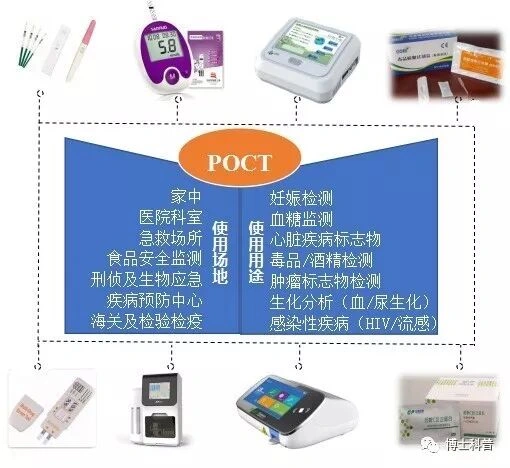
Point-of-care testing (POCT), also called immediate testing, meets some of these requirements as an inexpensive and rapid approach. Common POCT products include pregnancy tests, blood glucose meters and various virus-testing strips. A segment of the IVD-device industry, POCT is characterized by automation, miniaturization, bedside use, integration, molecular approaches, personalization and standardization. It largely avoids reliance on large, expensive equipment and specialized personnel, meeting basic needs for early diagnosis. POCT is also described as bedside testing, on-site alternative testing, patient self-testing, testing outside the laboratory, decentralized testing and “satellite” testing. It can rapidly support diagnosis, treatment, nursing and monitoring of disease progression, greatly improving care quality and patient satisfaction. POCT is now widely used in surgery, emergency departments, clinics, patients' homes and outdoor emergency settings (Figure 1).
Figure 1: Settings and purposes for POCT.
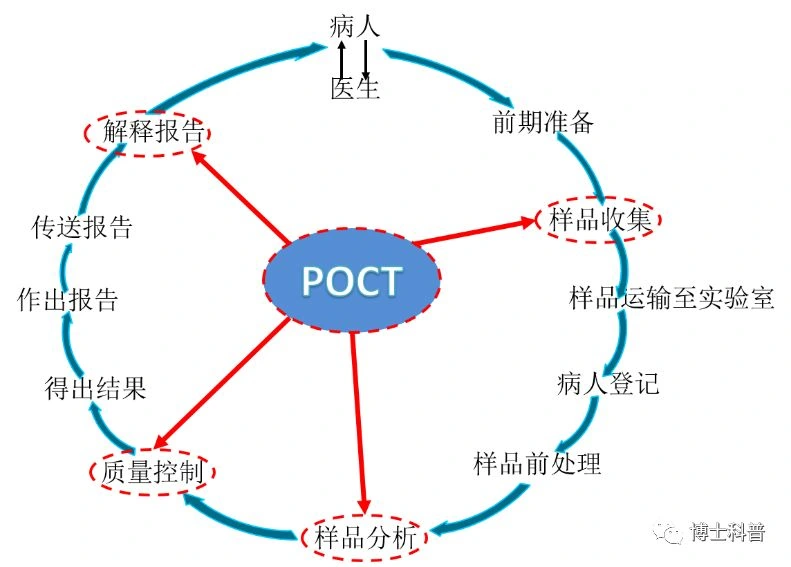
POCT has distinct advantages over traditional diagnosis in clinical laboratories (Figure 2). Future wearable devices for real-time monitoring will require users to wear POCT products for long periods, making flexible materials an important consideration. Current POCT products, however, have disadvantages such as high costs per individual test and limited flexibility. Flexible biomaterials address the rigidity of conventional materials, enabling devices that conform naturally to human tissues and provide long-term, precise medical measurements. Combined with mobile internet technology, they open new possibilities for telemedicine and supply real-time foundational data for data-driven healthcare. Flexible biosensors detect disease biomarkers by measuring temperature, respiration, blood pressure and electrocardiographic signals, as well as sampling body fluids. They can broadly support monitoring of physiological functions and early disease diagnosis. Flexible materials are soft, foldable, bendable and easily deformed; common examples include polyvinyl alcohol, polyester, paper and textiles. Sensors made from these materials have good flexibility and stretchability, can bend and fold freely, and can take many structural forms. Paper-based devices and microneedle patches are two flexible-material approaches that many researchers have developed for in vitro testing. Paper-based devices are inexpensive to manufacture, consume small sample volumes and provide rapid testing. Microneedle patches are easy to prepare, biocompatible, and capable of sampling interstitial fluid and delivering drugs in situ. These two low-cost materials are useful tools for making POCT products, with the potential to improve healthcare in remote regions and enable remote disease monitoring or early diagnosis.
Figure 2: Comparison of POCT with conventional disease diagnosis and treatment.
With rapid technological advances in the twenty-first century, analytical equipment is becoming smaller, more integrated and more portable. The development of the “lab-on-a-chip” offers many advantages, including miniaturization, personalization, integration and high throughput, making it a highly promising field. Its benefits include (1) miniaturization and integration, (2) low reagent consumption, (3) high-throughput separation and detection, (4) rapid analysis, and (5) low cost. The technology is widely used in biochemistry, materials science, pharmaceutical analysis and medical diagnosis. Professor Whitesides' team at Harvard University and other research groups have made chips from inexpensive paper and achieved notable progress in detecting biomolecules, cells, genetic material, metal ions and gases. Urine test strips and pregnancy tests are currently the most successful paper-based devices on the market. Urine strips detect various biomolecules through color changes and are used simply by dipping them into urine. Pregnancy tests require less sample than urine strips: fluid flows laterally from one end of the strip to the other, carrying reagents with it for detection. This is called immunochromatography.
Paper-based devices replace conventional materials such as quartz, silicon, glass and polymers with paper. Combining the benefits of paper and microfluidics, they are miniature analytical devices with patterned microchannels on the paper surface. Compared with conventional microfluidic chips, they offer (1) a large specific surface area for storing detection reagents, (2) self-driven flow through the channels without an additional driving force, since paper consists mainly of cellulose, (3) low sample consumption, (4) low detection background, (5) good biocompatibility and the ability to alter paper properties through chemical modification, (6) disposable, portable and environmentally friendly analysis, and (7) simple operation without specialized personnel. These devices provide portable testing and real-time on-site monitoring for clinical diagnosis and treatment, environmental health and food safety. They are also effective tools for low-cost immediate diagnosis in underserved regions lacking medical equipment and healthcare personnel. Nevertheless, paper-based devices have clear limitations: detection sensitivity can be unsatisfactory, channel fibers readily adsorb samples, high-precision integrated chips are difficult to produce, and solutions evaporate readily from open channels.
Although IVD is still developing, it is hoped that in the near future more health indicators can be tested more conveniently, helping safeguard people's health.
*This article represents the author's personal views, not those of this website. Other media, websites or individuals reproducing material from this website must acknowledge its source and assume responsibility for copyright and other legal matters. Authors who do not wish their work to be reproduced, or who wish to discuss reproduction fees or related matters, should contact us.
Images from the matching WeChat article
The following images were recovered from the matching article retained by the WeChat account and restored in their original order.
The text was recovered from a public archive of the original site's RSS feed; some original images are still missing. Additional images were recovered from the matching article retained by the WeChat account and grouped after the main text. The historical archive text and existing editorial corrections are preserved.