English translation of the original Chinese article. Publication dates and the extent of recovered text are preserved. Figures retain their original labels. Read the Chinese original.
Period television dramas often contain scenes of poisoning. Some that left a deep impression on me include the “Old Imp” 周伯通 collapsing after 黄药师’s venomous snake bites his calf on Peach Blossom Island in The Legend of the Condor Heroes; 段誉 suffering unusually severe pain throughout his body after a swarm of bees stings him in the Shu region in Demi-Gods and Semi-Devils; and 曹操’s third son, 曹冲, dying after a poisonous rat bites him in Romance of the Three Kingdoms. In everyday life, we also hear many similar stories, from news reports of poisoning after scorpion stings to people around us being poisoned by bee stings or snakebites. I have always wondered why venoms from creatures such as snakes and scorpions cause numbness and pain, and, in severe cases, paralysis, amputation, or even death. These questions were answered during my doctoral studies. As we know, these venomous creatures produce certain toxins. Some are proteins or peptides, while other toxic components belong to other chemical types. Certain toxins interact with ion channels in the human body, altering their opening, closing, or permeability to ions. Others act on different targets; not all poisoning mechanisms can be reduced to blocking ion channels. Because ion channels are a physiological foundation for normal nervous-system function, their blockage by toxin proteins can produce discomfort such as numbness and pain. To understand this mechanism simply, we first need to understand the term “ion channel.”
As the name suggests, an ion channel is a passage that permits ions to pass, rather like a highway tunnel through a mountain. Ion channels are large biological protein molecules expressed in cell membranes. They occur in the membranes of many kinds of cells and are particularly important in excitable cells such as nerve and muscle cells. Ions continually move into and out of cells. Ion channels tightly control the types and amounts of ions passing through, adjusting their relative concentrations inside and outside. Channels controlling sodium-ion permeability are called sodium channels; those controlling potassium-ion permeability are potassium channels. In a typical resting neuron, potassium concentration is usually higher inside the cell, while sodium concentration is higher outside. The selective permeability of the cell membrane and the sodium–potassium pump jointly maintain these gradients and the membrane potential. Ion-channel activity affects membrane potential and electrical signals, contributing to normal sensation and neural activity, but can also produce abnormalities when toxins interfere. Ion channels are one important factor influencing the distribution of ions inside and outside cells. When toxin proteins block them, ions can no longer enter and leave in an orderly, channel-controlled manner, and sensations such as numbness and pain arise.
Different toxins have different targets and mechanisms. Some block potassium, sodium, or calcium channels; others alter how long channels remain open. The manifestations of poisoning also depend on dose, route of entry, and affected tissues. They cannot be mapped one to one as “potassium-channel blockage equals pain” and “sodium-channel blockage equals numbness.” Severe poisoning may impair the function of nerves, muscles, or other organs.
Toxin proteins are not, however, entirely useless substances that can only harm humans. As research on toxin proteins and ion channels deepens, scientists are creatively modifying toxins in an effort to turn some into medicines beneficial to human health. Australian scientists, for example, are working to identify protein-based pain treatments from cone-snail toxins in the South Pacific, and this line of work has begun to show promise. Related medicines must undergo safety and efficacy testing and be used through properly regulated methods of administration.
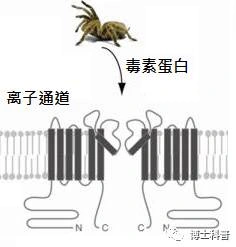
Figure 1: A toxin protein acting on an ion channel
References:
[1] Lahiani, A et al. The Molecular basis of Toxins` interactions with intracelular signaling via discrete protals. Toxins, 2017, 9(3), 107.
[2] Bohlen C. J. and Julius D. Receptor-targeting mechanisms of pain-causing toxins: how ow? Toxincon, 2012, 60(3), 254-264;
[3] Netirojjanakul, C. and Miranda, L. P. Progress and challenges in the optimization of toxin peptides for developement as pain therapeutics. Curr Opin Chem Biol, 2017, 38:70-79
Additional References
The text was recovered from the matching article retained in the WeChat account, with the original website’s publication record retained. The old WeChat promotional layout has been removed. Available original illustrations have been restored.
Editorial revision note: Recovery revision dated 2026-10-10: Corrected the resting distribution of sodium and potassium, toxin classifications, and channel mechanisms. Research progress is not equated with the idea that directly taking toxins can treat disease. The text contains no personal name, so the old website’s author field is retained.