English translation of the original Chinese article. Publication dates and the extent of recovered text are preserved. Figures retain their original labels. Read the Chinese original.
Department of Mathematics, University of Macau
Keywords: probability, gambling
I earned my master’s degree in mathematics at the University of Macau and lived in Macau for many years. When friends hear the words “mathematics” and “Macau,” they naturally think of gambling. They ask me for tricks to win at gambling, or even to pick lottery numbers. In Macau I often visited casinos, but I never gambled. Studying probability does not reveal better gambling techniques. Instead, it exposes how misleading gambling can be, which is why a rational person would not gamble. In fact, no academic discipline can teach you how to profit from gambling. Anyone hoping to get rich that way can give up the idea.
Influenced by the God of Gamblers films, many people imagine casinos as chaotic places where dealers cheat, most patrons belong to criminal gangs, and disagreements immediately lead to knives or guns. On this point, I can confidently say that such things could not happen in Macau’s licensed casinos. On the contrary, Macau’s gambling industry strictly follows the law, and public safety throughout Macau is generally very good. In its casinos, you need not worry about your personal safety after winning money. However, remember that Macau strictly enforces the rule prohibiting anyone under 21 from entering casinos, so children visiting Macau should not expect to see inside them. Casino security does not check every visitor’s identification; staff request it when someone looks possibly underage. Older-looking youngsters may therefore slip through. Similarly, lottery results in mainland China are not subject to deliberate manipulation, but a greater problem with sports and welfare lotteries is the lack of transparency about where their profits go. For example, the rules of the Double Colour Ball lottery require 35% of lottery revenue to be spent on public welfare, yet corresponding oversight is lacking.
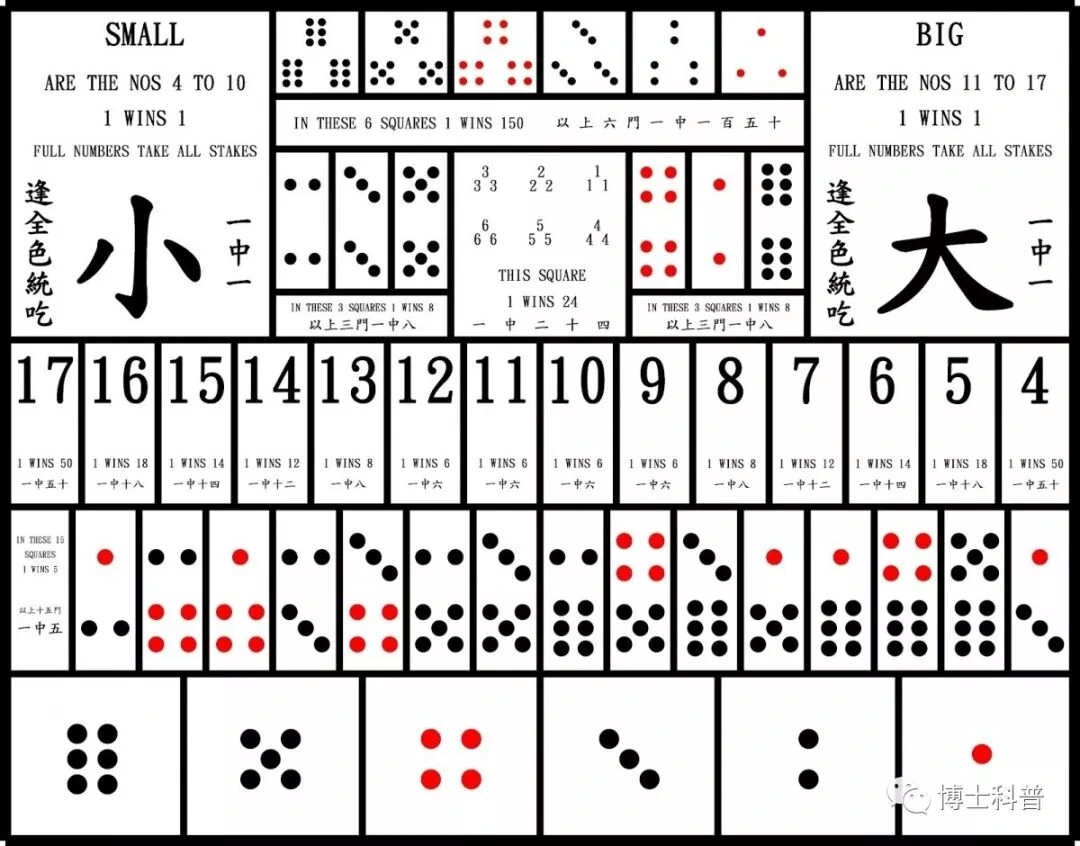
The simplest casino game is Sic Bo, also known as betting on Big or Small [1]. The picture below shows a typical Sic Bo table:
Figure 1: A Sic Bo table.
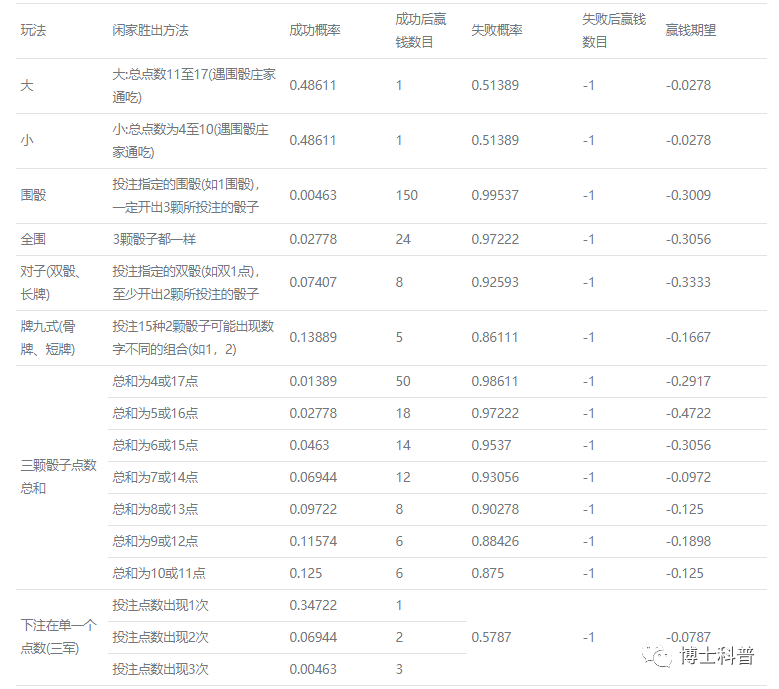
In Sic Bo, the most common bet is on whether the total on three dice is Big or Small: totals from 4 to 10 are Small, and totals from 11 to 17 are Big, excluding triples. A triple means that all three dice show the same number; in this case the house wins both Big and Small bets. If you choose correctly, you win an amount equal to your stake. If you choose incorrectly, or a triple occurs, the casino takes your stake. This is the most common way to play Sic Bo. Other bets follow similar rules but have different payouts. For example, in the second-to-last row, which shows two-dice combinations, if you bet on the rightmost combination, (1, 3), and the result includes both 1 and 3, you receive winnings equal to five times your stake. The final row, betting on a single number, also called Three Armies, works slightly differently. If you bet on 5 and one die shows 5, your winnings equal your stake; if two dice show 5, you win twice your stake; if three show 5, you win three times your stake. The table below lists the rules for each bet, its probability of winning, and the house’s expected advantage.
| Bet | How the bettor wins | Probability of success | Winnings on success | Probability of failure | Winnings on failure | Expected winnings |
| Big | Big: a total from 11 to 17; the house wins if a triple occurs | 0.48611 | 1 | 0.51389 | -1 | -0.0278 |
| Small | Small: a total from 4 to 10; the house wins if a triple occurs | 0.48611 | 1 | 0.51389 | -1 | -0.0278 |
| Specific triple | Bet on a specified triple, such as three 1s; all three dice must show the chosen number | 0.00463 | 150 | 0.99537 | -1 | -0.3009 |
| Any triple | All three dice show the same number | 0.02778 | 24 | 0.97222 | -1 | -0.3056 |
| Pair (double, long tile) | Bet on a specified double, such as double 1; at least two dice must show the chosen number | 0.07407 | 8 | 0.92593 | -1 | -0.3333 |
| Pai Gow-style combination (domino, short tile) | Bet on one of the 15 possible two-dice combinations of different numbers, such as (1, 2) | 0.13889 | 5 | 0.86111 | -1 | -0.1667 |
| Total on three dice | A total of 4 or 17 | 0.01389 | 50 | 0.98611 | -1 | -0.2917 |
| A total of 5 or 16 | 0.02778 | 18 | 0.97222 | -1 | -0.4722 | |
| A total of 6 or 15 | 0.0463 | 14 | 0.9537 | -1 | -0.3056 | |
| A total of 7 or 14 | 0.06944 | 12 | 0.93056 | -1 | -0.0972 | |
| A total of 8 or 13 | 0.09722 | 8 | 0.90278 | -1 | -0.125 | |
| A total of 9 or 12 | 0.11574 | 6 | 0.88426 | -1 | -0.1898 | |
| A total of 10 or 11 | 0.125 | 6 | 0.875 | -1 | -0.125 | |
| Bet on a single number (Three Armies) | The chosen number appears once | 0.34722 | 1 | 0.5787 | -1 | -0.0787 |
| The chosen number appears twice | 0.06944 | 2 | ||||
| The chosen number appears three times | 0.00463 | 3 |
Table 1: Expected returns on Sic Bo bets
Let me explain the table. Assume that the bettor stakes one unit. It shows the probabilities of winning and losing, and the expected return, for the different Sic Bo bets. To make it easier to read, winnings are positive and shown in green; losses are negative and shown in red. For example, the fourth row describes a bet on any triple. Its probability of success is 0.02778, and success brings winnings of 24 units. The probability that no triple occurs is 0.97222; in that case, the bettor loses the one-unit stake, which we record as winnings of −1 unit. Overall, the expected winnings are
0.02778×24+0.97222× (-1)= -0.3056,
In other words, the expected loss is 0.3056. The most unusual calculation is for the last row, a bet on a single number, or Three Armies. It is similar to the preceding calculations, but there are three winning outcomes. With probability 0.34722, the chosen number appears once and the bettor wins one unit. With probability 0.06944, it appears twice and the bettor wins two units. With probability 0.00463, it appears three times and the bettor wins three units. The probability that it never appears is 0.5787, resulting in a one-unit loss. Taken together, the expected winnings for a Three Armies bet are
0.34722×1+0.06944×2+0.00463×3+0.5787× (-1)= -0.0787,
Thus, the expected loss is 0.0787. What matters to us is the final column, expected winnings. Why is it entirely red, with no green? Of course it is: if a bet had a positive expected return shown in green, the casino would lose money. Casinos are not foolish.
As the rules above explain, when a bettor chooses Big or Small, the house wins either bet if a triple occurs. Its probability of winning is therefore slightly greater than 1/2, at 51.39%, while the bettor’s is slightly smaller, at 48.61%. This gives the house an advantage of 2.78%, or, more precisely, 1/36—the smallest house advantage among Sic Bo bets. Put simply, a HK$100 bet loses HK$2.78 on average. Macau casinos settle bets in Hong Kong dollars rather than renminbi or Macanese patacas. At first glance, an advantage of less than 3% may seem insignificant, just a tiny fraction of the stake. Do not underestimate it. If you deposit 100 dollars in a bank for a year, it might slowly earn about 3 dollars in interest. Put the same amount on a gambling table, and you can lose more than 2 dollars in less than a minute. Moreover, 100 dollars is usually only the smallest amount you can bet, and many other casino games give the house an advantage greater than 3%. Is that not a substantial loss?
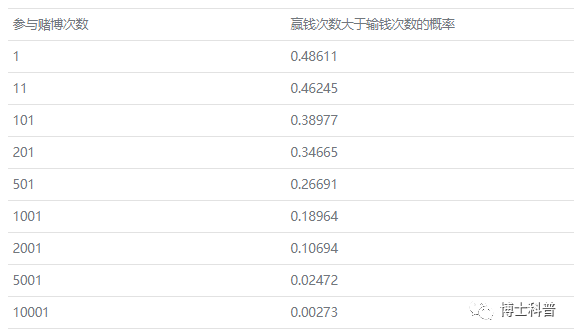
Many older people warn gamblers that “nine out of ten bets lose.” Strictly speaking, this is wrong. Winning and losing probabilities vary somewhat between games, but not by that much. For Big or Small, a more accurate statement is “51 losses in 100 bets.” Mathematics, however, gives us the law of large numbers. Roughly speaking, if you gamble often enough, the observed frequency of losses becomes close to the theoretical probability. Because the theoretical probability of losing is 51.39%, frequent gambling almost certainly brings more losses than wins, and the more you play, the more you lose. So persistent gambling leads to losses. The table below calculates the probability of having more wins than losses after 1, 11, 101, 201, 501, 1001, 2001, 5001 and 10001 bets. Odd totals are used to avoid a tie between the numbers of wins and losses.
| Number of bets | Probability that wins outnumber losses |
| 1 | 0.48611 |
| 11 | 0.46245 |
| 101 | 0.38977 |
| 201 | 0.34665 |
| 501 | 0.26691 |
| 1001 | 0.18964 |
| 2001 | 0.10694 |
| 5001 | 0.02472 |
| 10001 | 0.00273 |
Table 2: Probability of winning after repeated bets
The table shows that after 10001 consecutive Big-or-Small bets, the probability of having more wins than losses—that is, at least 5001 wins—is only 0.00273. After that many bets, losing money is almost certain.
Although probability readily exposes gambling’s misleading nature, many gamblers still have their own theories and believe these can deliver wins without losses. In fact, all theories promising gambling profits are wrong. Two such approaches are particularly widespread. Let us briefly examine these supposed gambling techniques.
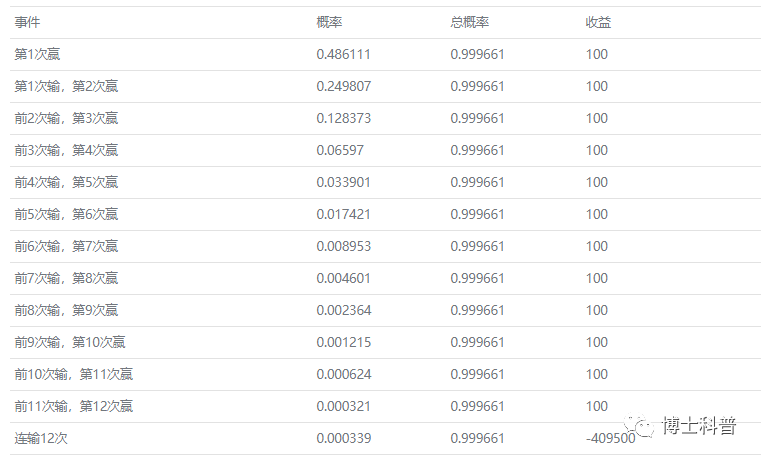
The first supposed “technique” is what we call doubling the stake. Again, consider Big or Small. Start by betting 100; if you win, stop. If you lose, bet 200, then 400 after another loss, and continue until you win or exhaust your bankroll. This does not violate the rules, but the house sets minimum and maximum bets. Suppose the minimum is HK$100 and the maximum HK$200,000. To simplify the calculation, let the maximum be HK$204,800, so it is exactly 2048 = 211times the minimum. This strategy then permits at most 11 doublings, provided you have a sufficiently large bankroll—about HK$409,500. If your bankroll is smaller, fewer than 11 doublings are possible. The table below summarises the probabilities and returns for the possible outcomes.
| Event | Probability | Total probability | Return |
| Win on the first bet | 0.486111 | 0.999661 | 100 |
| Lose the first bet; win the second | 0.249807 | 0.999661 | 100 |
| Lose the first two bets; win the third | 0.128373 | 0.999661 | 100 |
| Lose the first three bets; win the fourth | 0.06597 | 0.999661 | 100 |
| Lose the first four bets; win the fifth | 0.033901 | 0.999661 | 100 |
| Lose the first five bets; win the sixth | 0.017421 | 0.999661 | 100 |
| Lose the first six bets; win the seventh | 0.008953 | 0.999661 | 100 |
| Lose the first seven bets; win the eighth | 0.004601 | 0.999661 | 100 |
| Lose the first eight bets; win the ninth | 0.002364 | 0.999661 | 100 |
| Lose the first nine bets; win the tenth | 0.001215 | 0.999661 | 100 |
| Lose the first ten bets; win the eleventh | 0.000624 | 0.999661 | 100 |
| Lose the first eleven bets; win the twelfth | 0.000321 | 0.999661 | 100 |
| Lose twelve bets in a row | 0.000339 | 0.999661 | -409500 |
Table 3: Return distribution for the doubling strategy
This strategy therefore gives a probability of 0.99966082 of gaining HK$100, but also a probability of 0.000339 of losing HK$409,500. You are very likely to make a small gain, yet twelve consecutive losses cause an extremely large loss. Overall, the expected return is
0.99966082×100+0.000339× (-409500)= -38.9282866,
In other words, gambling with this strategy loses an average of HK$38.9282866 each time.
The second supposed “technique” can be summed up as “bet Small after repeated Big outcomes, and Big after repeated Small outcomes.” A player watches the table until Big appears ten consecutive times, then bets Small. Since the probability of eleven consecutive Big outcomes is only 0.000358, they reason that Small must now be very likely. This incorrectly calculates conditional probability and ignores the independence of successive casino rounds. Eleven consecutive Big outcomes are indeed unlikely. But given that the first ten have already happened, the probability of Big on the eleventh round is no different from its probability on any other round. The following mathematical derivation explains the calculation. Readers uninterested in the formulas can skip this section and go straight to the conclusion.
Let this denote the event of ten consecutive Big outcomes; B1denotes the event that the eleventh outcome is Big; B2denotes the event that the eleventh outcome is Small; B3denotes the event that the eleventh outcome is a triple. P(X) is the probability of event X; P(X|Y) is the probability of X given that Y has occurred; and P(XY) is the probability that X and Y both occur. Let the probability of Big in each round be p1, the probability of Small be p2, and the probability of a triple be p3. From the earlier table, we know that p1=p2=0.48611, p3= 0.02778. We can then calculate
Using the conditional-probability formula, we obtain
In the formula above, P(B1|A) is the probability that the eleventh outcome is Big, given Big on the preceding ten rounds. It is the same as the probability of Big in any round: p1. The same reasoning applies to Small and to triples on the eleventh round. Thus, after ten consecutive Big outcomes, the probabilities of Big, Small and a triple on the eleventh round are exactly the same as on any other round. The independence of the eleventh outcome from the first ten gives the same conclusion. There is therefore no pattern to gambling: the outcomes of the previous N rounds do not affect the next. Casinos’ large profits depend precisely on this uncertainty. Lotteries are the same: the results of the previous 100 draws do not affect the current draw. I can therefore confidently say that every expert who claims to analyse lottery patterns is a fraud, without exception. Lotteries also have a greater expected loss, around 50%, compared with roughly 3% in casinos, making them an even worse deal. Rational people do not buy lottery tickets or gamble.
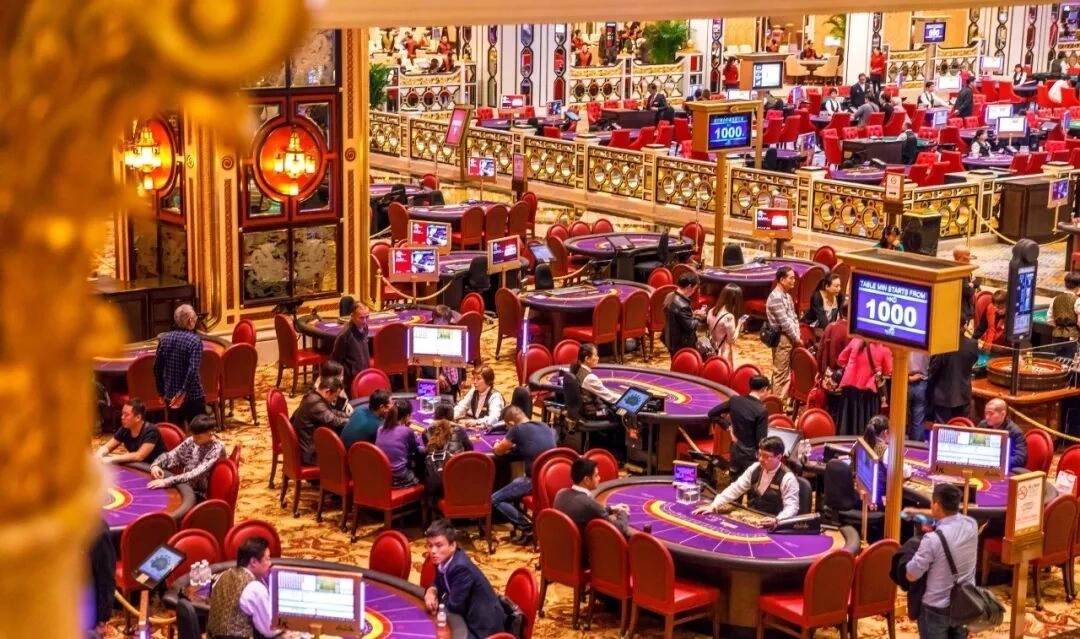
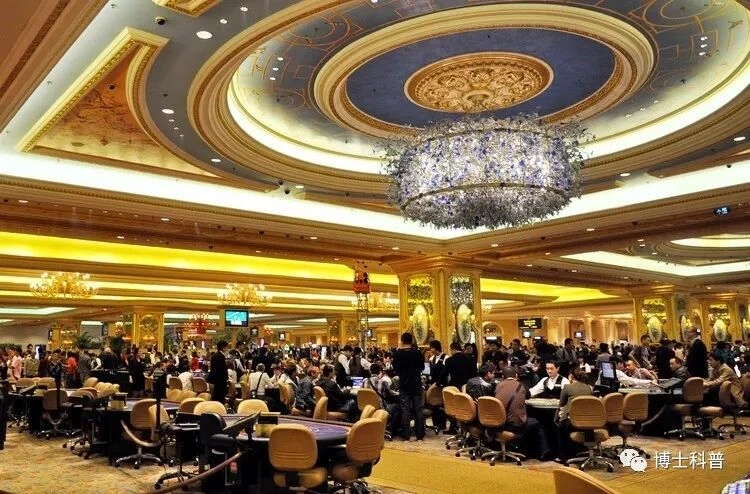
Sic Bo has given us a broad picture of how casinos make money. Their reliance on positive expected returns applies to every form of gambling. Casinos offer many other games; in Macau, the most common is baccarat [2]. Enter any casino and you see an impressive expanse of baccarat tables. The photograph below shows part of the Venetian casino in Macau. It comes from the internet, since visitors are not allowed to take photographs inside Macau casinos.
Figure 2: The Venetian casino, Macau
Baccarat’s rules are complicated, and interested readers can look them up. In broad terms, you choose either the banker or the player; choose correctly and you receive winnings, otherwise you lose. The banker and player have different rules for drawing an extra card, but bettors cannot decide whether to draw. As with Sic Bo, once the bet is placed, the outcome is out of your hands. Because the banker is slightly more likely to win, a successful bet on the banker pays only 95% of the stake. This still gives the casino an advantage. However, baccarat is among the games with the smallest expected return for the house. Its advantage is about 1.0579% on a banker bet and about 1.2351% on a player bet, both below the 2.78% advantage on Sic Bo Big-or-Small bets. This helps explain baccarat’s popularity in Macau. As with Sic Bo, whatever strategy you use, prolonged play almost certainly leads to losses under the law of large numbers.
Some readers may object: “But I saw a news story about a team of mathematicians who used mathematics to make a fortune in casinos.” You may mean the story “Nineteen Australian mathematicians gamble as a team for three years and win RMB15.6 billion” (http://news.163.com/12/0709/03/85UKG2NN00014AED.html). It was subsequently shown to be false, but the story had a real-world model. In the early 1990s, the MIT Blackjack Team used specialist knowledge of probability to make substantial profits in casinos [3]. Ben Mezrich later wrote a novel based on their story, titled Bringing Down the House (Bringing Down the House). Hollywood also made the film 21 in 2008, with the well-known Kevin Spacey among its stars. The MIT team certainly did not win at baccarat or Sic Bo, games in which bettors have no strategic choices. As its name suggests, the team relied on the one casino game in which players can beat the house in expected return: twenty-one, also called blackjack [4, 5]. Its rules are too complicated to explain fully here. The key is that players and the dealer can take cards; the higher total wins, but a total over 21 is a bust and loses. Your aim is therefore to make your total as high as possible without exceeding 21. One advantage for the dealer is that a player who busts loses even if the dealer also busts. Ordinarily, blackjack is unprofitable for the player. However, by using the cards already dealt to estimate the balance of high and low cards left in the deck, and adjusting the strategy accordingly, a player can beat the casino in expected return. Probability theory calls this Bayesian reasoning: updated information can improve a probability estimate [6]. For example, your girlfriend might reject your call when she is angry, but she might also do so because she is driving or in a meeting. A rejected call does not prove that she is angry, yet it gives you grounds to estimate that anger is more likely than usual. This is Bayesian estimation. Using it, the MIT Blackjack Team made substantial profits, but also attracted the casinos’ attention. They did not break the rules, yet they were blacklisted by the casinos and refused service whenever recognised. Do not assume their approach is easy to copy. It requires coordinated teamwork, exceptional memory and mental arithmetic, and avoiding casino blacklists. Anyone hoping to imitate it can abandon the idea.
You may be disappointed that I have not given you any tricks for gambling. In fact, nobody except a fraud would claim to have found such tricks. People say “small bets are entertaining; large bets can ruin your life,” but large bets begin with small ones. I therefore close by urging you to value your life and stay away from gambling.
*This article expresses the author’s personal views, not those of this website. Other media outlets, websites or individuals who reproduce it must credit the source and bear their own responsibility for copyright and other legal matters. Authors who do not wish their work to be reproduced, or who wish to discuss reproduction fees, should contact us.
References:[1] Sic Bo. https://zh.wikipedia.org/zh-cn/%E9%AA%B0%E5%AF%B6
[2] Baccarat. https://zh.wikipedia.org/wiki/%E7%99%BE%E5%AE%B6%E6%A8%82
[3] MIT Blackjack Team. https://en.wikipedia.org/wiki/MIT_Blackjack_Team
[4] Blackjack. https://zh.wikipedia.org/zh-cn/%E5%BB%BF%E4%B8%80%E9%BB%9E
[5] Jeff Ma. https://en.wikipedia.org/wiki/Jeff_Ma
[6] Bayes 27 theorem. https://en.wikipedia.org/wiki/Bayes%27_theorem
Images from the same-title WeChat manuscript
The following images come from the preserved WeChat manuscript with the same title and have been restored in their original order.


Additional illustrations have been recovered from the preserved WeChat manuscript with the same title and are grouped after the article. The archived text and existing editorial corrections have been retained.