
English translation of the original Chinese article. Publication dates and the extent of recovered text are preserved. Figures retain their original labels. Read the Chinese original.

Nagoya University
Keywords: reinforced concrete, corrosion, deterioration
Reinforced-concrete structures are widely used in buildings, highway bridges and other infrastructure because of their high structural stiffness and low construction cost. Deterioration during their service life directly affects their safety and fitness for use, shortening their lifespan. Strengthening and rehabilitating deteriorated reinforced-concrete structures already in service often requires substantial expenditure of labour and money. The American Society of Civil Engineers’ (ASCE) 2017 infrastructure report stated that strengthening and rehabilitating bridges in service across the United States would cost more than US$120 billion. Among the bridges requiring such work, a major cause of structural deterioration and damage is corrosion of the steel reinforcement inside the concrete.[1].
Rebar corrosion is common in highway bridges exposed to marine environments or large quantities of de-icing agents. Factors such as carbon dioxide and chloride ingress destroy the passive film that forms on the steel surface in the alkaline environment of concrete, causing the reinforcement to corrode. Meanwhile, repeated loads cause cracks in the concrete. Rainwater carrying chloride ions enters through these cracks, further accelerating corrosion of the reinforcement.
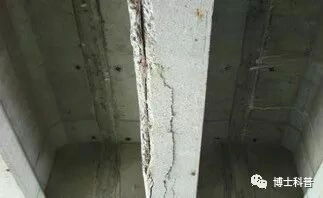
Rebar corrosion directly reduces the steel’s cross-sectional area and strength, while also causing cracks in concrete members. The corrosion products consist mainly of iron oxides and adhere to the steel surface. They occupy three to four times the volume of the steel that has corroded. As corrosion progresses, these products accumulate on the steel surface, creating expansive pressure at the steel–concrete interface. When that pressure reaches a certain level, the concrete surrounding the reinforcement cracks. As corrosion increases, the cracks extend to the concrete surface. Eventually, corrosion-induced cracks running along the reinforcement can be seen on the exterior of the concrete member, as shown in Figure 1.
Figure 1: Longitudinal cracking and concrete spalling caused by corrosion of the reinforcement at the bottom of a reinforced-concrete beam.[2]
For steel and concrete to work together in a reinforced-concrete structure, they must have good bond properties. With the deformed rebar commonly used, bonding to the concrete comes mainly from mechanical interlocking, or bearing. As Figure 2 shows, when we pull the reinforcement to the left, the surrounding concrete exerts not only chemical adhesion and friction along the interface, but also a bearing force perpendicular to it. For uncorroded reinforcement, bond strength is therefore directly related to the shape of the steel surface.
Figure 2: The bonding mechanism between deformed rebar and concrete.
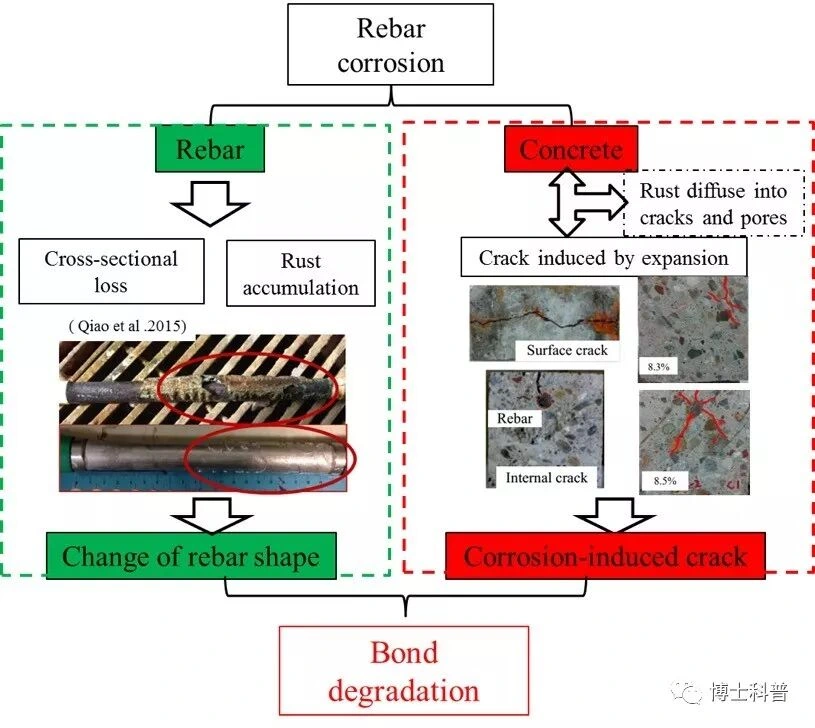
When reinforcement corrodes, its surface shape changes because its cross-sectional area decreases and corrosion products form. At the same time, corrosion-induced cracks in the concrete further reduce mechanical interlocking and friction between steel and concrete. This seriously affects the bond–slip behaviour of reinforcement embedded in concrete (Figure 3), and the steel can no longer share the loads carried by the concrete. Experimental studies show that corrosion-induced cracking is the most important factor affecting the bond strength of corroded reinforcement.[3].
Rebar corrosion also directly reduces the reinforcement’s stiffness and yield strength; severe localized corrosion can even cause it to fracture. Together, these effects substantially reduce the load-bearing capacity and plastic deformation capacity of the entire member or structure. Research into the effects of rebar corrosion on steel–concrete bond–slip behaviour and member load-bearing capacity remains a major topic in the study of concrete-structure durability.
Figure 3: How corrosion affects the bond between reinforcement and concrete.
*This article expresses the author’s personal views, not those of this website. Other media outlets, websites or individuals who reproduce it must credit the source and bear their own responsibility for copyright and other legal matters. Authors who do not wish their work to be reproduced, or who wish to discuss reproduction fees, should contact us.
References:[1] ASCE. Infrastructure Report Card, American Society of Civil Engineers,2017.
[2] Ministry of Land, Infrastructure and Transport. Guideline of bridge periodic inspection, Road Bureau, Japan, 2014.
[3] Yang, Y., Nakamura, H., Miura, T., Yamamoto, Y. Effect of corrosion-induced crack and corroded rebar shape on bond behavior, Structural Concrete, online version, 2019.
Images from the same-title WeChat manuscript
The following images come from the preserved WeChat manuscript with the same title and have been restored in their original order.

Additional illustrations have been recovered from the preserved WeChat manuscript with the same title and are grouped after the article. The archived text and existing editorial corrections have been retained.
