As he pulled his suitcase toward security, he suddenly turned back and said:
“Eight years. At last, I no longer have to worry that I might not be able to come back.”
I stood there, watching his figure slowly disappear into the distance.
Some journeys are long because of the waiting, rather than the distance.
Today I took a friend to the airport.
At last, he was going home to China.
It was not because his work had ended, his contract had expired, or he disliked Canada.
Quite the opposite.
He had an undergraduate degree, a PhD, and postdoctoral experience from prestigious universities, good professional opportunities, and an academic record that many people envied.
His reason for leaving was simple.
He had not been home for eight years.
From PhD student to postdoctoral researcher, from student to working researcher, from his twenties into his thirties.
One of the most important stretches of his life had been spent in Canada.
Yet the path home had never really opened.
Security screening for his visa.
Security screening for permanent residence.
Waiting.
More waiting.
Waiting again.
What had seemed like a temporary stage in life gradually became a way of living.
It was not that he did not want to go back.
He was afraid to go.
Because no one knew whether, after leaving, he would be able to return.
His parents grew older year by year, and he could see them only through a screen.
Spring Festival came again and again, and he could say “Happy New Year” only on a video call.
Home felt farther away, while the future remained suspended in something vague and uncertain.

Watching him walk into the security area, I suddenly realized that similar stories had not been rare among the people around me.
Some had spent three years awaiting security screening for a doctoral-study visa and ultimately missed the chance to enroll.
Some had waited five years for permanent-residence security screening, spending the best years of their early careers in uncertainty.
Some repeatedly submitted more documents, appealed, and sought legal help while waiting for an outcome.
Others, after weighing their options again and again, eventually chose to leave.
Among more than ten students and visiting researchers who had planned to join my former research group in Canada after 2021, only around three in ten ultimately arrived without difficulty.
Most of them had not been defeated by academic challenges.
They had been defeated by waiting.
In fact, I have experienced something similar myself.
Many years ago, one refusal of my Canadian study-visa application delayed me by an entire year.
That was when I began to understand that ability, education, and effort are not always what determine the course of a life.
Sometimes it is simply a decision on an application, a status in a system, or an unpredictable period of waiting.
If these were isolated cases, we might put them down to luck.
But when similar stories happen repeatedly to doctoral students, postdocs, and early-career researchers, they become more than individual destinies: they become marks that an era leaves on people.
Doctoral researchers ought to connect the world.
They cross borders for exchange, rather than confrontation.
For exploration, rather than boundaries.
To understand more of the unknown, rather than prove something.
Yet every era has its own problems.
Technology can become a field of competition.
Boundaries can be drawn around knowledge.
And people who once cared only about experiments, papers, and data can find themselves swept into the larger currents of their time without realizing it.
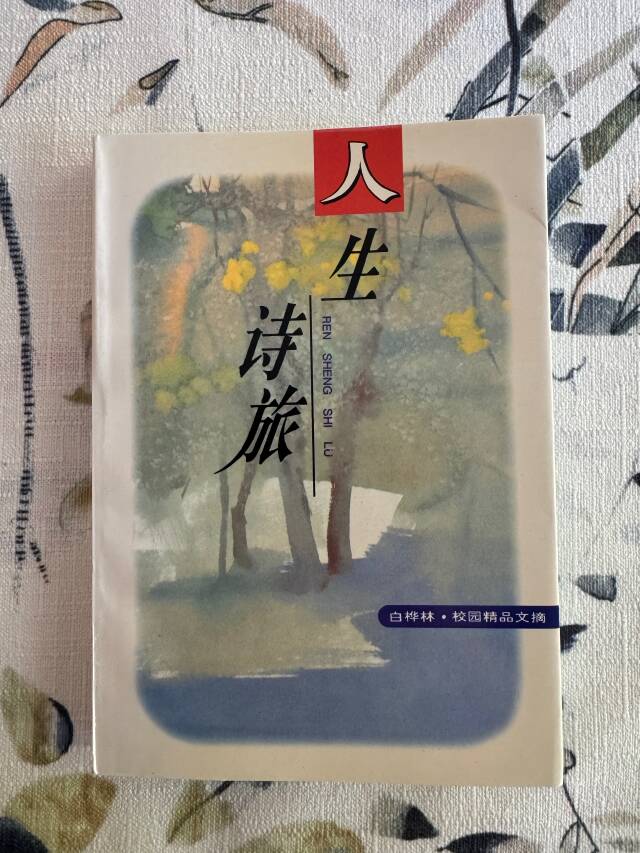
Recently, I happened to receive an old book from an older person’s collection.
It was called A Poetic Journey Through Life.
Its yellowed pages recorded reflections the author had written in 1996: small matters such as parting, waiting, gains and losses, and choices.
Yet as I read, I suddenly felt that those words had not become outdated at all.
Thirty years ago, people felt sorrow at parting, anxiety while waiting, and confusion when making choices.
Thirty years later, we still do.
The world has changed beyond recognition.
The internet has emerged.
Artificial intelligence has emerged.
The world seems more closely connected than at any previous time.
Yet the relationship between people and their destinies seems never to have changed.
We often think that the problems we face belong to our era.
But very often, they are still the problems of life itself.
How to face parting.
How to face waiting.
How to face loss.
And how to begin again.
At the airport today, we did not talk much about security screening or regrets.
Because, by the end, we realize that what truly matters in life is never just a particular visa, a particular status, or even a particular choice.
It is whether, when the answers take so long to arrive, we still have the courage to keep moving forward.
My friend is about to return to China.
There are new jobs, new platforms, new students, and new research projects there, as well as the home and family he has not seen for eight years.
To many people, this looks like an ending.
I prefer to see it as a new departure.
These years of waiting have not been wasted.
The loneliness, persistence, patience, and uncertainty have not trapped him in place. Quietly, they have shaped someone more mature and more resilient.
Research teaches us more than how to find answers.
More importantly, it teaches us to keep experimenting, exploring, and moving forward when answers remain elusive.
When the plane took off, the sun was setting at the far end of the runway.
Orange-red light spread across the wings and the distant clouds.
At that moment, it occurred to me that perhaps our generation of doctoral researchers are, in a sense, travelers through life.
We leave our hometowns, cross borders, and seek a sense of belonging among different cultures and systems.
We think we are pursuing knowledge and ideals, yet we also learn, almost without noticing, to live with uncertainty.
We keep setting out, saying goodbye, and beginning again.
Some people stay.
Some people leave.
Some people are still waiting.
But what ultimately shapes a person’s destiny is often whether, when the winds of an era blow, they still have the strength to move forward, wherever they happen to be.
Eight years is a long time.
Long enough for parents’ hair to turn grey, and for a young student to become an independent scholar.
Yet, on the longer scale of a life, it may be only the start of another journey.
By nightfall, the plane had long since disappeared beyond the clouds.
And I suddenly understood why the words written thirty years ago in A Poetic Journey Through Life still move us.
Because life itself is a journey.
Some people get off early.
Some keep going.
Some change direction along the way.
Growing up means being able to set out again each time we lose our way, rather than finally finding a road that will always be right.
May everyone still waiting receive the answers they are hoping for.
And may everyone setting out again meet a better version of themselves on their new journey.
31 May 2026, Canada
Sources and editorial history
Restored from a complete historical article exported from the PhDSciNet Official Account.